Get a summary of this article with your favorite AI
Key Highlights
- •Bill Matters vs AegisHealth compares two AI-powered platforms for medical claim denial management and appeal preparation.
- •AegisHealth focuses on denial intake, claim prioritization, payer-policy research, resolution selection, appeal submission and payer follow-up.
- •Bill Matters connects CARC and RARC interpretation with claim-level analysis to identify denial reasons and appropriate next steps.
- •Bill Matters uses Billing Evidence Finder and AI appeal generation to identify missing documentation and prepare source-backed, claim-specific appeals.
- •The key difference in Bill Matters vs AegisHealth is workflow focus. AegisHealth covers denial management through follow-up, while Bill Matters emphasizes claim investigation, evidence identification, appeal preparation and human review.
You've identified the denial. You know why the payer rejected the claim. But the payment is still nowhere in sight. Now someone on your team has to check the claim, dig through supporting documents, review payer requirements and figure out whether to correct the submission or challenge the decision. And that's just one claim.
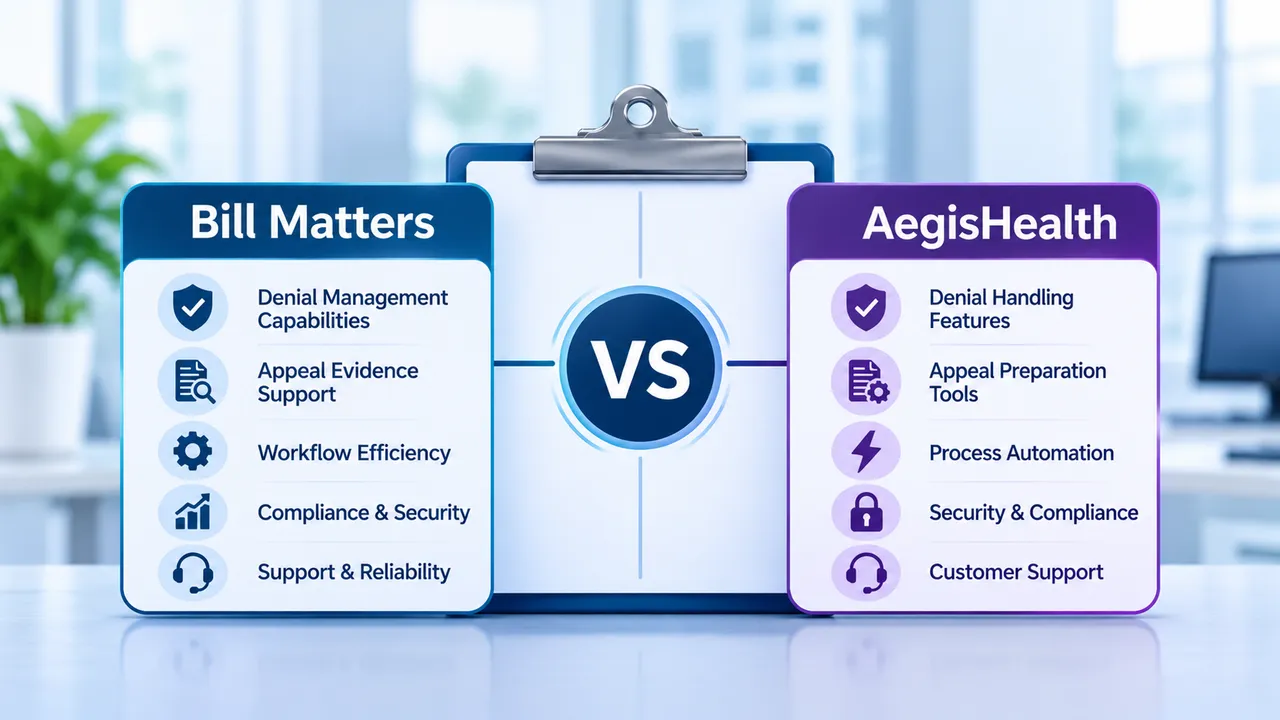
This is where Bill Matters vs. AegisHealth becomes an interesting comparison. Both platforms aim to take the pressure off denial-management teams, but they approach the process differently. Bill Matters brings denial analysis, claim investigation, evidence identification and appeal preparation together. AegisHealth describes a broader automated workflow that also covers prioritization, payer-policy research, appeal preparation, submission and follow-up.
The need for better workflows is clear. A 2026 KFF analysis of 2024 ACA Marketplace data found that around one in five claims were denied, yet fewer than 1% of denied in-network claims were appealed. This figure relates specifically to the ACA Marketplace data analyzed, rather than all claims across the US healthcare system.
So, having a system that identifies denials is useful. But what happens after that matters just as much. Let's take a closer look at what each platform brings to the table.
When a Payer Gives You Denial Codes, Which Platform Helps Uncover the Actual Claim Issue?
Both platforms aim to move beyond manual denial handling, but Bill Matters explicitly describes how it connects CARC and RARC information with claim-level context. Whereas AegisHealth emphasizes reading remittances and identifying denials as they arrive.
A denial code gives your team a starting point, not necessarily the complete explanation. CMS explains that Claim Adjustment Reason Codes (CARCs) provide the overall reason for an adjustment, while Remittance Advice Remark Codes (RARCs) can add more specific information. CMS explains how CARCs and RARCs work.
Here's how the two platforms approach the first step.
How Does AegisHealth Identify And Interpret Denied Claims?
AegisHealth says its platform reads denials from remittances as they arrive, rather than relying on staff to manually collect them and organize spreadsheets.
Its published denial-management workflow also describes:
- Categorizing denials by reason, payer and other claim attributes.
- Tracking denial information using ANSI codes, insurance and CPT details.
- Using a reason-code hierarchy that includes ANSI and payer-specific codes.
- Grouping denials into categories such as soft, hard, clinical and technical or administrative denials.
This structured approach helps teams see what kinds of denial issues are occurring across their claims. For example, a billing manager can look at denial categories and identify recurring problems that may need attention.
However, identifying a denial category and understanding the complete circumstances of an individual claim are two different tasks. The latter requires looking at the claim details, supporting records and payer requirements.
How Does Bill Matters Connect Denial Codes With Claim Details?
Bill Matters takes a more explicitly claim-context-driven approach through its claim denial decoder and related capabilities.
The claim denial decoder reads the CARC alongside its paired RARC and translates the information into a plain-language explanation. The platform also processes remittance information and connects it with the relevant claim and payment history.
This matters because the same broad denial reason can require different actions depending on the claim details.
For example, a missing-information denial may require a specific authorization record, treatment report or other supporting document. Simply knowing that information is missing doesn't tell your biller which document to find.
By connecting denial codes with underlying claim information, Bill Matters helps teams understand the issue behind a denial and determine what needs to be investigated next. This claim-level review can also help uncover payment discrepancies, including cases where a claim has been marked as paid but the reimbursement may be lower than the applicable contract allows.
Can a Claim Be Underpaid Even When It Shows as Paid?
Yes. A claim can receive a payment and still be reimbursed below the amount required by the applicable payer contract.
The Signature Smile Dentistry case study illustrates this issue very well. The practice was dealing with changing state and payer rules and did not have dedicated billing staff who could monitor every update.
Bill Matters compared remittance and payment information against the relevant payer contract terms, using the contract version applicable to the service date. This helped identify reimbursement discrepancies that might otherwise have been accepted as normal payments.
According to the published case study, the practice began identifying underpaid claims within weeks of uploading remittances, without hiring dedicated staff to monitor contract changes.
The example highlights an important point for billing teams: denial management should not be the only place you look for lost revenue. Payment discrepancies deserve attention too.
As of now, Bill Matters is currently free to use, with no platform fee at this stage. When the paid offering is introduced, the pricing model will be performance-based. This means users will pay based on the results Bill Matters delivers. The aim is to align the cost of using the platform with the value it helps billing teams achieve.
Also Read: What Should You Do First When Facing a Healthcare Claim Denial
How Do Bill Matters and AegisHealth Help Your Team Prioritize Denials?
AegisHealth describes a prioritization workflow based on claim value, filing deadlines and likelihood of overturn. Bill Matters emphasizes payer-specific denial patterns, response times and recovery outcomes. Both address workload visibility, but from different angles.
If your team has hundreds of open denials, working them in the order they arrive isn't always the best strategy. A high-value claim approaching its filing deadline may deserve attention before a smaller claim that has been waiting longer.
How Does AegisHealth Help Teams Prioritize Denials?
AegisHealth describes a prioritization workflow that considers:
- Potential recovery value: Which claims could bring in more revenue if resolved?
- Filing deadlines: Which claims need attention before an appeal or resubmission deadline passes?
- Likelihood of overturn: Which denials have a stronger possibility of being reversed?
It also describes customizable denial worklists, reporting and analytics, and standardized Denial Resolving Strategies (DRS). These features help teams organize their work and use previous resolution activity to guide future efforts.
AegisHealth also publishes a usual 24 to 48-hour turnaround for resubmissions. This should be understood as its stated resubmission turnaround, not a guarantee of appeal preparation, payer decision or payment recovery.
How Does Bill Matters Help Teams Understand Payer Patterns?
Bill Matters' payer insights capability focuses on identifying patterns across payers. It tracks denial trends, response times and recovery outcomes separately, helping teams recognize recurring documentation requirements or payer-specific issues.
This is particularly useful for medical billing companies managing claims across multiple providers, where payer rules, documentation requirements and recurring denial patterns can vary from one account to another.
Here's how the two approaches differ:
| What your team needs | AegisHealth | Bill Matters |
|---|---|---|
Find incoming denials | Reads denials from remittances | Processes remittance information and connects it with claims |
Prioritize work | Ranks by value, deadline and overturn likelihood | Provides payer-specific patterns and recovery insights |
Understand payer behavior | Reports recovery and overturn rates by payer | Tracks denial patterns, response times and recovery outcomes |
Identify recurring issues | Payer-level reporting and analytics | Payer-specific denial and documentation patterns |
For your billing team, payer-specific insights can help reveal patterns such as repeated requests for the same documentation, frequent reimbursement discrepancies or delays in payer responses.
Instead of investigating every denial without considering previous claims, your team can use these insights to understand where the same issues keep coming from. That information can help denial managers review documentation practices, address recurring billing errors and focus their efforts where problems persist.
The distinction is useful, AegisHealth describes prioritizing individual claims according to their recovery potential and deadlines, while Bill Matters' Payer Insights helps teams understand recurring payer behavior across claims.
Can the Platform Help You Decide Whether to Correct, Resubmit or Appeal a Claim?
Both platforms describe selecting an appropriate response instead of treating every denial as an appeal. Bill Matters explicitly identifies separate paths for appeals, corrected claims and requests for missing information. AegisHealth describes selecting an appeal, corrected claim or reconsideration for each denial.
This distinction can save your team from spending time on the wrong response.
Consider a hypothetical situation. A claim comes back because the payer did not receive a required authorization record.
Would you write a lengthy appeal arguing medical necessity? Probably not. The first step is to check whether the authorization exists and whether it can be attached to a corrected submission.
Now consider a different claim. The documentation is complete, the service meets the relevant coverage criteria, but the payer has denied payment. That may require a formal appeal supported by the clinical record and applicable policy.
The two situations need different responses.
What Does AegisHealth Offer for Resolution Selection?
AegisHealth says its platform evaluates each denial and selects an appeal, corrected claim or reconsideration. It also describes finding and citing payer policies to support the response.
Its approach is designed to move claims from identification to a selected resolution without leaving every decision to manual review.
How Does Bill Matters Make the Resolution Decision?
Bill Matters uses its AI Denial Agent to examine the denial, claim information, applicable policy and available evidence before recommending the next step.
Its published workflow describes several possible outcomes:
- Appeal: When the available information supports challenging the payer's decision.
- Corrected claim: When a billing or claim-level issue needs to be fixed.
- Request missing documentation: When the response depends on information that isn't available.
- Not appealable: When the available facts do not support an appeal.
The important point is that an appeal isn't automatically generated just because a claim was denied.
Generating more appeal letters isn't necessarily the goal. Sending the correct response is. A tool that identifies a correctable issue before drafting an appeal can help avoid unnecessary work. Equally, a claim that genuinely deserves an appeal shouldn't get lost in a generic correction process.
Bill Matters publicly explains its separate resolution paths in detail. AegisHealth also describes per-denial response selection, so the practical comparison is how accurately each platform reaches its decision and what information it shows your team along the way.
Also Read What Should You Do First When Facing a Healthcare Claim Denial
When a Claim Is Appealable, Can the Platform Help Build a Strong Appeal?
Both platforms claim to support appeal preparation using relevant payer and claim information. Bill Matters describes a detailed process for checking available evidence, identifying missing documents and building source-traceable appeal arguments. AegisHealth describes creating medical-necessity arguments from the clinical chart with cited evidence and payer policy support.
This is where the quality of the appeal matters more than the speed of producing a letter.
A convincing appeal needs to address the actual reason for denial. It should connect the payer's decision to the claim facts, supporting records and applicable policy. A generic letter with a few patient and claim details filled in won't necessarily do that.
How Does AegisHealth Prepare Appeals?
AegisHealth's published workflow describes how its platform:
- Finds the relevant payer policy and cites it.
- Builds medical-necessity arguments using information from the clinical chart.
- Cites the clinical evidence supporting those arguments.
- Selects an appeal or another resolution based on the denial.
This is a broad appeal workflow. It aims to reduce the manual work involved in researching payer requirements and preparing arguments.
AegisHealth presents appeal preparation as part of a larger denial-to-payment process. The platform isn't positioned simply as a letter-writing tool. It also describes handling submission and follow-up after the appeal is prepared.
How Does Bill Matters Prepare Evidence-backed Appeals?
Bill Matters separates evidence identification from appeal generation through two capabilities: billing evidence finder and AI appeal generation.
The billing evidence finder checks the documents available for a claim against the requirements associated with the denial and payer. It identifies relevant records and flags what is missing before the appeal is drafted.
AI Appeal Generation then builds the appeal around:
- The actual denial reason.
- Claim-specific information.
- Supporting clinical and billing documentation.
- Applicable payer policies, contracts, fee schedules or statutes, where relevant.
- Facts and references that can be traced to their sources.
Bill Matters also describes scoring the draft for strength and rewriting it when the score falls short. If a fact or source cannot be verified, the system is designed to flag that rather than present it as established information.
A Real Bill Matters Example: Missing Documentation In Workers' Compensation Claims
The workers' compensation documentation denial case study shows why checking evidence before resubmission matters.
The billing company in the case study handled claims across multiple states, where documentation requirements varied by state and carrier. A CARC 16 denial could indicate missing information without identifying the exact document required.
The team had to investigate requirements manually, including DWC forms, treatment reports and authorization records. Bill Matters' evidence-detection capability identified the missing items before resubmission.
This example highlights a practical difference between preparing an appeal and preparing a complete claim response. Sometimes the best next step isn't a stronger letter. It's finding the document that should have accompanied the claim in the first place.
Bill Matters' separation of evidence checking and appeal drafting makes the documentation gap visible before the argument is written. AegisHealth also describes evidence-supported medical-necessity arguments, so when evaluating either platform, look at the actual output:
- Does the platform identify missing records explicitly?
- Can it show which evidence supports each argument?
- Can the reviewer trace the claim back to its source documents
Missing Documents? Don't Let Them Play Hide-and-Seek.
A denied claim shouldn't turn your billing team into detectives searching for paperwork. See how Bill Matters helps uncover documentation gaps and move claims towards resolution.
What Should You Check Before Accepting An AI-generated Appeal?
Research suggests that these checks are important. A 2024 study published in JCO Clinical Cancer Informatics evaluated AI-generated appeal letters for radiotherapy denials. The researchers found that several models produced useful, readable drafts, but all tested models struggled to support clinical assertions with relevant, appropriately cited primary literature.
The study involved 20 simulated patient histories and focused on radiotherapy. It does not establish how either Bill Matters or AegisHealth performs. However, it highlights a genuine risk with AI-generated appeal content: a well-written letter is not automatically a well-supported one.
The study offers a useful reminder for RCM teams evaluating AI appeal generation. A draft can be readable and logically structured without every clinical assertion being adequately supported.
That is why an AI-generated appeal should be checked at three levels:
- Factual accuracy: Do the patient, service, claim and billing details match the source records?
- Policy accuracy: Does the cited policy apply to the payer, service and date in question?
- Evidence traceability: Can the reviewer locate the clinical record, contract clause or regulation supporting each important argument?
AI can help organize and prepare the argument, but the final review still needs to establish whether the evidence supports it.
Also Read: What Documentation Should Be Included with a Medical Claim Appeal?
Who Reviews the Appeal, and What Happens After It's Ready?
The main difference is what happens after an appeal is prepared. AegisHealth describes handling submission and payer follow-up, while Bill Matters focuses on validating, reviewing and exporting the appeal for your team to submit.
Once the appeal is ready, your team still needs to know that the information is accurate and that the final response is ready to go.
| Evaluation point | AegisHealth | Bill Matters |
|---|---|---|
AI output validation | Specific validation process should be confirmed with AegisHealth | Uses a second, different AI model for independent validation |
Human review | Review and approval controls should be confirmed in a demo | Outputs are reviewed when needed; users can review and edit appeals |
Final appeal format | Submission through payer channels | Editable Word and PDF exports |
Payer submission | Describes submitting claims and appeals through payer channels | Team submits through its existing process |
Deadline tracking | Tracks filing deadlines | Submission and deadline-management workflow should be confirmed |
Follow-up | Tracks appeals and follows up with payers until payment | Post-submission follow-up workflow should be confirmed |
Recovery reporting | Reports recovery and overturn rates by payer | Provides payer-specific recovery insights |
AegisHealth describes handling submission, deadline tracking and payer follow-up within its workflow. Bill Matters gives your team a validated, editable appeal that you can review, refine and export before submitting it through your existing process.
This review step matters, particularly when an appeal involves clinical information. As Dr. Deborah Greer, system lead for advanced appeals and settlements, denials management and prevention at CommonSpirit Health, explained in a Becker's Hospital Review interview, "the decision has to stay with the physician who can be accountable for it."
For your team, the key is to understand where AI validation ends and human approval begins, who owns submission, and how follow-up is recorded. Ask both vendors to show what happens when a fact is incorrect, a document is missing or a reviewer challenges the recommendation.
Bill Matters vs. AegisHealth: How Do Their Denial Management and Appeal Workflows Compare?
We've looked at how both platforms handle different stages of denial management. Now, let's put their capabilities side by side. The comparison below highlights what each platform offers and where their workflows differ.
| Evaluation area | Bill Matters | AegisHealth |
|---|---|---|
Denial intake | Processes remittance information and connects it with claim details | Reads denials from remittances as they arrive |
Denial interpretation | Decodes CARC and paired RARC information with claim context | Identifies denials and researches relevant payer policies |
Prioritization | Provides payer-specific denial patterns, response times and recovery insights | Ranks claims using value, deadlines and likelihood of overturn |
Resolution selection | Identifies whether a claim needs an appeal, correction or missing documentation | Selects an appeal, corrected claim or reconsideration |
Evidence identification | Billing Evidence Finder identifies relevant and missing supporting documents | Uses clinical chart evidence to build appeal arguments |
Appeal generation | Creates claim-specific drafts with source-supported information | Builds medical-necessity arguments with cited clinical evidence |
Validation and review | Independent second-model validation, with review when needed; users can edit drafts | Specific validation and human-review controls should be verified |
Submission | Exports editable Word and PDF appeals for submission through the team's existing process | Describes payer submission and follow-up |
Reporting | Provides payer-specific denial patterns, response times and recovery insights | Reports recovery and overturn rates by payer |
Workers' Compensation experience | Published case study demonstrating support for documentation challenges across multiple states and carriers | Specific workers' compensation experience is not detailed in the public product information reviewed |
Pricing model | Currently free to use. A future paid model is planned around performance, with users paying only when they achieve a defined result. | Pricing details should be confirmed directly with the vendor. |
How Can Bill Matters Reduce Manual Work in Denial Management?
The real value of denial management software becomes clear when you look at the work your team no longer has to handle entirely manually.
With Bill Matters, your team can:
- Spend less time interpreting denial messages: claim denial decoder connects CARC and RARC information to help explain the reason behind an adjustment.
- Find documentation gaps before preparing an appeal: Billing Evidence Finder checks available records and flags missing supporting information.
- Avoid preparing the wrong response: AI Denial Agent distinguishes between claims that need correction, additional documentation or an appeal.
- Prepare appeals around actual claim evidence: AI Appeal Generation creates claim-specific drafts with source-supported information rather than relying on generic appeal templates.
- Review the appeal before submission: Independent validation, editing and export give your team control over the final document.
- Spot payer-related reimbursement issues: Payer Insights helps identify recurring denial patterns and underpayment trends that deserve attention.
For a billing manager, these capabilities matter because they connect several tasks that would otherwise require moving between remittance records, claim details, payer requirements and supporting documents.
How Can You Evaluate the Actual Denial Management Workflow?
A feature list can tell you what a platform claims to do. It won't necessarily show you how accurately it handles your team's claims.
During a product demonstration, use the same de-identified claim package to assess the workflow. Ideally, include a denial notice, remittance advice, clinical records, relevant payer policy and at least one missing document.
Pay attention to whether the platform can:
- Interpret the denial correctly using the claim and service-line details.
- Identify whether the claim needs correction, additional documentation or an appeal.
- Locate relevant supporting records and flag what's missing.
- Connect appeal arguments to actual claim information and applicable payer requirements.
- Show where the information in the generated appeal came from.
- Identify unsupported or incorrect information before the appeal is finalized.
- Give your team a clear review and approval process.
Also, look at how much manual work remains after the platform generates its response. Does your team still need to search for documents, verify payer requirements or rewrite large parts of the appeal?
For your team, that's the comparison that matters, not just how many denial management features a platform offers, but how well those features help turn an unpaid claim into a properly investigated and supported response.
Your Denial Workflow Deserves More Than a Spreadsheet and a Prayer.
Discover how Bill Matters brings denial analysis, evidence identification and AI-powered appeal preparation together to make your team's work a little less complicated.
Bill Matters and AegisHealth Compared for Denial Management and Appeals
Every denied claim needs a closer look. Your team needs to understand the payer's reasoning, investigate the claim, verify the supporting documentation and decide how to move forward. The quality of that process directly affects how effectively your team can challenge denials and recover revenue.
Bill Matters and AegisHealth bring different approaches to this work.
AegisHealth covers the denial-management lifecycle end to end, from denial intake and prioritization to appeal submission and payer follow-up.
Bill Matters puts greater emphasis on claim investigation and appeal readiness. It connects denial interpretation with claim-level analysis, resolution decisions, evidence identification and appeal preparation. Validation and review are built into the workflow, giving teams an opportunity to examine the supporting information and assess the strength of a response before submission.
For your team, the distinction comes down to the work behind every appeal. How accurately does the platform interpret denial reasons? How relevant is the evidence it identifies? How much investigation can it take off your team's plate? And how much visibility do your reviewers have before an appeal goes out?
These are the questions worth asking when evaluating a denial-management platform, because every decision influences the quality of your appeals and your ability to recover denied revenue.
See Bill Matters in action and discover how it can support your team's denial investigation and appeal preparation.