
Get a summary of this article with your favorite AI
Key Highlights
- •A CO-197 denial pairs the Contractual Obligation group with CARC 197, reporting an absent precertification, authorization, notification, or pre-treatment requirement.
- •A claim denied despite prior authorization may involve pending approval, missing claim data, or an approval the payer cannot match.
- •Complete authorization-to-claim reconciliation by comparing approved services, dates, units, providers, facilities, and reported claim details line by line.
- •Support the case with authorization requests, approval notices, payer correspondence, original claim records, acknowledgements, and applicable policy documents.
- •Choose correction, reprocessing, retrospective review, or appeal based on findings; track deadlines because pending reviews may not pause them.
- •Prevent recurrence through payer-specific controls; Bill Matters adds evidence intelligence, appeal preparation, and Payer Insights for payer-pattern and outcome tracking.
CO-197 denial means the payer has reported that a required precertification, authorization, notification, or pre-treatment requirement was absent, according to X12’s Claim Adjustment Reason Codes. It does not prove approval was never obtained.
Why can a claim receive CO-197 when a medical practice has an authorization on file?
An approval on file does not, by itself, show that it covered the billed service or that the payer could identify it in the submitted claim. CO-197 alone does not reveal which issue occurred. The team must check payer-specific authorization requirements and compare the records.
In its 2025 research, MGMA reported that 92% of surveyed medical group practices had hired or reassigned staff solely to handle growing prior authorization requests. This is not a CO-197 denial rate; it reflects wider pressure around authorization management.
For medical billing teams at medical practices, a missing prior authorization on a medical claim must be investigated before correction or appeal. This guide explains which records to verify, how to choose a resolution, what can support an appeal and how to prevent repeat denials.
What Does CO-197 Mean in Medical Billing?
A CO-197 adjustment contains two separate codes. Each communicates a different part of the payer's decision. The CO-197 denial code combines a Claim Adjustment Group Code with a Claim Adjustment Reason Code.
According to X12's official code lists, CO identifies the adjustment category, while 197 identifies the specific reason.
| Component | What it identifies |
|---|---|
CO | Contractual Obligation adjustment group |
197 | Precertification/authorization/notification/pre-treatment absent |
Note: The distinction matters because CO and 197 are not interchangeable. The group code categorizes the adjustment, while the reason code explains why the payer made it. Now,
1. A CO-197 Adjustment Does Not Automatically Establish That Authorization Was Never Obtained
- The reason code identifies the payer's reported determination, not the complete circumstances behind it
- It does not establish whether the required approval was missing, the claim lacked relevant information, or the payer could not match an existing record.
The remittance also shows where the adjustment applies. According to CMS remittance advice guidance, adjustments can occur at the claim or service-line level.
Does a CO-197 denial affect the entire claim or only the affected service line?
Not necessarily the entire claim. Check the adjustment's reported level to identify which claim or service lines are affected.
2. Authorization, Precertification and Notification Are Related but Not Identical Requirements
X12 groups these requirements under CARC 197, but the code does not identify which specific requirement applied. The payer's policy determines what the provider needed to complete.
Does a payer's pre-service notification requirement always mean formal authorization is required?
No. Notification and formal authorization are not automatically interchangeable. Verify the specific requirement under the applicable payer policy.
The following codes help distinguish other authorization-related adjustments:
| Code | Reason reported |
|---|---|
197 | Requirement absent |
198 | Requirement exceeded |
210 | Authorization not received in a timely fashion |
284 | Authorization number does not apply to billed services |
296 | Authorization number does not apply to provider |
302 | Authorization time limit expired |
These distinctions come from X12's official CARC list. A billing team should follow the actual adjustment code rather than classify every authorization discrepancy as CO-197.
What Causes CO-197 Denials in Medical Billing?
A CO-197 denial can originate at different points in the authorization process. Sometimes the required approval was never obtained. In other cases, the approval exists, but the information does not reach the payer accurately.
1. The Required Authorization Was Never Requested
A missing prior authorization on a medical claim can result from an oversight during scheduling or patient access. The staff member arranging the service may not recognize that the patient's insurance plan requires authorization. Unclear responsibility between scheduling, clinical and billing teams can also leave the requirement unattended.
This commonly happens when:
- The applicable plan's authorization requirements are overlooked
- A procedure is scheduled without checking whether approval is required
- Authorization responsibilities are not clearly assigned
- A service is incorrectly assumed to be exempt from authorization.
2. The Authorization Request Was Submitted but Required Approval Was Not Obtained
Submitting an authorization request does not mean the payer has approved it. The request may remain pending, receive a non-affirmation decision or lack documentation required for review.
For applicable CMS prior authorization programs, providers receive an affirmed or non-affirmed decision before the service is rendered. Therefore, performing a service without the required approval can leave the authorization requirement unsatisfied.
3. Authorization Information Was Not Transferred Accurately to Billing
An authorization may be approved, but the approval details may not reach the billing system correctly. This can happen when information is transferred manually between scheduling, authorization and billing teams.
Common data gaps include:
- Authorization reference numbers missing from billing records
- Incorrect reference numbers entered into the system
- Approved service details not transferred with the authorization
- Incomplete information carried into claim submission
For applicable professional claims, CMS reporting guidance identifies where prior authorization information belongs on the CMS-1500 and corresponding 837P transaction.
4. Authorization Records Were Not Recognized During Payer Processing
Sometimes the provider has an authorization record, but the payer's claim-processing system cannot locate or associate it with the submitted claim. Inconsistent reference information or disconnected records can contribute to this problem.
An Iowa Medicaid EOB crosswalk illustrates this situation by associating CARC 197 with a missing or unavailable prior authorization reason code.
5. The Original Approval No Longer Matches the Billed Service
Authorization details can become outdated when the planned service changes. A different procedure, rendering provider, facility or number of authorized units may fall outside the original approval.
These situations can involve approved CPT/HCPCS services, authorized visit and unit limits, or rendering provider validation. However, not every mismatch results in CO-197. The actual adjustment code depends on the payer's determination.
The causes are not baseless claims made in thin air. Biz4Group announced the launch of Bill Matters on September 22, 2026, as an AI-powered healthcare denial-management and appeals platform.
Our work on Bill Matters required us to look beyond denial-code definitions and understand how authorization-related failures develop across the revenue cycle.
We examined these situations with input from:
- medical billing professionals responsible for authorization records and claim submission,
- denial specialists who trace payer adjustments to underlying claim issues, and
- appeal managers who evaluate denial evidence and recovery decisions
Their operational perspectives helped us examine where authorization information can break down between service scheduling, approval, claim submission and payer adjudication. This research also informed our understanding of why two claims carrying an authorization-related denial may require different explanations.
Also Read: Why was a Health Insurance Claim Denied? 10 Common Denial Reasons Explained
Every Denial Tells a Different Story
Bill Matters is built for the decisions behind real denial work, not one-size-fits-all responses to payer outcomes.
How Should Medical Billing Teams Investigate a CO-197 Denial Before Taking Action?
A CO-197 denial requires claim-level investigation before anyone changes the billing information. RCM heads and denial specialists need to establish which authorization requirement applies, what the payer received, and whether the approval covers the billed service.
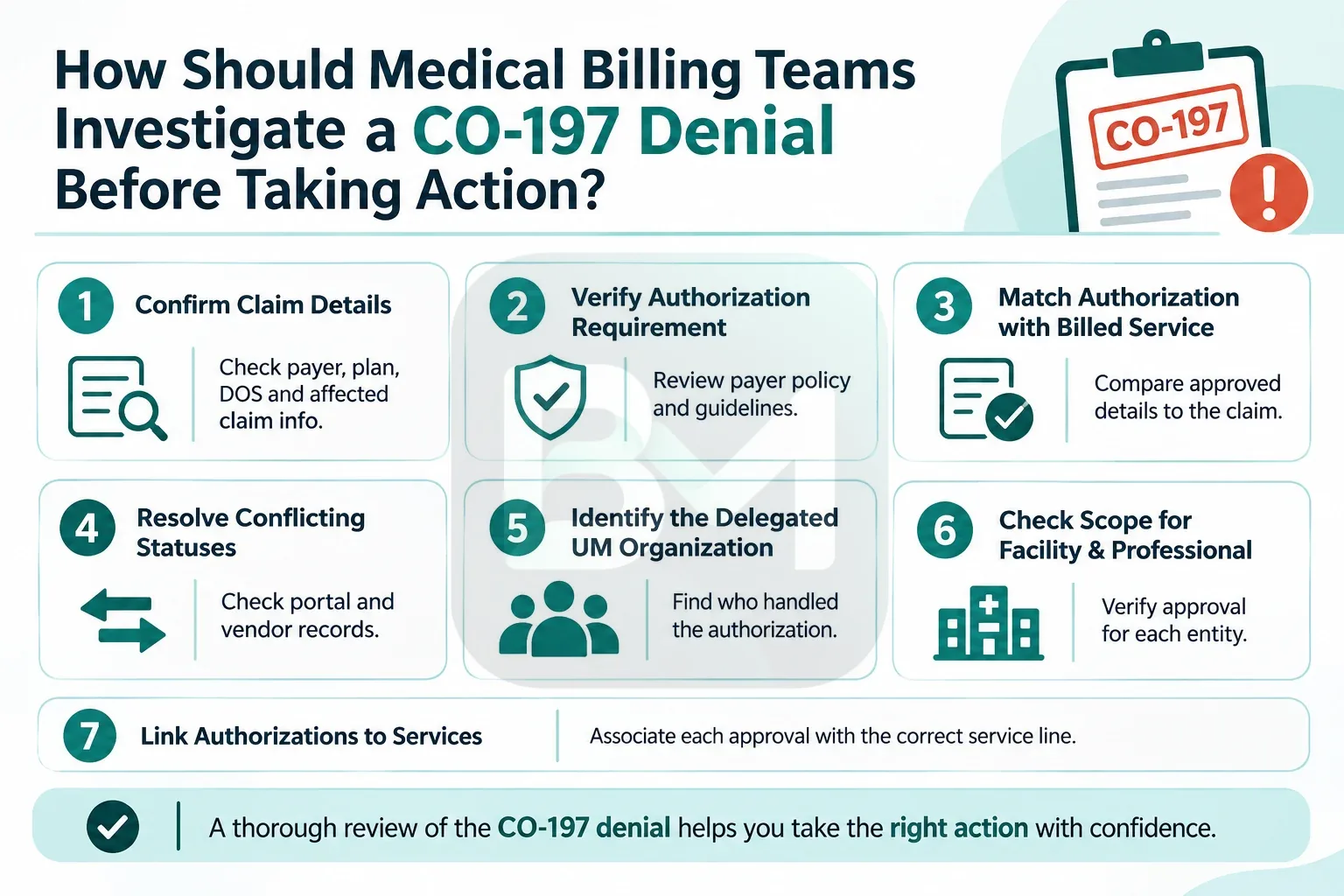
1. Confirm the Payer, Plan, Date of Service and Affected Claim Details
Start with the original claim and the payer's remittance advice. Identify the exact adjustment and the services it affects. CMS remittance guidance explains that adjustments can apply at the claim, service-line or provider level.
Capture the following claim details before reviewing the authorization:
- Payer, insurance product and member information
- Claim number and date of service
- Affected CPT/HCPCS code and service line
- CO-197 adjustment and any accompanying remark codes
2. Verify the Authorization Requirement Using the Governing Payer Documents
Check the requirements that applied to the patient's specific plan and service date. The payer's provider manual, authorization policy and service-specific guidelines establish whether the procedure required approval or notification. Use the relevant policy version rather than an outdated authorization checklist.
Which payer documents establish whether a specific procedure requires prior authorization?
The applicable plan documents, provider manual and service-specific authorization policy establish the requirement. Confirm that they correspond to the payer, product, and date of service.
3. Compare the Approved Authorization with the Billed Service
An authorization-to-claim reconciliation establishes whether the approval covers the service actually billed. Compare each authorization detail with its corresponding claim information.
| Authorization record | Submitted claim |
|---|---|
Authorization reference number | Reported authorization number |
Approved CPT/HCPCS services | Billed CPT/HCPCS codes |
Effective and expiration dates | Actual service date |
Authorized visit and unit limits | Billed visits and units |
Authorized provider and facility | Rendering provider and service facility |
Approved setting | Reported place of service |
Note: Check each field individually. A CO-197 denial after prior authorization approval still requires this comparison. Scenarios involving an unauthorized CPT code, service outside authorization dates or rendering provider mismatch also require verification of the actual adjustment reason.
CMS provides further guidance on reporting authorization information in CMS-1500 Item 23 and the corresponding 837P Loop 2300 REF segment. Its instructions apply to the specified Medicare professional-claim context.
4. Reconcile Conflicting Authorization Status Records
A payer portal and an authorization vendor may display different approval statuses. Compare the records using their dates, reference numbers, and request history.
What should a provider do when the payer portal and authorization vendor show different approval statuses?
Establish which organization recorded the authorization decision and obtain confirmation of the status associated with the actual service. Retain the relevant verification history.
5. Identify the Delegated Utilization Management Organization
Some payers use external organizations for authorization administration or clinical review. Identify which organization handled the request and distinguish its role in the process.
How does a delegated utilization management company affect authorization verification?
It introduces another record source. Utilization management records should identify the organization responsible for the decision and connect its authorization reference to the applicable payer and plan.
6. Check Authorization Scope for Facility and Professional Services
Facility and professional claims may involve different authorization requirements. Compare the billing entity, provider and approved service rather than assuming one authorization covers both.
Can an authorization cover a facility charge but not the separately billed professional service?
Yes. Coverage depends on the payer's rules and the approval's scope. Verify the authorization requirements for each billing entity and service.
7. Link Separate Authorizations to Their Respective Service Lines
When one claim contains multiple services, maintain a clear connection between each service and its corresponding approval.
How should separate authorization approvals be linked to multiple services on one claim?
Associate each authorization reference with the service, date, units, provider and location it covers. Do not apply one reference indiscriminately across unrelated service lines.
This gives the medical billing team a documented picture of the authorization requirement, approval records and submitted claim before moving to the evidence and resolution process.
What Evidence Should You Collect Before Resolving or Appealing a CO-197 Denial?
A strong CO-197 appeal supporting documentation checklist should establish what the provider requested, what the payer approved and what information accompanied the claim. Each record should support a specific fact. A larger document package does not necessarily make the case stronger.
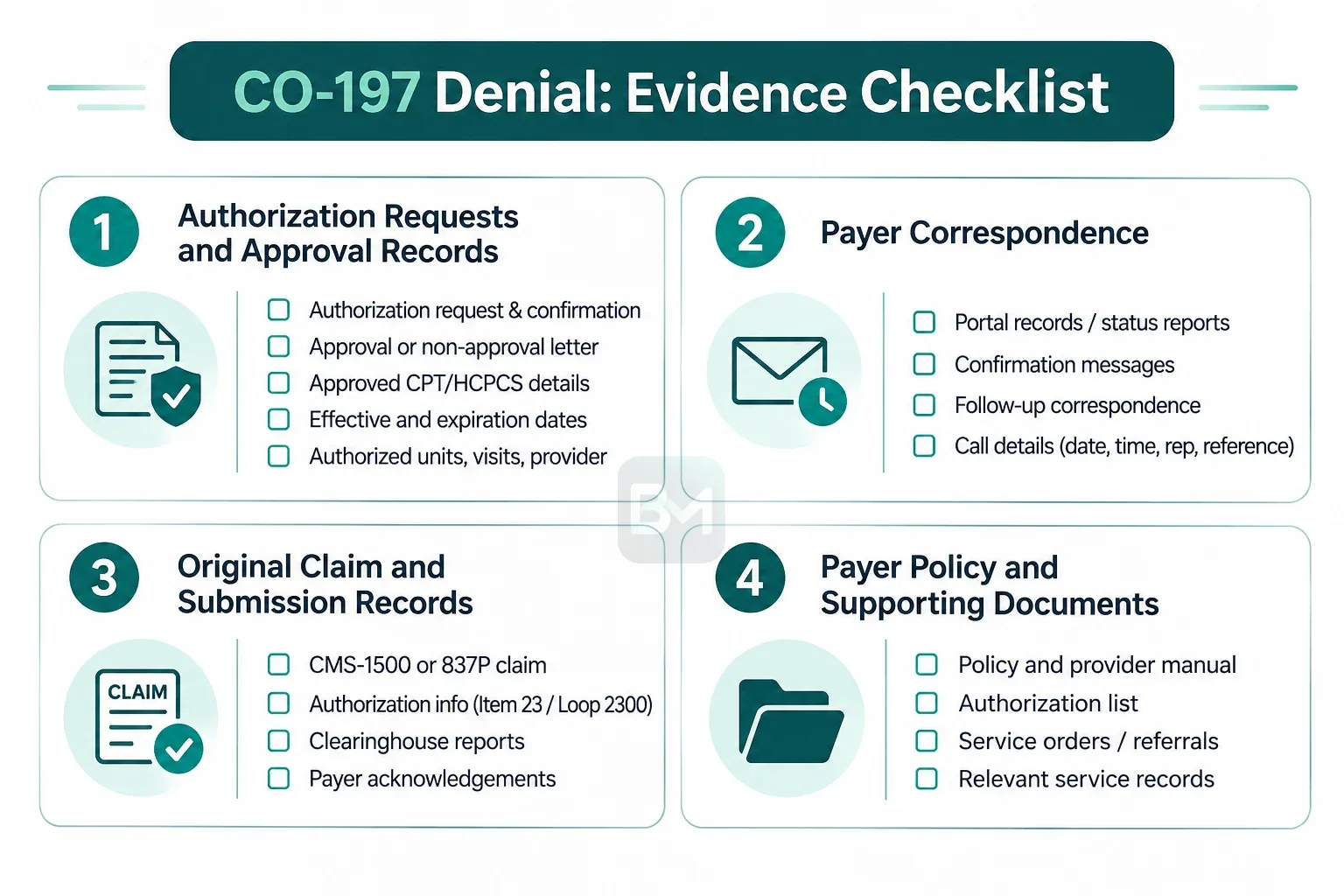
1. Authorization Requests and Approval Records
Keep the original authorization request alongside the payer's decision. The request establishes what the provider sought, while the approval confirms what the payer granted. Both are useful when the billed service is disputed.
The supporting records should include:
- Authorization reference number and request confirmation
- Approval or non-approval letter
- Approved CPT/HCPCS procedures and service details
- Effective and expiration dates
- Authorized units, visits, provider and facility
- Subsequent authorization amendments
2. Payer Correspondence and Authorization Communication History
- Payer communication records help establish what the insurer or its authorization administrator confirmed
- Preserve portal records, downloadable status reports, confirmation messages and relevant follow-up correspondence
What documentation should staff retain when an authorization is confirmed only through a payer phone call?
Record the call date, time, representative's identification where available, call reference number and information confirmed. A call note supports the communication history but does not replace formal approval when required.
3. Original Claim and Submission Records
- The original claim establishes what the provider actually submitted
- Retain the CMS-1500 or 837P record, applicable authorization information, clearinghouse acceptance reports and payer acknowledgements
- For Medicare professional claims, CMS identifies Item 23 and the corresponding 837P Loop 2300 REF for applicable authorization information.
4. Payer Policy and Supporting Administrative Documents
- Retain the policy applicable to the service date, provider manual, plan-specific authorization list and relevant utilization management records
- Service orders, referrals and provider or facility records can also establish the circumstances surrounding the authorization
| Record | What it establishes |
|---|---|
Authorization request | Request details |
Approval confirmation | Decision issued |
Payer correspondence | Communication history |
Original claim and EDI records | Information submitted |
Payer policy | Applicable requirements |
Service records | Service actually ordered or delivered |
Note: Workers' compensation billing teams should verify the applicable jurisdiction and carrier requirements separately. Commercial health-plan procedures should not be assumed to apply.
Collecting records is only part of the task. Healthcare billing professionals also need to identify missing evidence and understand which documents support the disputed claim. That's exactly where Bill Matters multi-agent AI workflow comes to your aid as its:
- Billing Evidence Finder identifies missing documentation against denial and payer requirements
- Document & EOB Processing structures remittance information, and
- AI Appeal Generation prepares case-specific appeal drafts using available evidence and applicable policies giving you smooth transition from discovering evidence gaps to denial recovery
Also Read: What Documentation Should Be Included with a Medical Claim Appeal?
How Should You Resolve a CO-197 Denial Based on the Investigation Findings?
The right resolution for a CO-197 denial depends on what the investigation established. An existing authorization, an omitted claim reference and an authorization that was never obtained require different responses. Sending every denied claim through the same appeal process can create unnecessary work. Here are the answers:
1. When Authorization Exists but the Payer Cannot Locate It
- When the approval applies to the billed service but the payer cannot locate it, request a claim review or reprocessing
- Ask the payer to reassess the determination using the authorization reference and the existing approval record
- If the payer maintains the denial despite confirming the approval, use its formal reconsideration or appeal process
- Do not repeatedly submit the same claim without addressing the payer's stated issue
2. When the Authorization Number Was Omitted or Entered Incorrectly
If the authorization was valid but its reference was missing or incorrect in the claim, a corrected or replacement claim may be appropriate.
Follow the payer's instructions for correcting the original submission. Do not submit a duplicate claim as a new original claim
For Original Medicare, CMS distinguishes minor claim errors and omissions from formal appeals, directing applicable corrections through its reopening process
3. When Authorization Was Never Obtained
- Check whether the payer permits retroactive authorization for a denied medical claim or recognizes any applicable exception
- A post-service review may be available under certain payer policies, but approval is not guaranteed.
- If no retrospective authorization route exists, determine whether another contractual or appeal provision applies before closing the recovery opportunity
4. When the Payer Applied an Authorization Requirement Incorrectly
- If the service did not require authorization, challenge the denial through the payer's reconsideration or formal appeal process
- Refer to the applicable policy and explain why its authorization requirement did not apply
- A processing inquiry alone may not be sufficient when the provider disputes the payer's actual determination
5. When Retrospective Authorization Review Is Still Pending
Keep the pending review separate from the claim's appeal timeline.
How should a provider handle a claim while a requested retrospective authorization review is pending?
Track the request and its status without assuming that the review pauses another filing deadline. For Original Medicare, CMS explains that requesting a reopening does not extend the appeal filing timeframe. Other payer timelines depend on their applicable rules.
CO-197 Resolution Decision Guide
| Investigation finding | Appropriate next step |
|---|---|
Authorization exists and matches the claim | Request payer review or reprocessing |
Authorization number was omitted | Submit a corrected claim if permitted |
Authorization information was incorrect | Follow the payer's claim correction process |
Authorization was never obtained | Check retrospective review or applicable exceptions |
Authorization was not required | Challenge the payer's determination |
Authorization did not match the service | Determine whether amendment, correction or appeal is permitted |
Note: Choosing the correct route requires more than identifying the denial reason. Medical billing teams must distinguish a claim that needs correction from one that requires a payer dispute. This decision also becomes harder when teams manage large denial volumes across multiple payers.
This is where Bill Matters' AI Denial Agent has a relevant role. It describe a decision process that can direct a denial toward a full appeal, corrected claim, missing-document request or a determination that the case is not appealable.
The result remains subject to review by the billing team. Rather than treating every denial as an appeal opportunity, Bill Matters supports a more targeted approach to denial recovery.
Also Read: Human-in-the-Loop Requirements: Why AI Should Flag, Not Auto-Decide?
A CO-197 Denial Isn't a One-Route Journey
Give your revenue cycle team a more focused approach to complex claim recovery with Bill Matters
How Can Medical Billing Teams Prevent Recurring CO-197 Denials?
Medical billing teams can prevent recurring CO-197 denials by maintaining updated payer-specific authorization requirements, revalidating approvals when service details change, and ensuring authorization information reaches billing before claim submission.
1. Maintain Payer-Specific Authorization Requirements
Keep authorization requirements updated for each payer, insurance product and service. A single authorization checklist may not work across different plans. MGMA's 2025 prior authorization research highlights how payer requirements and submission procedures vary across medical practices.
Maintain clear ownership of:
- Policy updates and effective dates.
- Services requiring authorization or notification.
- Provider and facility-specific requirements.
2. Revalidate Authorization When Scheduled Services Change
An approval should not be treated as permanent when the planned service changes. A revised procedure, additional units, different provider or new service location may affect the original authorization's scope.
Does changing a scheduled procedure require the provider to verify authorization again?
Yes. The change should trigger a review of the original approval. An amendment or new authorization may be necessary if the revised service falls outside its approved scope.
3. Establish Clear Authorization-to-Billing Handoffs
Define responsibility between scheduling, authorization, clinical and billing teams. The person handling claim submission should have access to the current authorization status. Establish a shared process for communicating changes before services are billed.
This prevents authorization updates from remaining isolated within one department.
4. Monitor Repeat Denial Patterns by Payer and Service
RCM heads and denial specialists should review recurring CO-197 denials across payers, procedures, providers and facilities. Look for repeated workflow gaps rather than treating each denial as an isolated incident.
This requires visibility into payer-specific trends and recovery outcomes. Bill Matters' Payer Insights supports this by tracking denial patterns, payer response times and recovery outcomes separately for each payer. This gives revenue cycle teams a clearer view of recurring issues without replacing their existing authorization processes.
Conclusion: Make Every CO-197 Denial an Evidence-Based Decision
A CO-197 denial should be investigated before a claim is corrected or appealed. The decision should follow three checks:
- Establish whether the authorization requirement applied.
- Complete the authorization-to-claim reconciliation.
- Select the recovery action supported by the evidence and payer rules.
Our experience building Bill Matters has reinforced one principle: denial decisions must reflect the actual circumstances of each claim, not assumptions based on a code alone. For medical billing teams, doctor practices and practice owners, maintaining traceable authorization records is essential to preventing missing prior authorization on medical claims from becoming a recurring source of billing rework.
I’m keeping these FAQs focused on CO-197, consistent with the blog title. I've retained your five questions and added one additional question that addresses an important technical distinction.