
Get a summary of this article with your favorite AI
Key Highlights
- •CO-16 vs CO-4 denial codes distinguish claim-information errors from modifier mismatches; CO represents contractual obligation, not patient responsibility.
- •For CO-16, use its required non-alert remark to locate the affected claim field; attachment requests follow separate adjustment reasons.
- •For CO-4, verify the affected CPT/HCPCS line, modifiers, service date, and payer rules; a present modifier may still be incompatible.
- •N519, N822, and N823 identify different modifier issues: invalid combinations, missing modifiers, and incomplete or invalid modifiers on a claim.
- •Choose correction, reopening, or appeal by claim status; MA130 requires resubmission, and Medicare reopening rules apply selectively to clerical errors.
- •Bill Matters combines denial interpretation, evidence identification, appeal drafting, and payer-pattern insights, with authorized staff reviewing and submitting appeals.
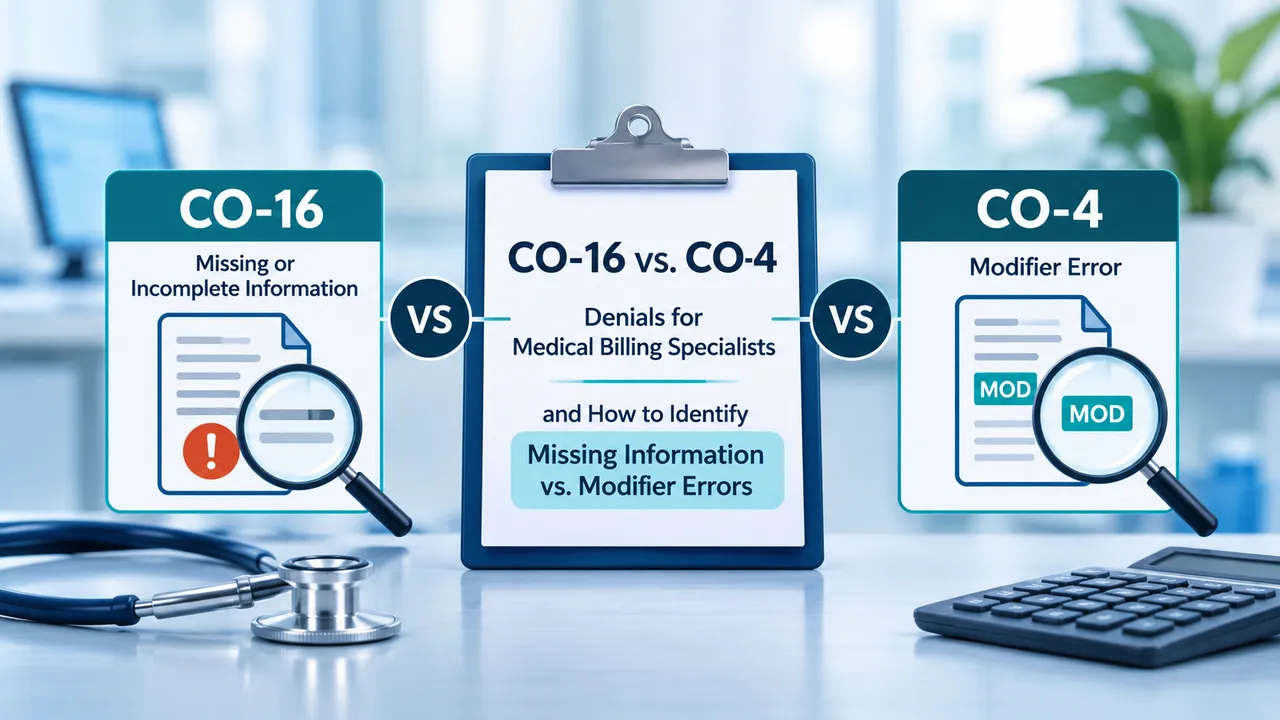
CO-16 vs CO-4 denial codes identify different problems on a claim. CO-16 signals that the claim lacks information or contains a submission or billing error. CO-4 means the procedure code is inconsistent with the modifier used.
Both can affect payment, but they point to different issues. For professional services, the 837 professional claim format carries the submitted claim details; the remittance reports the payer’s adjustment.
Can CO-4 appear even when a modifier is already on the claim?
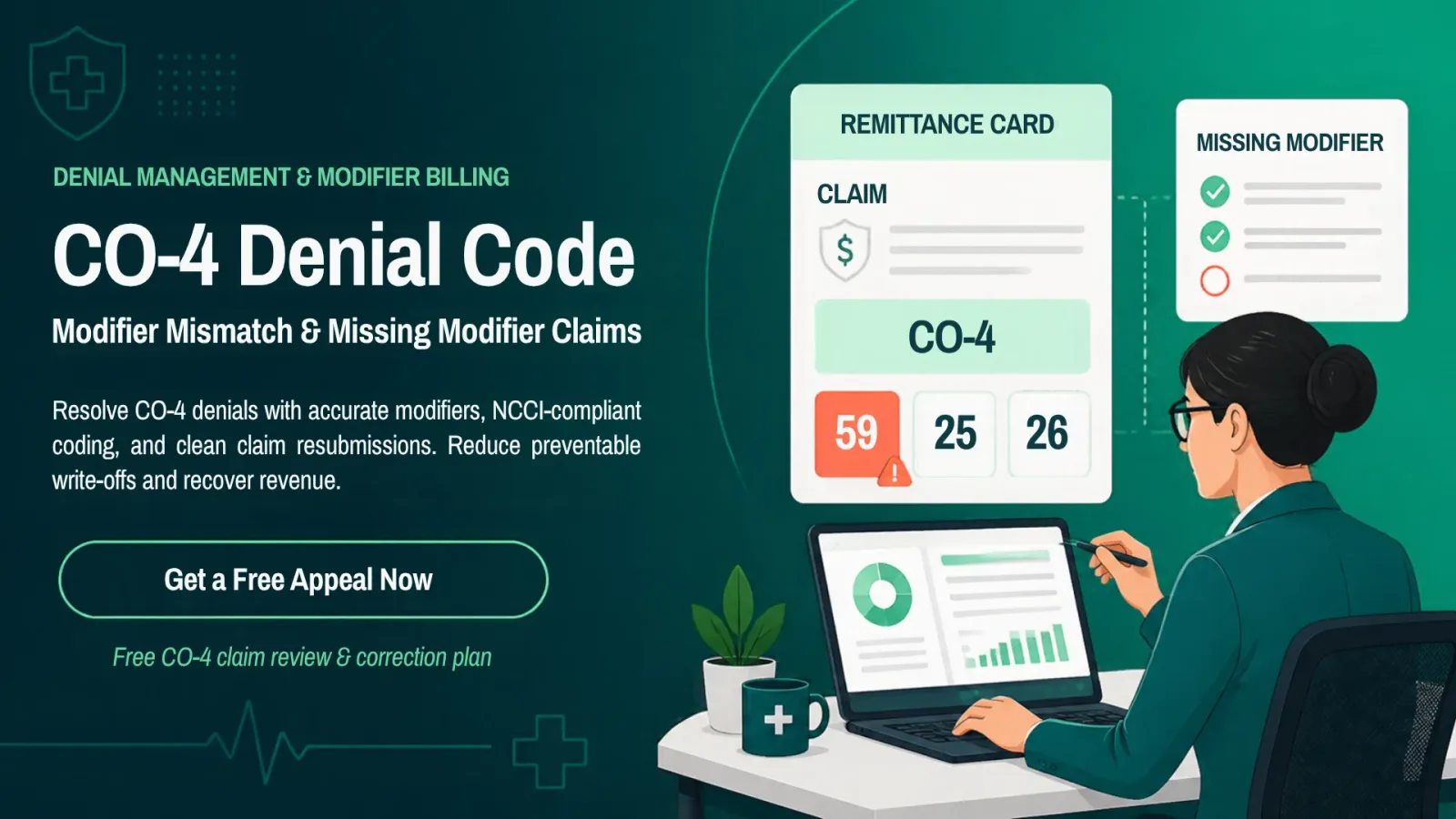
Yes. The official X12 CARC definitions describe CO-4 as a mismatch between the procedure code and modifier, not simply a missing modifier.
A CO-16 claim information error has a separate requirement: X12 says it must be accompanied by at least one non-alert remark code or an applicable NCPDP reject reason code.
That distinction matters because medical billing teams should not treat the two adjustments as interchangeable. The first task is to identify which part of the submitted claim the payer is questioning before deciding how to address it and that what this blog will walk you through. Let's dive in.
CO-16 vs CO-4: What Does Each Adjustment Actually Identify?
When reviewing an ERA, CO-16 and CO-4 identify different reasons for a claim adjustment. The CO prefix identifies the adjustment group, while the number identifies the specific reason. CMS also explains that adjustments can apply at either the claim or service-line level.
| Component | What it communicates |
|---|---|
CO | Contractual Obligation adjustment group |
CARC 16 | Claim information or submission/billing error |
CARC 4 | Procedure-code/modifier inconsistency |
RARC | Additional information about the adjustment |
According to X12's official CARC definitions, both CARC 16 and CARC 4 also reference the 835 Healthcare Policy Identification Segment (Loop 2110 REF), if present.
The differences become clearer when compared side by side.
| Comparison factor | CO-16 | CO-4 |
|---|---|---|
What is questioned? | Claim information or submission accuracy | Procedure-code/modifier compatibility |
Main reference | Remittance and original claim | Affected service line and applicable policy |
Primary investigator | Billing or claim operations | Coding or billing specialist |
Possible resolution | Correction, resubmission, or dispute | Correction, eligible reopening, or appeal |
Can a CO adjustment be transferred to the patient simply because the claim was not paid?
No. CO and PR represent different financial responsibilities. CO indicates Contractual Obligation, while PR identifies Patient Responsibility. For Medicare, CMS permits beneficiary billing only when the adjustment uses group code PR. Therefore, healthcare billing professionals must not interpret a CO adjustment as patient liability.
How Do You Trace a CO-16 Adjustment to the Exact Claim-Information Problem?
For a CO-16 denial code, review the complete ERA/835, not just the EOB summary. A CO-16 claim information error or CO-16 missing information denial must be tied to its accompanying remark. CMS explains that adjustments may occur at claim or service-line level.
1. Locate the Remark and Affected Claim or Service Line
Find the non-alert remark and determine whether it applies to the claim or a specific service line. The CO-16 denial remark code provides additional detail. X12 also directs users to the 835 Healthcare Policy Identification Segment (Loop 2110 REF), if present.
If CO-16 appears on an EOB without a visible remark code, where can the missing detail be found?
Retrieve the complete 835 through the clearinghouse or payer portal. If the remark is still missing, ask the payer to clarify.
Can one CO-16 adjustment contain multiple remarks identifying different claim errors?
Yes. An ERA can carry remarks at claim and service-line levels. Match each remark to its associated adjustment before identifying the error.
2. Match the Remark to the Claim Field and Source Record
Compare the submitted claim with the original record that supplied the information. Use the accompanying remark to identify what needs verification. Below is a table of examples for you:
| RARC | What to verify |
|---|---|
M76: Missing, incomplete, or invalid diagnosis | Diagnosis record and diagnosis-to-procedure linkage |
N290: Missing, incomplete, or invalid rendering-provider identifier | Submitted identifier and provider master record |
M77: Missing, incomplete, or invalid place of service | Encounter location and submitted place of service |
3. Separate Claim-Field Errors from Attachment Requirements
CARC 16 should not be used when the payer is specifically requesting an attachment or other supporting documentation. X12 provides separate adjustment reason codes for these situations. This distinction matters because correcting a claim field and supplying a required document involve different actions.
How can a biller distinguish a missing claim field from a required medical record attachment?
Check the CARC. X12 says not to use CARC 16 for attachments or other documentation. CARC 250 identifies an incorrect attachment, 251 an incomplete or deficient attachment, and 252 documentation required for adjudication.
During Bill Matters' development, our team examined CO-16 scenarios with billing professionals, denial specialists, and appeal managers. That research reinforced the need to interpret the remark alongside the underlying claim record.
Bill Matter's Claim Denial Decoder and Document & EOB Processing interpret paired CARC/RARC information, structure uploaded remittance files, and flag uncertain data for review. Workers' compensation billing teams must also check applicable state and carrier requirements.
Also Read: What Documentation Should Be Included with a Medical Claim Appeal?
How Do You Verify the Procedure Code and Modifier Combination Behind CO-4?
A CO-4 denial code calls for line-level review. For a CO-4 modifier mismatch denial, compare submitted codes and modifiers with the service record. CMS maps CMS-1500 Item 24D to Loop 2400 SV101-2 in the 837P.
1. Isolate the Affected Procedure Line
- Identify the adjusted line
- Check its CPT/HCPCS code, modifiers, service date, setting, and supporting record
- A CO-4 CPT modifier denial cannot be assessed by checking for a modifier elsewhere on the claim.
2. Use the Remark to Pinpoint the Modifier Issue
The official X12 RARC list identifies three remarks relevant to modifier-related investigations:
| RARC | Meaning | What to verify |
|---|---|---|
N519 | Invalid HCPCS modifier combination | Whether the combination is permitted |
N822 | Missing procedure modifier(s) | Whether a modifier was required |
N823 | Incomplete/invalid procedure modifier(s) | Whether the modifier is complete and valid |
Note: An CO-4 invalid HCPCS modifier combination requires checking modifiers together. A CO-4 missing procedure modifier requires checking code instructions.
Can a modifier be valid in general but still be rejected for a particular procedure code?
Yes. HCPCS modifier compatibility depends on the procedure and applicable rules. A modifier's existence does not make every combination acceptable.
Also Read: How Medical Billers Can Fix HCPCS Modifier and Billing Unit Errors to Prevent Claim Denials
3. Verify the Rule for the Date of Service
- Check the modifier effective date and payer-specific modifier policy
- For Medicare, consult CMS's 2026 NCCI Policy Manual and applicable edits effective January 1, 2026
- Check a relevant Local Coverage Determination policy article and its related Billing & Coding Article when coverage rules apply
- The 835 Healthcare Policy Identification Segment (Loop 2110 REF), if present, may identify the cited policy.
How can billing teams verify that a modifier was valid on the exact date of service?
Check code instructions effective that day, payer policy, and supporting records. This matters to independent doctor practices and practice owners.
The CO-4 cases we examined while shaping Bill Matters reinforced one distinction: a modifier on the claim does not prove it met the payer's rule. Its Contract & Fee Schedule Intelligence extracts modifiers and exceptions from governing contracts or applicable state fee schedules for review. It does not replace CPT/HCPCS coding validation.
Also Read: HCPCS Level II vs. CPT and How Medical Billers Can Choose the Right Code to Avoid Claim Denials
Is Your Modifier Policy Playing Hide-and-Seek?
Bring a real CO-4 or CO-16 case to a live demo and assess how Bill Matters supports your wider denial-review workflow
How Should You Resolve a CO-16 or CO-4 Claim: Correct, Reopen, or Appeal?
The right response to CO-16 or CO-4 depends on the verified error and claim status: correct the submission, request an eligible Medicare reopening, or appeal a disputed determination.
| Investigation finding | Appropriate next step |
|---|---|
Incorrect claim information or modifier | Correct and resubmit |
Claim returned as unprocessable | Submit a new claim |
Eligible Medicare clerical error | Consider reopening |
Correct claim, incorrect payer decision | Consider appeal |
1. Correct the Claim When the Submitted Information or Modifier Is Wrong
- For a CO-16 corrected claim, fix the field identified by the remark. For CO-4, change the code or modifier only after confirming an error
- Follow payer replacement instructions and include the original payer claim identification number where required.
A corrected replacement claim may need a replacement indicator. CMS lists claim frequency code 7 as a replacement of a prior claim for institutional claims. Check the claim format and payer instructions before applying it to a professional claim.
When CO-16 affects one service line, does the entire claim always need to be replaced?
No. Check the adjustment scope and follow the payer's correction process.
2. Request a Medicare Reopening for an Eligible Clerical Error
- A CO-4 Medicare reopening may apply to an adjudicated Medicare claim with an eligible clerical error
- CMS includes incorrect data items, including modifier use, among examples handled through Medicare reopening for clerical errors
- The contractor determines whether the error qualifies. A Medicare CO-4 modifier error reopening for clerical mistake is not automatic.
3. Check Whether the Claim Was Returned as Unprocessable
A CO-16 unprocessable claim with MA130 resubmission may occur when a Medicare clinical trial claim lacks its required trial number. CMS directs the provider to submit a new claim.
In a separate TAVR example, a missing Q0 modifier leads to CO-4 with MA130. These are specific Medicare scenarios, not universal rules.
Why can a CO-4 adjustment have an unprocessable-claim message and no appeal rights?
MA130 states that appeal rights are not afforded because the claim is unprocessable. Correct and resubmit as instructed rather than treating the return as an adjudicated denial.
4. Appeal When the Payer's Determination Is Disputed
A CO-4 denial appeal, or a dispute involving CO-16, may be appropriate when the claim was correctly reported but the payer applied the wrong rule. Address the payer's stated reason with supporting evidence.
What evidence is needed to dispute a CO-4 adjustment when the coding and documentation support the modifier?
| Evidence | What it establishes |
|---|---|
Original claim | Code and modifier submitted |
Clinical/service record | Support for the service |
Coding instructions | Validity on the service date |
Payer policy and remittance | Whether the rule was applied correctly |
For Medicare Part A and B, request redetermination within 120 days of receiving the initial determination. Commercial deadlines vary; check the plan's appeal instructions.
For RCM heads and denial specialists looking for an ideal AI solution, Bill Matters' multi agent AI workflow identifies whether a case needs an appeal, corrected claim, or missing information. Supporting capabilities include:
- Billing Evidence Finder to compare records with payer evidence requirements.
- AI Appeal Generation to prepare a case-specific, source-backed draft.
An authorized team member reviews and submits each appeal.
Also Read: Human-in-the-Loop Requirements: Why AI Should Flag, Not Auto-Decide?
How Can Billing Teams Prevent CO-16 and CO-4 Errors from Recurring?
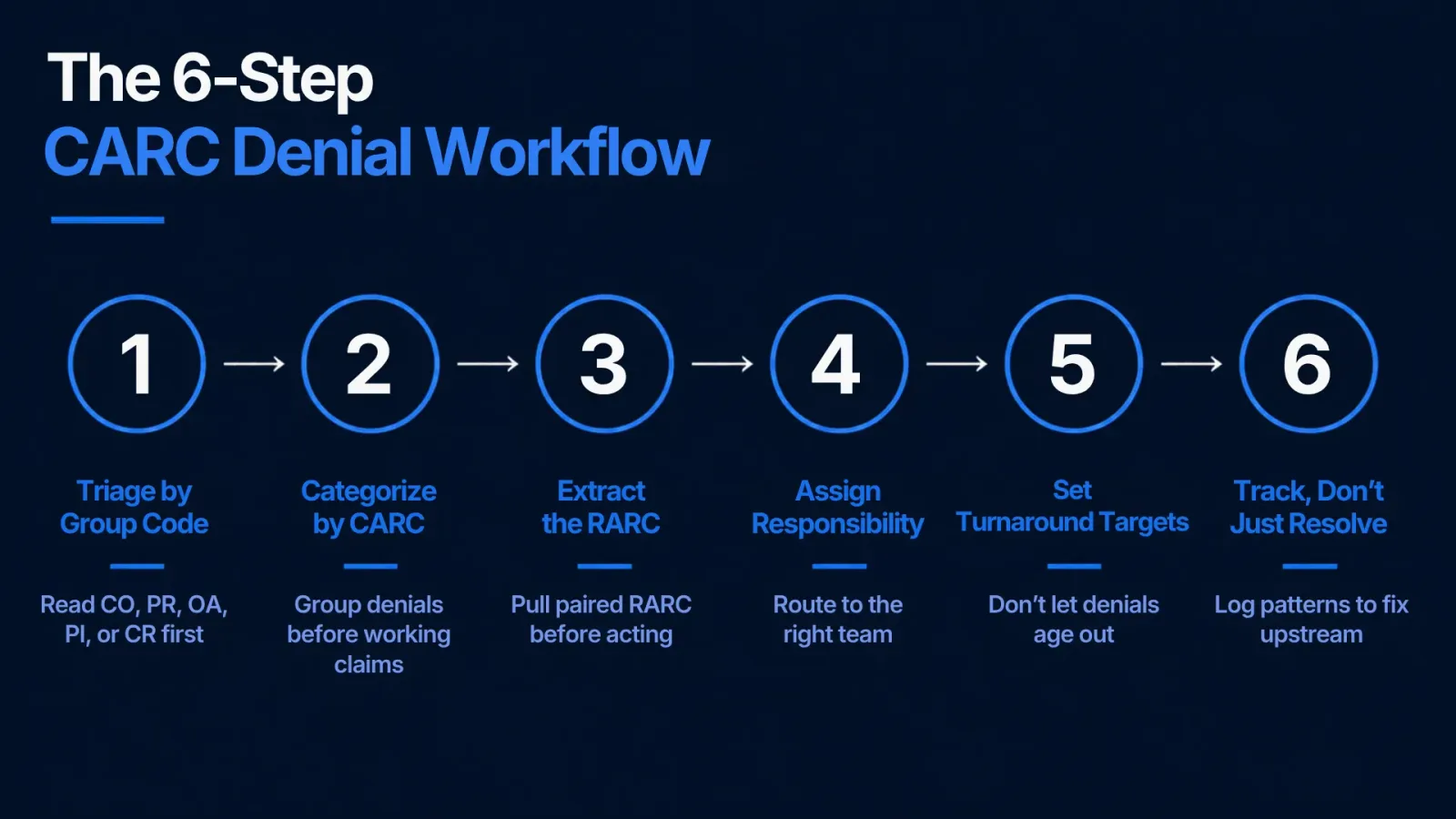
Correcting individual claims does not prevent the same adjustments from returning. Medical billing teams and medical practices need to identify which upstream billing processes generate recurring CO-16 and CO-4 errors. The preventive controls differ depending on the pattern.
| Recurring adjustment pattern | Potential upstream issue | Preventive control |
|---|---|---|
Repeated diagnosis-related CO-16 | Incomplete diagnosis entry | Diagnosis-field validation |
Repeated provider-related CO-16 | Incorrect provider master data | Rendering-provider identifier checks |
Repeated POS-related CO-16 | Incorrect location selection | Place-of-service validation |
Repeated CO-4 adjustments | Inconsistent coding or charge entry | Modifier compatibility checks |
Payer-specific CO-4 patterns | Outdated payer instructions | Regular policy updates |
1. Identify Shared Process Failures Behind Recurring Adjustments
A recurring adjustment may point to a billing-system configuration problem rather than an isolated staff error. Compare denial trends across payers, providers, procedures, and submission workflows.
How should a billing team identify whether recurring CO-16 and CO-4 adjustments originate from the same upstream billing system issue?
Group denial records by:
- Payer and provider.
- Procedure code and modifier combination.
- Accompanying remark and affected claim line.
- Billing system or charge-entry source.
Use these findings to review claim scrubber edit configuration before claims reach the payer. CMS explains how front-end claim edits identify submission errors, while its NCCI resources support correct coding through established edits.
Bill Matters' Payer Insights tracks denial patterns, response times, and recovery outcomes separately for each payer. This helps teams identify recurring payer-specific issues instead of treating every adjustment as an isolated incident.
Your Denial Queue Shouldn't Play Déjà Vu
Give your team a stronger basis for deciding which recurring issues deserve attention before they consume another billing cycle
Make the Right Decision Before Acting on a Denial
CO-16 vs CO-4 denial codes require different responses, and identifying the actual issue is essential. For CO-16, follow the accompanying remark to the claim information that needs attention. For CO-4, verify the procedure code and modifier against the applicable payer-specific modifier policy.
The experience behind Bill Matters has reinforced one principle: denial decisions must be grounded in claim evidence and applicable rules, not assumptions based on code descriptions.
Whether the next step is correction, an eligible reopening, or a CO-4 denial appeal, the decision should reflect the facts. A careful review prevents unnecessary rework and unsupported appeals.