
Get a summary of this article with your favorite AI
Key Highlights
- •Bill Matters and Amperos use AI to support claim denial management and appeal generation, with different approaches to denial analysis and appeal preparation.
- •Bill Matters interprets CARC and RARC codes, explains denial reasons, and recommends the next action, including an appeal, corrected claim, documentation request, or no appeal.
- •The Billing Evidence Finder identifies relevant supporting documents and missing evidence for medical claim appeals.
- •AI Appeal Generation prepares claim-specific, evidence-backed appeals with source traceability, unverified information flags, and a second AI model validation step.
- •Bill Matters gives healthcare providers, RCM teams, and medical billing companies a focused workflow for AI-powered denial analysis, evidence identification, and human-reviewed appeal preparation.
For RCM leaders, a denied claim often means another round of manual work: interpreting denial codes, checking payer requirements, finding missing records, and deciding whether an appeal is worth pursuing. And with denial volumes rising, that workload can quickly become difficult to manage.
Experian Health's 2026 State of Claims survey found that 75% of providers reported increasing claim denials, while 78% said payer policies were changing more frequently.
That's why choosing the right denial management and appeal generation software matters. Bill Matters vs. Amperos is a comparison worth making if your team wants to understand denials more accurately, reduce manual investigation, and prepare stronger, evidence-backed appeals.
Both platforms use AI to support claim denial management and recovery. However, the important differences lie in how they interpret denial information, identify supporting documentation, build appeal arguments, and help billing teams review the final output.
Let's look at how they compare across these areas and what your team should evaluate before choosing one.
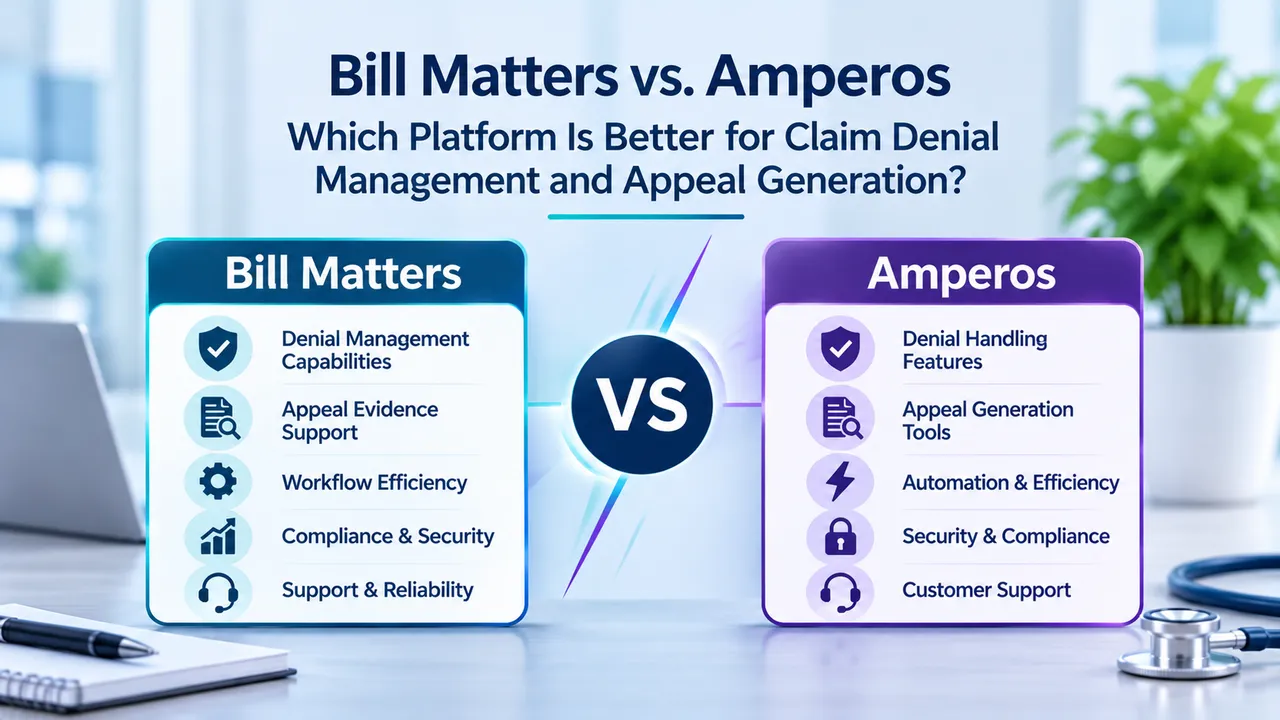
Bill Matters vs. Amperos: A Quick Comparison
The main difference is how each platform supports the journey from a denied claim to an appeal. Bill Matters brings together denial interpretation, resolution guidance, evidence identification, and claim-specific appeal generation. Amperos combines AI-driven denial workflows with RCM expertise and broader claim recovery capabilities.
| Comparison area | Bill Matters | Amperos |
|---|---|---|
Primary focus | Claim denial investigation and appeal preparation | AI-supported denial management and insurance recovery |
Denial interpretation | Claim Denial Decoder interprets CARC and RARC information together | Denial analytics and claim categorization |
Next-action guidance | AI Denial Agent recommends an appeal, corrected claim, missing documentation, or no appeal | Denial handling within its broader recovery workflows |
Evidence identification | Billing evidence finder identifies relevant and potentially missing records | Appeal filing is part of its recovery workflow; detailed public information on evidence mapping is more limited |
Appeal generation | Generates claim-specific appeal drafts using denial details, supporting records, and applicable requirements | Appeal filing is documented; detailed public information on its appeal-generation methodology is more limited |
Appeal validation | A second AI model checks the generated appeal, including its denial reasoning | The precise appeal-validation process is not clearly detailed in the information reviewed |
Human review | Users can review, edit, reject, or regenerate drafts before submission | RCM specialists work alongside AI agents |
Best suited to | Teams seeking focused denial analysis and evidence-backed appeal preparation | Organizations seeking AI-supported denial handling within a broader recovery operation |
This comparison looks at product information, documented capabilities, and workflows relevant to claim denial management and appeal generation. We focused on how each product interprets denials, recommends next steps, identifies supporting evidence, drafts appeals, validates outputs, and incorporates human review. Where the technical details weren’t clearly explained, we’ve flagged them for verification during a product demo rather than assuming the capability is missing.
How Do Bill Matters and Amperos Help Your Team Understand Claim Denials?
Bill Matters helps your team interpret denial information at the claim level and understand what action to take next. Amperos approaches denial management through AI-supported analytics, claim categorization, and RCM expertise.
The difference is not just about if a platform can identify a denial. It's whether it helps your team understand why the claim was denied and what needs to happen before an appeal can be prepared.
1. How Bill Matters Interprets Denial Codes?
A denial code gives your billing team a starting point, but it may not tell the whole story.
A Claim Adjustment Reason Code (CARC) explains why a claim or service line was adjusted. A Remittance Advice Remark Code (RARC) can provide additional information about the adjustment. Looking at both together helps build a clearer picture of the denial.
Bill Matters' claim denial decoder interprets the CARC and its paired RARC, then translates the information into a plain-language explanation.
For example, instead of leaving a biller to interpret a code description and search for additional context, the decoder helps explain what the denial means in relation to the claim.
Bill Matters also uses its AI denial agent to evaluate the denial, claim information, applicable policy, and available evidence before recommending a next step.
The recommended resolution paths include:
| Recommended action | When it may apply |
|---|---|
Appeal | The available information supports challenging the payer's decision |
Corrected claim | The claim contains an issue that needs correction |
Request missing documentation | Additional records are needed before the claim can be properly supported |
Not appealable | The available information does not support an appeal |
This distinction is important. Not every denied claim should become an appeal. Sometimes the right response is to correct the claim or obtain missing records first.
2. How Amperos Approaches Claim Denial Management?
Amperos uses AI and RCM expertise to support denial analytics, claim categorization, and claim handling.
Its approach connects denial-related information with the wider recovery process. This gives organizations a way to work assigned claims through their denial and recovery workflows.
For teams comparing denial management capabilities, the important question is how much detail the platform provides when investigating an individual claim.
For example, ask how it:
- Interprets the reason behind a specific denial.
- Uses claim information to understand the issue.
- Distinguishes a correctable claim from one that needs an appeal.
- Identifies when additional documentation is required.
- Explains the reasoning behind its recommended action.
Based on the information shared by Amperos, there is limited detail on how it interprets specific CARC/RARC combinations or chooses between these resolution paths.
3. Why Is Choosing the Right Next Action Important?
If a claim is denied because the payer needs additional documentation. Sending an appeal without the required records may not resolve the issue.
But if we consider a claim where the submitted documentation supports the service, but the payer's decision appears inconsistent with the available evidence. In that case, a well-supported appeal may be appropriate.
The two situations require different responses.
When evaluating AI denial management platform, check whether it can distinguish between:
- A claim that needs correction.
- A claim that needs additional supporting records.
- A claim that has grounds for an appeal.
- A claim that should not be appealed.
A useful platform should help your team understand the reason behind its recommendation, not simply generate an action based on a denial label.
Also Read: What Should You Do First When Facing a Healthcare Claim Denial
How Do Bill Matters and Amperos Identify Supporting Evidence for Appeals?
Bill Matters helps medical billing teams identify the records relevant to a denial and understand what may be missing before preparing an appeal. Amperos includes appeal filing within its broader recovery workflows, although its detailed evidence-identification and appeal-construction methodology is less clearly described in the information reviewed.
This stage deserves attention because an appeal is only as useful as the information supporting it.
1. How Bill Matters Finds Relevant and Missing Documentation?
Finding the right document can take time, especially when a claim involves multiple records, payer requirements, or state-specific documentation rules.
Bill Matters' billing evidence finder checks the documents available for a claim against the denial information and relevant requirements. It helps identify:
- Which available records are relevant to the denial.
- What supporting documentation may be missing.
- Why a particular document matters to the claim.
- Which evidence may help support the appeal.
The type of evidence needed depends on the reason for denial. Here are some examples:
| Denial type or issue | Supporting evidence that may be relevant |
|---|---|
Medical necessity | Clinical notes, treatment records, and relevant medical documentation |
Authorization issue | Authorization records and related payer correspondence |
Procedure or service dispute | Operative reports and documentation of the service performed |
Workers' Compensation documentation denial | Applicable state or carrier forms, treatment reports, and authorization records |
Payment or reimbursement dispute | Contract terms, fee schedules, remittance information, and payment records |
These examples are not universal requirements. The documents needed for a particular appeal depend on the denial reason, payer instructions, and claim circumstances.
A practical example: In a Bill Matters-published workers' compensation case study, a multi-state billing company was dealing with CARC 16 denials where the payer response did not clearly identify the missing document.
Bill Matters helped identify specific documentation gaps, including missing DWC forms and authorization records, before resubmission.
The company reported fewer resubmission cycles and recovery on claims that had previously gone unworked. These results come from the published case study and have not been independently audited.
2. How Amperos Handles Evidence and Appeal Preparation?
Amperos documents appeal filing as part of its broader claim recovery process. Its model combines AI agents with RCM specialists who work on assigned claims.
However, the publicly available information reviewed for this comparison provides less detail about how the platform:
- Maps individual supporting documents to a specific denial reason.
- Identifies missing evidence before an appeal is prepared.
- Connects documentation to individual statements in an appeal.
- Flags information that cannot be verified.
This is an area worth exploring during a product demonstration. Ask Amperos to show how it handles a denied claim where the payer has requested a specific document or where the available records need to be matched against the denial reason.
The aim is to compare the actual evidence-identification process, not just whether the platform can file an appeal.
3. What Should You Look for in an Evidence Identification Tool?
When comparing medical claim denial management software, don't stop at whether it can read uploaded documents.
Check whether it helps your team answer these questions:
| What to evaluate | Why it matters |
|---|---|
Document relevance | Does the system identify records related to the actual denial? |
Missing evidence | Can it flag documents that may be needed but are not available? |
Denial-specific matching | Does it connect the evidence to the reason for denial? |
Source traceability | Can reviewers identify where important information came from? |
Unverified information | Does it flag gaps instead of filling them with assumptions? |
Human review | Can a billing professional check the evidence before it is used in an appeal? |
A tool that simply collects documents may save some time. A tool that helps explain which documents support a particular denial can make the investigation more useful.
4. What Does Denial Investigation Look Like in a Real Claim Scenario?
Consider a workers' compensation claim denied under CARC 16, where the payer's response does not clearly explain which document is missing.
For a billing team, the challenge is figuring out what the payer needs before sending the claim back. Repeatedly resubmitting the same claim without addressing the documentation gap can create more work.
Using the type of scenario described in Bill Matters' workers' compensation case study, the investigation can be approached in these steps:
- Understand the denial: Review the CARC 16 response and available claim information to establish what documentation issue needs attention.
- Check the available records: Examine the claim documents to identify relevant Workers' Compensation forms, treatment reports, and authorization records.
- Identify documentation gaps: Determine which required records appear to be missing or unavailable.
- Decide the next action: Obtain the missing documentation before proceeding with the appropriate claim correction or resubmission.
- Review before taking action: Have the billing team verify the identified gap and supporting records before moving the claim forward.
This example shows why identifying the documentation gap matters before resubmitting a denied claim.
Also Read: What Documentation Should Be Included with a Medical Claim Appeal?
How Do Bill Matters and Amperos Generate Medical Claim Appeals?
Bill Matters uses AI appeal generation to prepare claim-specific appeal drafts using denial information, claim details, supporting evidence, and applicable requirements. Amperos includes appeal filing in its broader recovery workflows, but its detailed appeal-drafting methodology is less clearly explained in the information reviewed.
For RCM heads, this is one of the most important parts of the comparison. A generated appeal should do more than restate the denial or produce a professional-looking letter. It should connect the payer's reason for denial with the facts and documentation that support the provider's position.
1. How Bill Matters Creates Claim-Specific Appeal Drafts?
Once the denial has been investigated and relevant evidence identified, Bill Matters' AI appeal generation prepares a draft based on the information available for that claim.
The process brings together:
- The reason for denial.
- Relevant claim information.
- Supporting clinical or administrative documentation.
- Applicable payer policies or requirements.
- Information that supports the appeal argument.
The goal is to produce an appeal that addresses the actual denial rather than relying on a generic letter template.
Bill Matters also supports source traceability for important facts and references. This helps reviewers understand where information used in the appeal came from.
If the system cannot verify a piece of information, it is designed to flag it rather than present an unsupported statement as fact.
2. How Amperos Approaches Appeal Generation?
Amperos documents appeal filing as part of its denial and insurance recovery workflows. Its AI agents and RCM specialists work together to progress assigned claims, including cases that require appeals.
However, there is less publicly available technical detail about the precise process used to construct individual appeal arguments.
For a fair comparison, don't assume that less detail means a missing capability. Instead, ask Amperos to demonstrate how it prepares an appeal from the initial denial through the final draft.
In particular, look at whether the system:
- Uses the specific denial reason to shape the argument.
- Incorporates relevant claim and supporting-document details.
- Connects the appeal's statements to supporting records.
- Identifies missing or uncertain information.
- Allows a human reviewer to assess the draft before submission.
This will help you compare the actual appeal output rather than relying only on feature descriptions.
3. What Makes an AI-Generated Medical Appeal Useful?
A well-written appeal is not necessarily a well-supported appeal.
Your team should assess the content and reasoning behind the draft, not just its format or generation speed.
Use this checklist when comparing the platforms:
- Denial relevance: Does the appeal address the actual reason for denial?
- Claim accuracy: Are the claim and service details correct?
- Evidence: Does it use relevant supporting documentation?
- Payer requirements: Does the argument consider applicable payer rules?
- Traceability: Can reviewers identify the sources behind important statements?
- Completeness: Does it flag missing information?
- Readability: Is the argument clear and easy for a reviewer to follow?
- Editability: Can an authorized user make changes before submission?
These checks are especially important if you're evaluating AI medical appeal generation or looking for medical claim appeal software that can support a human review process.
How Do the Platforms Validate Appeal Quality and Support Human Review?
Bill Matters includes a second AI validation step that checks the generated appeal, including its denial reasoning, before a user reviews it. Amperos combines AI agents with RCM specialists, although the exact technical process used to validate appeal drafts is less clearly detailed in the information reviewed.
Validation matters because an AI-generated appeal can contain incorrect details, unsupported statements, or arguments that do not properly address the denial.
1. How Bill Matters Checks Generated Appeals?
Bill Matters uses a second AI model to review the appeal generated by the first model.
The validation step specifically checks the denial reason and whether the appeal addresses it appropriately. This creates an additional review layer before the draft reaches the human user.
The validation step is not a guarantee that every appeal is correct. It is designed to catch issues that may otherwise require the billing team to spend more time reviewing and correcting the draft.
After the draft appears in the application, users can:
- Review the generated appeal.
- Edit the content.
- Reject the draft.
- Regenerate it when changes are needed.
The final decision remains with the human reviewer, who determines whether the appeal is appropriate and submits it through the organization's existing process.
2. How Amperos Incorporates Human Expertise?
Amperos describes a model in which AI agents work alongside RCM specialists. This combines automation with human involvement in claim recovery.
For appeal generation specifically, ask how the specialist review process works and when a claim is escalated for additional attention.
Useful questions include:
- Who reviews an appeal before it is filed?
- How are incorrect or incomplete drafts identified?
- Can the provider review and edit the appeal?
- How are unsupported statements handled?
- What happens when the available documentation does not support the appeal?
The answers will help you understand how much review responsibility remains with your team.
3. Bill Matters vs. Amperos: Appeal Review Comparison
| Review area | Bill Matters | Amperos |
|---|---|---|
AI validation | Second AI model checks the appeal, including denial reasoning | Exact technical validation process is less clearly detailed in the information reviewed |
Human involvement | User reviews the draft before submission | AI agents work alongside RCM specialists |
Editing | Users can edit the generated draft | Ask for a demonstration of the available editing process |
Rejection or regeneration | Users can reject or regenerate the draft | Confirm the available options during a demonstration |
Final responsibility | Customer reviews and submits the appeal | Confirm who reviews and authorizes the final appeal in the agreed workflow |
The key is to understand where AI assistance ends and human responsibility begins. Your team should be comfortable with both the quality checks and the level of control available before an appeal is submitted.
Is Bill Matters the Right Fit for Your Claim Denial Management and Appeal Generation Needs?
Bill Matters is designed for healthcare teams that want to investigate claim denials, identify missing supporting documents, and prepare accurate, claim-specific appeals. It brings these steps together to help your billing team spend less time on manual investigation and more time preparing well-supported appeals.
Consider Bill Matters if your team wants to:
- Interpret CARC and RARC information together to understand denial reasons.
- Identify whether a claim needs an appeal, correction, or additional documentation.
- Find relevant supporting evidence and flag missing records before drafting an appeal.
- Generate claim-specific appeals using available documents and applicable requirements.
- Trace important statements in an appeal back to their supporting sources.
- Validate generated appeals through a second AI model before human review.
- Review, edit, reject, or regenerate appeal drafts before submission.
This makes Bill Matters particularly relevant for provider organizations, specialty practices, and medical billing companies that already manage payer relationships but need better support with denial investigation and appeal preparation.
1. What About Pricing?
Bill Matters is currently available for free during its early-access period, with three free appeal generations per organization.
As we move towards paid pricing, our approach is simple: we don't want clients to pay unless they can see tangible results from using Bill Matters. Our pricing approach will be designed around the visible value and outcomes clients receive, rather than charging simply for access to another software tool. The final pricing structure will be communicated before paid plans are introduced.
2. How Does Amperos Compare?
Amperos may be worth considering if your organization wants AI-supported denial handling and appeal filing as part of a wider claims recovery operation. Its approach also combines AI agents with RCM specialist involvement.
Ultimately, if your priority is improving how your team understands denials, finds supporting evidence, and prepares appeals, Bill Matters is worth evaluating closely.
3. Questions to Ask Before Choosing an AI Denial Management Platform
A product demo should show more than a polished dashboard or a sample appeal letter. Ask both vendors to work through the same de-identified denied claim.
Use these questions to compare the actual workflow:
| Evaluation question | What you should look for |
|---|---|
Can it interpret the denial? | A clear explanation of the denial reason and relevant codes |
Can it recommend the next action? | A reasoned distinction between appeal, correction, and missing documentation |
Can it identify supporting evidence? | Relevant records matched to the denial |
Can it find missing documents? | Clear identification of gaps in the available evidence |
Can it generate a claim-specific appeal? | An argument based on the actual claim and denial details |
Can it support the appeal with sources? | Traceable facts and references |
Can it check the draft? | A validation or review process that identifies potential issues |
Can a human review the output? | Clear editing and approval responsibilities |
What happens when information is incomplete? | The system flags uncertainty instead of inventing details |
These are comparisons of the capabilities and workflows described in the information reviewed. They should not be treated as proof that either platform lacks a capability simply because it is not described in detail.
Ready to make denials less of a headache?
Let Bill Matters handle the denial detective work while your team focuses on getting claims back on track.
The Right Denial Management Platform Must Deliver More Than Speed
Speed is an easy metric to demonstrate in a software demo. Reliability is harder to establish.
In its February 2026 coverage of AI adoption in denial management, HFMA noted that only about one in five healthcare providers were applying AI to this area, which reflects the trust gap around what AI can actually deliver.
For RCM teams, that makes transparency an important buying criterion. An appeal should not be a black-box response that staff are expected to approve. They need to understand the reasoning, verify the supporting information, and retain control over the final submission.
Bill Matters addresses this with source traceability in its generated appeals, flags for unverified information, a second-model validation step, and human review before submission. These are meaningful distinctions for teams that want AI assistance without handing over the final judgment.
Ready to give denials a little less drama? Book a demo and see Bill Matters in action!