
Get a summary of this article with your favorite AI
Key Highlights
- •Medical claim denial recovery time depends on how efficiently billing teams move denied claims from initial review to verified payment.
- •A centralized denial work queue ensures every denial is recorded, assigned, and given a clear next action.
- •Prioritizing claims by appeal deadlines, financial value, A/R age, and recovery potential helps teams focus on the claims that need attention first.
- •Accurate denial analysis, complete supporting documentation, and payer-specific appeals or corrected claims reduce avoidable rework and submission delays.
- •Consistent payer follow-up, escalation of unresolved claims, payment verification, and recovery metrics help teams identify bottlenecks and improve the denial management process.
A denied claim rarely fixes itself. Your team has to figure out what went wrong, find the right information, decide what to do next, and make sure the claim does not get lost along the way. And the longer it takes to start that work, the longer your expected payment stays out of reach.
The scale of the problem is hard to ignore. A February 2026 report from the Massachusetts Health Policy Commission found that insurers denied more than 9 million of the 45.9 million commercial claims reported in Massachusetts during 2024. Around 7.6 million were denied for administrative reasons, such as incomplete claims, coding errors, duplicate submissions, or other issues with payer requirements.
For your revenue cycle team, an administrative denial can mean another round of work:
- Finding out exactly why the payer denied the claim.
- Tracking down missing details, records, or corrected codes.
- Deciding whether to correct the claim or prepare an appeal.
- Making sure someone owns the next action and its deadline.
- Following through until the claim is resolved and payment is received.
If these tasks are handled in separate queues, passed between teams, or left without a clear owner, even a fixable denial can take longer than necessary to resolve.
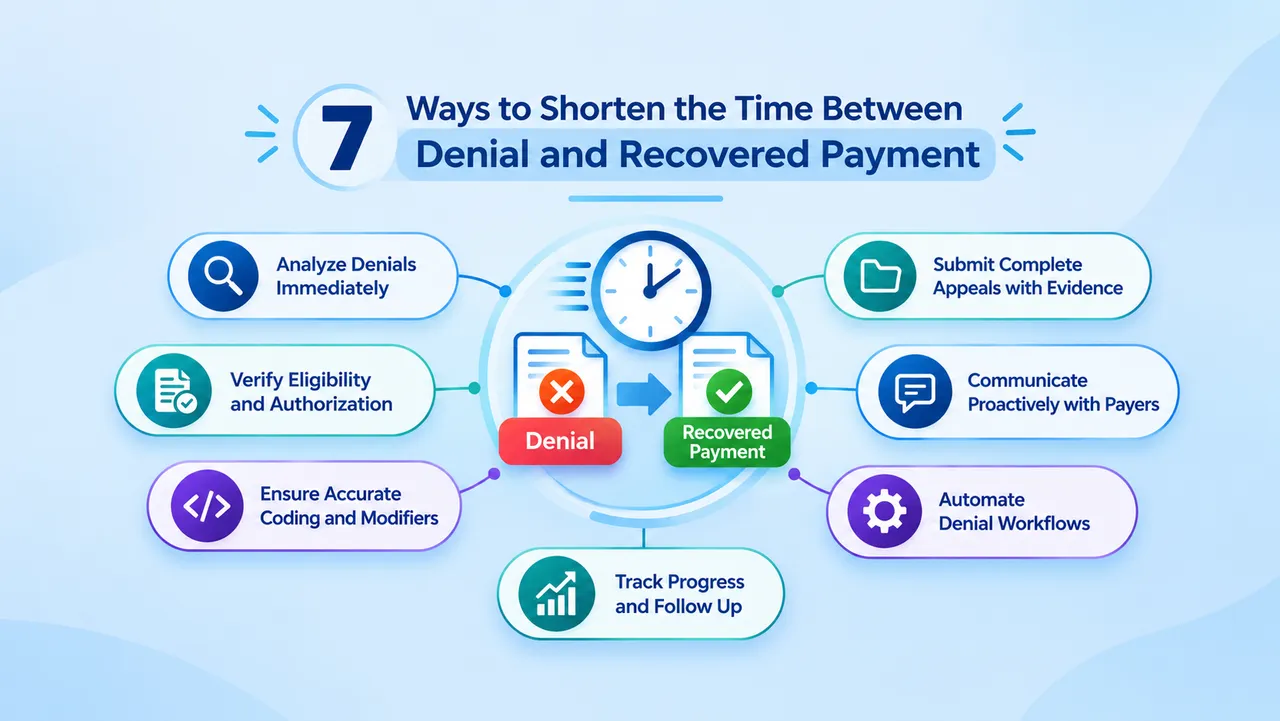
So, how do you keep that from happening? Here are seven practical ways to help your team resolve denied claims faster and recover payments without unnecessary rework.
What Are the Seven Ways to Shorten Denial-to-Payment Recovery Time?
Shortening denial-to-payment recovery time requires a clear process for managing each denied claim, from the moment it arrives to the point payment is verified. Focus on these seven steps:
| Step | What your team should do |
|---|---|
Capture every denial | Record all denials in a centralized work queue and assign ownership. |
Prioritize claims | Rank claims by appeal deadlines, financial value, and recovery potential. |
Identify the denial reason | Understand why the payer denied the claim and choose the right resolution path. |
Gather supporting evidence | Collect and validate all documentation required to address the denial. |
Prepare the response | Submit a complete, payer-specific appeal or corrected claim. |
Follow up with payers | Track submission status, follow up consistently, and escalate unresolved claims. |
Verify recovered payments | Confirm the final payment and measure denial-to-payment turnaround time. |
Let's take a closer look at each of these seven strategies.
1. Capture Every Denial in a Centralized Work Queue as Soon as It Arrives
The first step toward faster medical claim denial recovery is making sure every denial is visible to your team as soon as it arrives. A centralized denial work queue helps you identify new cases, assign responsibility, and prevent claims from sitting unnoticed.
Denial information can reach your billing team through electronic remittance advice (ERA), explanation of benefits (EOB), payer portals, emails, and billing system reports. When staff members manage these sources separately, a denial can easily go unnoticed or get assigned late.
1.1 Create One Place to Track Incoming Denials
Your team needs a consistent place to record and review denied claims. This could be an existing billing system, a dedicated denial management platform, or a structured worklist.
For every denied claim, capture:
| Information | Why It Matters |
|---|---|
Patient and claim identifiers | Helps locate the correct claim and related records |
Payer and plan | Identifies the responsible insurance company and applicable requirements |
Date of service | Connects the denial to the correct service |
Denial date and received date | Shows when the payer issued the decision and when your team could start working on it |
Denial reasons or code | Provides the starting point for investigation |
Denied amount | Shows the financial exposure |
Current status | Makes the claim's position in the workflow visible |
Assigned owner | Establishes responsibility |
Next action and due date | Prevents the claim from remaining without a clear task |
Keep the denial date and the date your team received the information separate. The difference helps you identify whether delays are occurring before the denial reaches your staff or after it enters your workflow.
1.2 Assign an Owner and Record the First Action
Assign one primary owner to monitor its progress, even if another department needs to complete a specific task, as a claim appearing in a work queue doesn't mean someone is actively working on it.
For example, an ERA file may contain a newly denied claim on Monday. If nobody assigns it to a biller until Friday's reconciliation, the claim has already lost several days before investigation begins.
A daily review of newly received and unassigned denials can help prevent this.
Once your team identifies a denial that needs investigation, then a platform like Bill Matters can analyze the uploaded denial document, explain the payer's reason, and help identify information relevant to the next action. This gives doctor practices and practice owners a clearer starting point for reviewing the case.
Also Read: What Should You Do First When Facing a Healthcare Claim Denial
2. Prioritize Denied Claims by Appeal Deadlines, Financial Exposure, and Recovery Potential
Prioritizing denied claims helps your team focus on cases that need attention first instead of simply working through the queue in the order they arrived. The right priority depends on the deadline, outstanding amount, A/R age, and whether a supportable recovery path exists.
Treating every denial as equally urgent can waste staff time. A smaller claim approaching its appeal deadline may need immediate attention, while a larger claim with sufficient time remaining can go through a more detailed review.
2.1 Rank Claims Using More Than Their Dollar Value
Start by reviewing these five factors:
| Priority Factor | Question to Ask | Why It Matters |
|---|---|---|
Appeal deadline | How much time remains to respond? | Helps prevent missed opportunities for reconsideration |
Financial exposure | How much reimbursement is outstanding? | Shows the potential financial impact |
A/R age | How long has the amount remained unpaid? | Identifies claims that are becoming increasingly delayed |
Recovery potential | Is there a supportable correction or appeal path? | Helps direct effort toward realistic recovery opportunities |
Resolution effort | How much time and specialist involvement will be required? | Helps allocate available staff resources |
Example: Your team has two denied claims:
- Claim A: $450 outstanding, with only a few days remaining in its applicable appeal window.
- Claim B: $8,000 outstanding, with 45 days remaining and additional clinical documentation still required.
Claim A may need immediate attention because the deadline is approaching. Claim B still deserves attention, but your team can assign the necessary clinical review while addressing the more urgent deadline.
2.2 Separate Quick Resolutions From Complex Reviews
Every denial doesn't needs the same amount of investigation. Separate claims into practical work categories, such as:
- Straightforward claim corrections.
- Missing-information requests.
- Clinical or medical-necessity appeals.
- Complex coding disputes.
- Contractual or reimbursement investigations.
This helps prevent every denial from entering a lengthy specialist review when a simpler resolution may be appropriate.
Also, don't automatically abandon low-dollar claims. Decisions to adjust, write off, or stop pursuing an amount should follow your organization's policies, payer requirements, contracts, and applicable law.
Prioritization answers one question: which claim needs attention first? The next step is understanding what actually went wrong.
3. Identify the Exact Denial Reason and Choose the Correct Resolution Path
Your team can reduce claim denial recovery time by understanding the payer's actual reason for denial before deciding whether to correct the claim, provide additional information, or prepare an appeal.
Starting with the wrong response can add an unnecessary processing cycle. For example, submitting a formal appeal for a correctable billing error may take longer than fixing the information and resubmitting the claim through the appropriate process.
3.1 Review the Payer's Explanation and Denial Codes
Begin with the information available in the remittance advice, EOB, payer portal, and claim history.
Pay attention to:
- Claim Adjustment Reason Codes (CARCs): Explain why a claim or service line was adjusted or paid differently than billed.
- Remittance Advice Remark Codes (RARCs): Provide additional information about an adjustment or remittance processing.
- Claim details: Help establish which service, date, or billed amount is affected.
- Payer communications: May clarify what information or action is required.
CARCs and RARCs should be interpreted together with the claim circumstances. A code alone may not provide enough information to determine the correct response. The official X12 code lists are useful references for checking current code descriptions.
3.2 Choose the Appropriate Resolution Path
Once you understand the denial, determine what action is appropriate.
| Denial Situation | Potential Resolution |
|---|---|
Incorrect or missing claim information | Correct and resubmit, where permitted |
Missing supporting documentation | Obtain and submit the required records |
Medical-necessity disagreement | Evaluate whether a formal appeal is appropriate |
Authorization issue | Verify approval details and determine the payer-appropriate correction or appeal route |
Non-covered or unsupported service | Review applicable payer requirements and determine whether further recovery action is justified |
Prior authorization issues belong in this investigation too. For example, if a payer denies a claim because authorization details do not match, check the approval record, service dates, provider, and authorized units before deciding how to respond.
3.3 Don't Appeal Every Denial Automatically
A formal appeal is not always the fastest or most appropriate option. A correctable data issue may need a corrected claim, while a medical-necessity disagreement may require clinical evidence and a formal appeal.
Bill Matters' denial analysis workflow can help billing specialists understand payer explanations and evaluate possible next steps using the uploaded denial information. The final resolution decision should still be reviewed by an authorized person.
The right resolution path saves time because your team works on the action the claim actually needs, rather than creating another round of avoidable work.
Also Read: What Should You Do First When Facing a Healthcare Claim Denial
4. Gather All Required Supporting Evidence Before Starting the Resolution Process
Gathering the right supporting evidence before preparing a response helps prevent incomplete submissions, repeated document requests, and avoidable resubmissions.
Your organization may already have the required records. The challenge is finding the relevant information and confirming that it supports the specific denial being addressed.
4.1 Match the Evidence to the Denial Reason
Different denials require different documentation. A standard document request for every claim can create unnecessary work.
For example:
| Denial Type | Supporting Evidence to Check |
|---|---|
Medical necessity | Relevant clinical notes, medical records, physician orders, and applicable coverage criteria |
Authorization | Prior authorization approval, reference number, approved dates, and authorized services |
Timely filing | Original claim submission records, clearinghouse acknowledgments, and payer receipts |
Coding or billing | Claim details, coding documentation, and relevant supporting records |
Eligibility or coverage | Eligibility verification, coverage details, and relevant payer communications |
Before requesting documents, identify:
- Which records are already available.
- Which documents directly address the denial.
- What information is missing.
- Who is responsible for retrieving it.
- Whether the documents match the correct patient, claim, service, and date of service.
A claim-specific evidence checklist can help your team avoid asking multiple departments for information that has already been provided.
4.2 Assign Document Retrieval to the Right Department
Instead of sending a broad request to several departments, identify the exact information needed and direct the request to the person who maintains it.
For example, clinical records may come from the treating department or Health Information Management (HIM), while authorization details may need to come from patient access or the authorization team.
Record when the request was sent and when the document was received. This helps you see where documentation retrieval is taking longer than expected.
4.3 Validate the Evidence Before Moving Forward
A complete appeal package is not simply a large collection of documents. Every record should be relevant to the claim and the payer's reason for denial.
Check that:
- The documents address the actual denial reason.
- Required forms and supporting information are included.
- Records are complete and signed where required.
- Patient, claim, and service identifiers match.
- The correct service line and date are covered.
- The evidence supports the response your team intends to prepare.
A Workers' Compensation Example
In a workers' compensation billing operation handling claims across multiple states, documentation requirements varied by state and insurance carrier. Some CARC 16 denials indicated missing information without clearly identifying the specific document required.
The billing team had to investigate and locate several types of records:
| Documentation Needed | What the Team Had to Find |
|---|---|
State-specific DWC forms | Forms required for the applicable workers' compensation claim |
Treatment reports | Records supporting the services billed |
Authorization records | Information confirming the required treatment authorization |
By identifying missing documentation before resubmitting claims, the team reduced a two-cycle rework process to one cycle. It also recovered payments on claims that had previously gone unworked, without adding headcount.
The takeaway for your billing team is straightforward: identify what's missing before resubmission, not after another denial arrives.
Bill Matters' billing evidence finder helps analyze uploaded documents, identify potentially missing supporting records, and assist with evidence preparation. Your team can review the identified gaps and provide the relevant documents before moving to appeal preparation.
Also Read: What Documentation Should Be Included with a Medical Claim Appeal?
5. Prepare and Submit a Complete, Payer-Specific Appeal or Corrected Claim
A complete, claim-specific response helps reduce delays caused by generic appeals, missing information, and incorrect submission requirements.
Once your team has identified the denial reason and gathered the supporting evidence, the next step is preparing the appropriate response. This could be a corrected claim or a formal appeal, depending on the issue and the payer's process.
5.1 Keep Payer-Specific Requirements Accessible
Maintain updated references for the payers and appeal pathways you handle regularly, your team shouldn't have to research the same payer's appeal instructions from scratch every time a similar denial appears. So, include:
- Applicable appeal levels and filing deadlines.
- Required forms and claim identifiers.
- Submission channels and addresses.
- Documentation requirements.
- Relevant payer policies or coverage criteria.
- Internal review and approval requirements.
Keep these references current. Requirements can vary by payer, plan, claim type, and appeal level.
5.2 Build the Response Around the Actual Denial
A useful appeal should connect the payer's decision with the claim facts and supporting evidence.
Make sure the response clearly explains:
- Which claim or service line is being disputed.
- What reason the payer provided for the denial.
- Why the provider believes the decision should be reconsidered.
- Which claim and clinical facts support that position.
- Which payer policy or contractual requirement applies.
- What supporting records are included.
- What action the provider is requesting.
For example, a generic medical-necessity appeal might simply request reconsideration. A claim-specific response should address the payer's actual medical-necessity rationale and identify the clinical records that support the service.
Standardized templates can reduce repetitive writing, but they should never make every appeal identical.
5.3 Review the Submission Before Sending It
Before submission, verify the claim and provider identifiers, supporting documents, required forms, appeal deadline, and submission channel.
Also confirm that an authorized person has reviewed the response. Keep a copy of the completed package and available proof of filing.
A quickly prepared appeal that comes back for missing information hasn't saved your team time. It has simply moved the delay to a later stage.
Medical billing companies can use AI-powered tools like Bill Matters to make denial review and appeal preparation more manageable. It's multi agent AI workflow has capabilities such as denial interpretation, evidence identification, and AI-assisted appeal drafting help teams understand uploaded denial information, locate relevant supporting details, and prepare evidence-backed appeal drafts. It's AI denial agent, claim denial decoder, billing evidence finder, and AI appeal generation features support different stages of this process.
Once a draft is ready, an authorized team member reviews it and submits the appeal through the appropriate payer channel. This keeps the final review and submission in the hands of the billing team while making the preparation process more organized.
Less denial decoding. More payment recovering. Sounds like a better workday, doesn't it?
Ready to make denial recovery easier?
Let's talk!
6. Follow Up Consistently With Payers and Escalate Claims That Remain Unresolved
A consistent denial follow-up process helps prevent submitted appeals and corrected claims from remaining pending without attention. Your team needs to confirm receipt, check progress, and know when to contact the payer again.
Submitting an appeal does not mean the payer has received it, accepted it for review, or issued a decision. These are separate milestones, and your team should track them individually.
6.1 Record the Important Follow-Up Details
For every submitted response, maintain a record of:
| Follow-Up Detail | What to Record |
|---|---|
Submission date | When the appeal or corrected claim was sent |
Submission method | Portal, mail, or another permitted channel |
Confirmation | Submission reference or confirmation number |
Payer acknowledgment | When receipt was confirmed |
Current status | Sent, received, under review, awaiting information, or decided |
Expected response timeframe | Applicable payer, contractual, or regulatory expectation |
Next follow-up date | When your team should check again |
Assigned owner | Who is responsible for the next contact |
This helps your team distinguish between an appeal that has been sent and one that the payer has actually received.
6.2 Schedule Follow-Ups Around the Applicable Timeline
Avoid applying the same follow-up schedule to every payer. Response expectations vary by payer, contract, claim type, and appeal pathway.
Your team should:
- Confirm that the payer received and indexed the submission.
- Check whether additional information is required.
- Document calls, portal interactions, and correspondence.
- Retain reference numbers.
- Record the next action after every interaction.
- Escalate unresolved cases through the appropriate channel.
For example, Original Medicare fee-for-service has specific first-level redetermination rules. CMS generally gives an appellant 120 days from receipt of the initial determination to request a redetermination. Medicare Administrative Contractors generally issue a decision within 60 days of receiving the request.
These are Medicare fee-for-service requirements, not universal deadlines for commercial, Medicaid, or Medicare Advantage claims. Check the CMS first-level redetermination guidance for the applicable requirements.
6.3 Escalate Repeated Delays Instead of Treating Every Claim Separately
If several appeals from the same payer remain unacknowledged, or the payer repeatedly requests information already submitted, look for a recurring issue.
Individual claim follow-up belongs with the assigned billing or denial specialist. Repeated payer issues may need attention from payer relations, contracting, or RCM leadership.
This keeps your team from repeatedly performing the same status checks without addressing the underlying problem.
7. Verify Reprocessed Claims and Reconcile Every Recovered Payment
Your team should close a recovery case only after verifying the final claim outcome and confirming whether the expected payment was received. An appeal approval or favorable payer response does not automatically mean the reimbursement has reached your organization.
Payment verification is the final step in medical claim denial recovery. Without it, a claim may appear resolved while some or all of the expected amount remains outstanding.
7.1 Compare the Final Payment With the Original Denial
Once the payer reprocesses the claim, review the updated EOB or ERA and compare it with the original claim.
Check:
- Original denied amount.
- Approved or allowed amount.
- Actual payer payment.
- Contractual and other applicable adjustments.
- Remaining patient responsibility.
- Outstanding balance, if any.
Match the payment to the correct claim and service line, then post it to the appropriate account using your organization's established payment posting process.
A partial payment or incorrect adjustment may require further investigation. Don't close the case simply because the claim has a zero balance. The balance may have reached zero through a payment, contractual adjustment, write-off, or another disposition.
7.2 Measure How Long Recovery Actually Takes
Tracking recovery time helps your RCM team understand where delays occur and whether workflow changes are making a difference.
Useful medical billing denial resolution metrics include:
| Metric | What It Helps You Understand |
|---|---|
Average days from denial to resolution | How long claims take to reach a final decision |
Average days from denial to payment | How quickly recovered claims produce actual payment |
Appeal submission turnaround time | How long your team takes to prepare and submit appeals |
Appeal pending time | How long claims remain with the payer after submission |
Recovery rate by denial reason | Which denial categories produce recoverable payments |
Recovered amount | The financial value of recovered claims |
Use consistent start and end dates when calculating these measures. For example, denial-to-payment time can run from the initial denial date to the date the recovered payment is posted or otherwise confirmed.
Report unresolved claims separately. Otherwise, an average based only on completed claims may make recovery appear faster than it actually is.
HFMA's standardized denial metrics guidance defines time from initial denial to appeal and time from initial denial to claim resolution. Its claim-resolution measure includes a zero balance with or without payment. Your organization can track denial-to-payment time separately to measure actual financial recovery.
7.3 Use the Numbers to Fix Recurring Delays
Review recovery data by payer, denial reason, service line, specialty, and workflow stage.
For example:
- If claims spend too long waiting for clinical records, review the documentation request process.
- If appeals take too long to prepare, standardize payer-specific requirements and response templates.
- If one payer repeatedly delays acknowledgment, escalate the pattern through payer relations.
- If recovered payments are frequently lower than expected, review the remittance and applicable reimbursement terms.
The purpose of measuring denial-to-payment time isn't just to produce another dashboard. It's to find where your team loses time and make a targeted improvement.
What Can Slow Down the Denial-to-Payment Recovery Process?
Several operational problems can extend medical claim denial recovery time, and they often build on one another.
The most common include:
- Delayed denial identification: A claim remains unnoticed before anyone begins investigating it.
- Missed appeal deadlines: Teams discover the denial too late to use the applicable response pathway.
- Incorrect resolution decisions: A corrected claim is needed, but staff prepare an appeal, or the reverse.
- Incomplete documentation: Missing records lead to additional requests or another submission cycle.
- Generic appeal submissions: The response doesn't address the payer's actual reason for denial.
- Inconsistent follow-up: Submitted claims remain pending without an assigned next action.
- Unverified payments: Teams record a favorable outcome without confirming the actual reimbursement.
These problems can compound. A late denial review can delay evidence collection, which can lead to a rushed appeal and another round of payer requests.
The seven practices above address these delays at different stages. Improving one stage helps, but connecting all seven gives your team a more consistent denial management process.
How Can AI and Denial Management Platform Help Reduce Recovery Delays?
AI and denial management platform can reduce manual effort in claim investigation, denial interpretation, evidence identification, and appeal preparation. Their value depends on how well they support the work your team actually needs to complete.
Here are some practical ways technology can assist:
| Technology Capability | How It Can Help |
|---|---|
Denial document analysis | Extracts relevant information and explains payer denial reasons |
CARC/RARC interpretation | Helps translate adjustment codes into understandable explanations |
Resolution guidance | Helps identify whether a correction, documentation request, or appeal may be appropriate |
Evidence identification | Helps locate relevant records and flag potentially missing documents |
Appeal preparation | Helps organize claim facts, supporting evidence, and payer-specific information into a draft |
Reporting and analytics | Helps identify recurring denial categories and operational bottlenecks where supported by the platform |
AI should support the work, not replace the review of claim-specific facts. Your team still needs to verify the denial explanation, supporting documentation, payer requirements, and final response.
Also Read: Why was a Health Insurance Claim Denied? 10 Common Denial Reasons Explained
Faster Denial Recovery Starts With Better Process Visibility
As Richard Gundling, Senior Vice President, Professional Practice at HFMA, puts it, “Denial prevention and management are key focuses of high-performance revenue cycle management teams.”
For RCM heads and denial specialist, effective denial management also means understanding where recovery efforts lose momentum. Are claims waiting too long for documentation? Are appeals being sent back because they lack supporting evidence? Are resolved claims actually translating into the expected payment?
Tracking these patterns helps teams move beyond clearing individual denials and improve the way recovery work gets done. The real measure of progress is not how many appeals your team submits, but how much recoverable revenue it successfully brings back.