
Get a summary of this article with your favorite AI
Key Highlights
- •Medical billing appeal preparation time is spent reviewing denials, reconstructing claim context, finding evidence, and preparing an initial draft.
- •Bill Matters uses AI medical claim appeal generation to prepare case-specific drafts from uploaded denial letters, EOBs, and claim details.
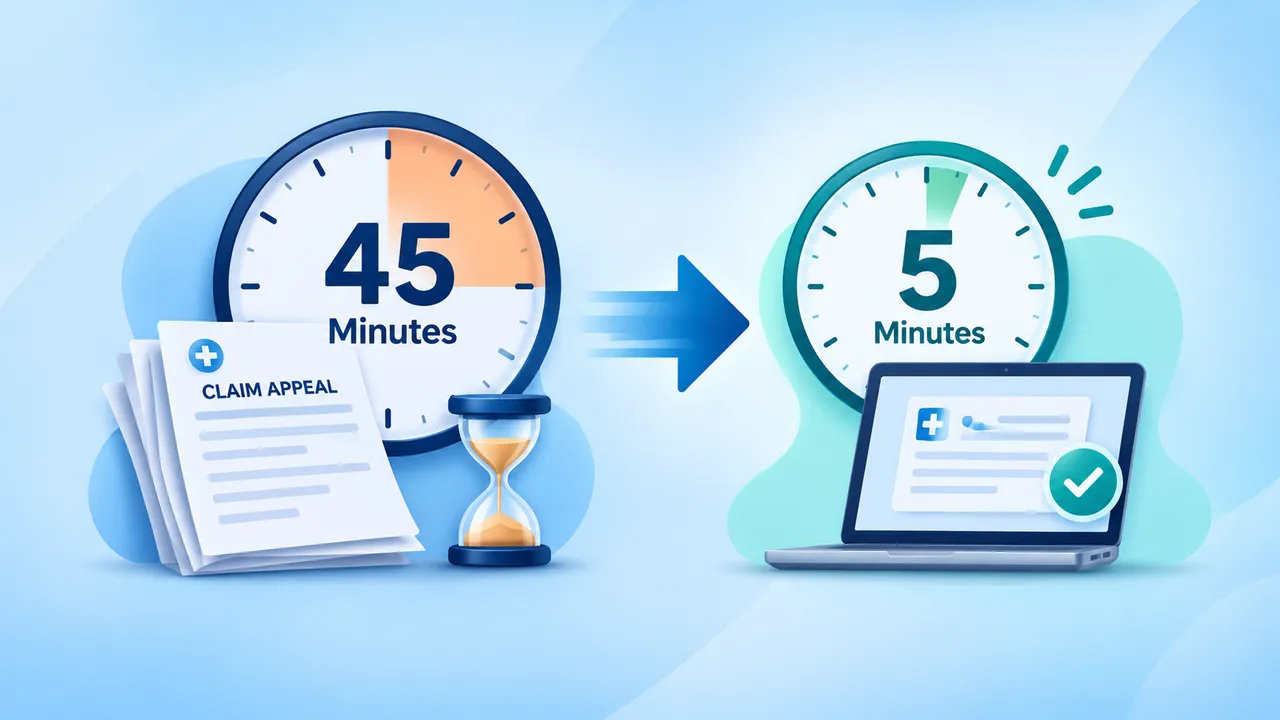
- •For suitable cases, Bill Matters can turn a 45-minute manual preparation reference into an initial draft in around five minutes.
- •That represents a 40-minute difference and an 88.9% calculated reduction in first-draft preparation, not the full appeal cycle.
- •A gastroenterologist using Bill Matters reports 3–4-minute drafts and approximately 90% less time, while retaining review and verification before submission.
- •Evaluate medical billing appeal software for RCM teams with test cases; measure reviewer time, corrections, appeals per specialist, and cost.
Can AI medical claim appeal generation tool move appeal preparation from 45 minutes of manual work to a five-minute initial draft?
In suitable cases, yes. Bill Matters can produce that first draft in around five minutes. The 45-minute figure is an illustrative manual-preparation reference, not a measured comparison against the product.
Biz4Group launched Bill Matters on September 22, 2026. It is an AI-powered healthcare denial management and appeals platform for US healthcare billing teams.
Developing Bill Matters involved examining how medical billing professionals, denial specialists and appeal managers prepare denied claims for review. That work reflects the practical questions teams must answer:
- Interpret the payer's stated reason and establish claim context.
- Find records that support the dispute and identify missing information.
- Shape the appeal argument before it reaches a reviewer.
For RCM teams, AI-assisted medical appeal drafting can shorten the work of moving from denial information to an editable first draft. 5 minutes covers draft generation only. It excludes human corrections, additional documentation, further iterations, final approval and payer submission. That distinction defines what Bill Matters can accelerate and where reviewer judgment remains essential.
Let’s open the hood.
What Actually Consumes the Time in Manual Medical Claim Appeal Preparation?
Manual medical claim appeal preparation takes time because writing the letter is only the final task. Before drafting, RCM heads and denial specialist must understand the payer's concern, establish claim level context, and locate records. The 45-minute reference covers preparation, not just typing.
1. Reviewing the Denial and Reconstructing the Claim Context
You cannot start with the appeal letter alone. Identify the disputed claim or service line, read the payer's explanation and check available remittance and billing details. What has the payer questioned, and which claim facts matter?
This manual denial research takes time when information is spread across documents. The specialist must bring the details together before deciding what the appeal should address.
2. Locating the Evidence and Checking Whether It Supports the Dispute
Finding a document does not mean it supports the appeal. Locate relevant records, check dates and details, and decide whether they address the payer's concern.
To make that distinction, separate:
- Available records: What is already in the claim file?
- Relevant evidence: What supports this dispute?
- Missing information: What does the case still need?
This check adds to medical billing appeal preparation time and keeps the argument tied to the issue.
3. Writing the Appeal and Assembling the Supporting Package
Once the facts and evidence are clear, the specialist frames the argument, connects claim details to the dispute, organizes supporting records and checks the draft before review.
| Manual stage | Work performed | Required result |
|---|---|---|
Denial review | Read payer's reason; identify issue | Clear understanding |
Case review | Reconstruct claim context | Relevant claim facts |
Evidence research | Locate and check records | Supporting evidence |
Draft preparation | Write argument; organize support | Initial appeal draft |
These stages show what the 45-minute reference covers. They do not assign measured minutes to individual tasks.
How Does AI Powered Platforms Move a Denied Claim from Uploaded Documents to an Appeal Draft?
Bill Matters turns uploaded denial documents and available case information into an editable draft for review. Your team uploads the denial notice or EOB and adds supporting records. This AI tool then drafts medical claim appeals from uploaded denial letters and EOBs but does not establish a live connection to billing systems or payer feeds. The available claim-level context shapes the draft.
1. Uploaded Denial and EOB Documents Establish the Starting Point
Start with the denial notice or EOB. It gives your team the payer's stated reason and information needed to review the disputed claim. Add relevant claim details and supporting records so the case is not assessed from the denial statement alone.
Bill Matters works from these user-uploaded documents and the information supplied for the case. This gives its denial appeal workflow automation a clear starting point without implying automatic access to billing or remittance systems.
2. Denial Interpretation Connects the Payer's Reason to the Actual Claim
A denial code alone does not explain the full issue. Bill Matters claim denial decoder interprets the denial information alongside available claim details, helping your team understand what the payer has questioned before drafting begins.
The response then addresses the disputed issue in relation to the claim, rather than treating the code as a stand-alone definition.
3. Evidence Matching Identifies Relevant Records and Missing Information
Bill Matters' billing evidence finder supports relevant document matching for claim appeals. Through denial-to-evidence mapping, it helps identify records that may address the dispute and highlights gaps before drafting.
A file can be available without supporting the appeal:
- Missing-evidence detection in medical claim appeals helps reviewers see where more documentation may be needed
- Bill Matters identifies missing supporting documents before drafting provides evidence-gap detection while leaving the reviewer to assess the records and add missing information
Also Read: What Documentation Should Be Included with a Medical Claim Appeal?
4. Case-Specific Appeal Generation Turns the Analysis into a Reviewable Draft
Bill Matters uses the denial reason, available claim details, supporting records and payer information available for the case to prepare an editable draft.
- Its AI appeal letter generator prepares evidence-backed medical claim appeals.
- Where relevant clinical and claim records are available, it supports payer-specific appeal letter generation using clinical and claim documentation
- The draft is checked against its supporting information before human review.
How do payer-specific appeal letters differ from generic appeal templates?
A generic template provides a reusable structure. A payer-specific draft addresses the payer's stated concern using the facts and records available for that claim. It gives the reviewer a case-specific starting point to validate, correct, and approve before submission.
Also Read: Why was a Health Insurance Claim Denied? 10 Common Denial Reasons Explained
What Does the 45-to-5-Minute Comparison Actually Measure?
Bill Matters can bring medical billing appeal preparation time from a 45-minute manual task to an initial draft in around 5 minutes in suitable cases. Reviewers start with a draft, not a blank page.
Manual preparation covers more than writing. A specialist reviews the denial, reconstructs claim context, locates supporting records, checks gaps and prepares the initial draft.
Now here's something you should know:
1. Bill Matters' Five-Minute Mark Is the Initial Appeal Draft
For suitable denial cases, Bill Matters prepares the initial appeal draft in around five minutes from an uploaded denial or EOB and available claim information. This is the first-draft turnaround time for AI-generated medical insurance appeals.
| Included in Bill Matters' five-minute draft | Handled after the draft is ready |
|---|---|
Uploaded denial/EOB and available claim information | Human review and corrections |
AI-assisted initial appeal drafting | Finding or requesting unprovided documents |
Draft ready for reviewer assessment | Further iterations and final approval including submission and payer adjudication |
Your team reviews the draft, makes corrections, adds records if needed, and approves submission.
2. The 45-to-5 comparison equals an 88.9% reduction
Start when the denial and available claim information are ready. Stop when the initial draft is ready for review. On those matching points:
- Manual preparation reference: 45 minutes
- Bill Matters initial draft: around 5 minutes
- Time difference: 40 minutes
- Calculated reduction: 88.9% (40 ÷ 45 × 100)
The 88.9% calculation applies to initial-draft preparation, not the full appeal process or payer decision time. This is not the baseless claim made in thin air by our team. Below we have given what our clients have to say about Bill Matters.
Customer Experience: Jorge A. Zapatier, Gastroenterologist at Altamonte Spring, Florida
I’ve been using Bill Matters to manage claim denials, and it has made my workflow much more efficient.
- The platform analyzes EOBs within minutes and helps me prepare appeal drafts in just 3-4 minutes, significantly reducing 90% of my time I previously spent on this work
- I also appreciate that I remain in control of the final appeal. I can review, edit, and verify everything before it is submitted
- The platform also helps me identify the revenue tied up in denied claims, making it easier to prioritize recovery opportunities.
Stop Letting Denied Claims Consume Your Team's Time
Give your billing specialists a better way to approach denied claims with Bill Matters while keeping valuable time available for higher-priority work
What Happens After Producing the Initial Appeal Draft?
Bill Matters gives your team an editable draft. Your reviewer checks it against the case records, makes corrections and decides whether an authorized team member can submit it.
1. The Reviewer Checks the Draft Against the Actual Case Records
- A responsible person from the medical billing team matches the draft to the correct claim and denial
- Check that its facts reflect the records, its supporting documents relate to the argument, and payer references apply, and
- Flags statements needing correction or more support
What quality checks should be applied before an AI-generated appeal is approved?
Use this checklist:
- Claim identification: Correct claim and service?
- Factual accuracy: Details match the records?
- Evidence relevance: Do the documents support the argument?
- Payer references: Do they apply to this case?
- Requested action: Is the request clear?
- Completeness: Are necessary details and records included?
2. Corrections and Additional Documents May Create Further Iterations
Your reviewer may correct a claim detail, clarify the argument or add a supporting record. Bill Matters supports a reviewer correction cycle: the revised draft is checked again. Each version needs review; the initial draft does not include this additional work.
How should teams audit payer-policy references used in AI-generated appeals?
Check the original payer source, confirm it applies to the plan and claim, and verify its version or effective date where relevant. Ensure the appeal's statement is supported by that source.
What Is the Difference Between an AI-Generated Draft and a Submission-Ready Appeal Packet?
The draft is the starting document. A submission-ready packet also needs reviewer validation, relevant records, corrections, and approval. This is appeal packet completeness while measuring reviewer active time separately across the wider draft-to-submission cycle.
Also Read: Human-in-the-Loop Requirements: Why AI Should Flag, Not Auto-Decide?
How Should RCM Teams Measure the Actual Operational Impact of Faster Appeal Drafting?
A faster first draft matters only if it reduces the work your team must complete. To evaluate Bill Matters, measure generation time separately from staff effort, revisions and submission preparation.
1. Separate System Generation Time from Reviewer Active Time
Record these measures for manual and Bill Matters-assisted cases using the same starting and ending points.
| Metric | What It Measures | What It Does Not Prove |
|---|---|---|
First-draft turnaround time | Case-ready input to initial draft | Total appeal completion time |
Reviewer active time | Minutes spent checking and editing | Total elapsed time |
Revision rounds | Number of draft changes | Final appeal accuracy |
Missing-evidence resolution | Gaps identified and subsequently addressed | Payer approval |
Draft-to-submission cycle | Preparation through approved submission | Payer adjudication time |
Appeals processed per specialist | Cases reaching a defined stage per specialist over a set period | Higher approval rates |
How Should a Billing Team Measure the Amount of Human Correction Required After AI Drafting?
Log corrections by type and impact:
- Factual corrections: Incorrect claim, service or denial details
- Substantive changes: Changes to the appeal argument or requested action
- Evidence-related corrections: Missing or unsuitable supporting records
- Stylistic edits: Changes that do not alter meaning
- Rejected drafts: Outputs that cannot be used
Track the impact of each correction, not just the number of edits.
2. Include Reviewer Labour and Operational Costs in the Cost per Appeal
Include allocated platform cost, reviewer labour, document retrieval, administrative handling, and rework. Calculate the result as follows:
Cost per approved appeal = Allocated platform cost + review labour + handling cost / Appeals approved for submission
Use appeals approved for submission as the denominator. Do not substitute payer-approved or paid appeals. Those measure subsequent outcomes.
3. Model Draft-Stage Capacity Using Your Team's Actual Appeal Volume
Assuming each suitable case achieves the full 40-minute difference, consider these scenarios:
| Suitable Appeals | Theoretical First-Draft Time Difference |
|---|---|
5 | 3 hours 20 minutes |
10 | 6 hours 40 minutes |
20 | 13 hours 20 minutes |
25 | 16 hours 40 minutes |
This is a scenario calculation, not guaranteed labour savings. Review, corrections and missing-document work still take time.
For medical practices and workers' compensation billing teams seeking to reduce manual medical appeal preparation time without adding denial specialists, these figures show the potential draft-stage capacity available. Actual impact depends on case complexity and reviewer effort.
What Should Medical Billing Teams Evaluate Before Adopting AI Medical Appeal Drafting Platform?
Before choosing a tool, test whether it improves the work your team performs. Medical claim appeal drafting platform should produce a usable draft from real case information and fit your review process.
Below is the step-by-step framework that will help doctor practices, practice owners and billing owners understand better:
1. Test Draft Quality Against Actual Denial Cases
Use a controlled sample of suitable cases your organization is authorized to share. Give the same denial notice, claim details and supporting records and
- Select representative denial cases
- Record the time to produce each initial draft
- Have a reviewer check claim identification, factual accuracy and evidence relevance
- Log missing information and substantive corrections
- Compare reviewer effort as well as generation time
This gives your team a practical way to assess AI medical claim appeal generation.
2. Check Consistency Across Client Accounts
For medical claim appeal automation for multi-client billing companies, set shared review standards while checking every case on its own merits:
- Confirm the correct client and claim before drafting
- Keep client-specific payer guidance and approved examples separate
- Apply consistent evidence and reviewer checklists
- Record corrections to identify recurring quality issues
3. Confirm the Product Fits Your Current Billing Workflow
Medical billing appeal software for RCM teams should:
- Work alongside existing billing or practice management systems.
- Highlight evidence gaps before reviewer approval.
- Leave edits, approval and submission under your team's control.
Bill Matters multi agent AI workflow focuses on denial and appeal work rather than replacing your wider RCM environment. It prepares evidence-backed drafts from available case information, reducing hours of manual work.
Conclusion: Faster Appeal Preparation Still Needs Human Review
AI medical claim appeal generation is valuable when it shortens preparation without confusing a faster draft with a completed appeal. The five-minute mark is a preparation milestone, not the finish line. With Bill Matters, AI-assisted medical appeal drafting helps RCM teams move towards a reviewable draft while preserving human responsibility.
The distinction remains clear:
- AI prepares the initial appeal draft
- The reviewer verifies and corrects its contents
- The organization measures draft time separately from reviewer effort and the full submission cycle
Ultimately, faster preparation should give your specialists a quicker starting point, not remove their control over the appeal.