
Get a summary of this article with your favorite AI
Key Highlights
- •An evidence gap analysis for medical claim appeals compares payer requirements with the documentation available for a denied claim.
- •It identifies missing, incomplete, insufficient, inconsistent or misinterpreted evidence.
- •Each evidence gap requires a targeted response, such as obtaining missing records, clarifying existing documentation or challenging the payer’s interpretation.
- •Reviewing evidence against specific denial reasons and coverage requirements helps teams avoid unnecessary document requests and repetitive appeal work.
- •A structured evidence review improves documentation accuracy, strengthens appeal support and helps RCM teams manage Workers' Compensation and other medical claim denials more consistently.
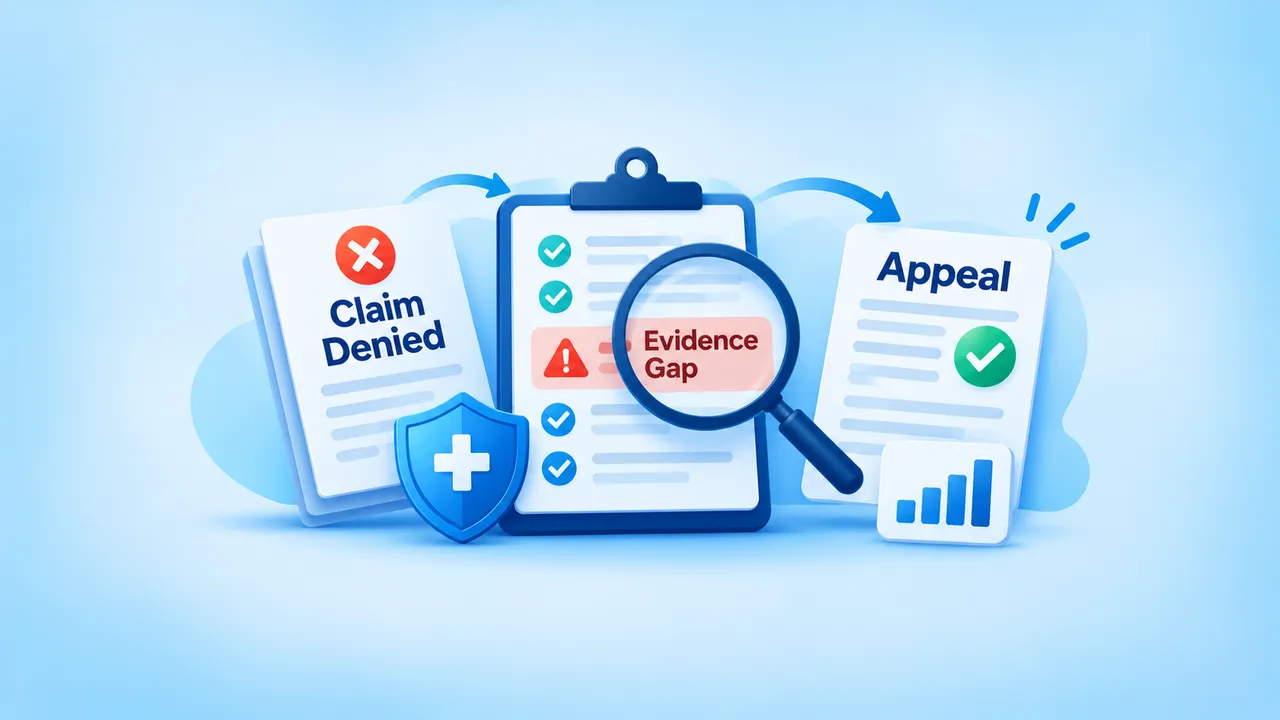
Denial specialists can compare the payer's denial reason with the documents already in the claim file to spot what's missing, what needs clarification, and whether the existing evidence is enough to challenge the denial.
And this matters because documentation issues account for a large share of payment errors. According to CMS’s FY 2026 Medicare Fee-for-Service improper payment data, insufficient documentation accounted for 54.2% of estimated improper payments, while missing documentation accounted for another 14.6%. Together, they made up 68.8% of estimated improper payments.
But does every documentation-related denial mean you need to collect more records?
Not at all. Sometimes the evidence is already there, but it doesn't clearly address the payer's concern. Other times, a key document is incomplete or missing. A closer review helps your team tell the difference and decide what to do next.
Let's look at the types of evidence gaps that can affect a medical claim appeal.
What Types of Evidence Gaps Affect Medical Claim Appeals?
Medical claim appeals can involve five common types of evidence gaps: missing, incomplete, insufficient, mismatched, and inconsistent evidence. Each points to a different problem with the documentation and helps denial specialists decide what needs attention before moving forward with an appeal.
But what exactly makes something an evidence gap? It happens when the records available for a claim fail to establish a required fact, meet a documentation requirement, or support the appeal argument. And here's the interesting part, not every gap means a document is missing. Sometimes the record is already there, but it doesn't provide the specific information the payer needs.
To see how these gaps differ in practice, let's look at the table.
| Type of evidence gap | What it means | Example |
|---|---|---|
Missing evidence | A required record is absent from the available file. | The authorization document cannot be located. |
Incomplete evidence | The record exists but lacks a necessary detail. | A clinical note describes treatment but omits a relevant clinical finding. |
Insufficient evidence | The documentation does not establish the applicable requirement. | Records are available but do not substantiate the medical necessity criterion. |
Mismatched evidence | The submitted material does not address the specific issue being disputed. | Treatment notes are submitted for a denial involving timely filing. |
Inconsistent evidence | Two or more records contain conflicting information. | The service date differs between the claim and supporting documentation. |
There is another situation worth recognizing, evidence that exists but has not been adequately recognized or connected to the disputed issue.
For example, a clinical record may contain information relevant to medical necessity, but the appeal argument does not identify the specific entry or explain how it supports the disputed criterion.
That calls for a different response from obtaining an entirely new record.
A Real CMS Example: When Medical Records Do Not Establish a Specific Requirement
The Centers for Medicare & Medicaid Services (CMS) provides an example, which involves a supplier's claim for a multi-positional patient lift, HCPCS E0636.
The supplier submitted:
- A standard written order with the correct HCPCS coding.
- The treating practitioner's medical record.
- Proof of delivery.
However, the medical record did not completely describe why the patient required supine positioning during transfers.
Although the record established the basic coverage criteria for a lift, it did not establish this additional requirement. CMS identifies this as an insufficient documentation error, resulting in Medicare Administrative Contractor recoupment.
What should a denial specialist learn from this example?
The problem was not that the supplier had submitted no medical records. The problem was that the available records did not establish a specific requirement.
That distinction matters when evaluating supporting evidence. Your team must determine what each record proves rather than simply checking whether a document exists.
Can a Medical Claim Have All Its Required Documents and Still Have an Evidence Gap?
Yes. A claim can contain all the expected document types and still lack the specific information needed to establish coverage or justify payment.
For example, a physician's note may be present, but it may not document the clinical finding required by the applicable coverage policy.
The important question is not whether the document is attached. It is whether the document establishes the fact being disputed.
How Do You Conduct an Evidence Gap Analysis for a Medical Claim Appeal?
You can conduct an evidence gap analysis by identifying the disputed requirement, reviewing the available records, comparing the information against that requirement, classifying the gap and assigning the appropriate next action.
A consistent framework helps denial specialists avoid reviewing documents without a defined purpose.
Step 1: How Do You Identify the Exact Medical Claim Requirement in Dispute?
Start with the requirement behind the denial. Avoid treating a general denial description as the complete explanation of the evidence problem.
For example, a medical necessity denial may require your team to investigate whether the records establish:
- The patient's relevant diagnosis and clinical condition.
- The specific findings supporting the service.
- Previous treatment or conservative-care history, where required.
- The clinical rationale for the treatment.
- The applicable payer coverage criteria.
Use the relevant payer policy or coverage determination to identify the actual requirement.
Step 2: Which Medical Records Should You Review During Evidence Gap Analysis?
Examine the records available for the claim. Instead of creating another general document checklist, record what each relevant source actually establishes.
| Evidence source | Information to examine | Question to answer |
|---|---|---|
Clinical notes | Findings, symptoms and treatment history | Does the record establish the disputed clinical fact? |
Physician orders | Service, treatment and ordering details | Does the order support the billed service? |
Diagnostic reports | Test findings and results | Do they establish the required clinical information? |
Authorization records | Approval details and effective dates | Does the approval cover the disputed service? |
Claim submission records | Dates and acceptance information | Do they establish timely filing? |
The purpose is to evaluate the information, not simply count the documents.
Step 3: How Do You Compare Existing Documentation Against Payer Requirements?
Now compare the payer's stated requirement with the relevant information in the claim file. This is where an evidence gap map becomes useful.
| Requirement being examined | What the record establishes | What remains unsupported | Evidence status |
|---|---|---|---|
Medical necessity | General clinical condition is documented. | A specific coverage criterion is not established. | Incomplete or insufficient |
Authorization | An authorization number is referenced. | The actual service-date coverage cannot be verified. | Missing verification |
Timely filing | Claim creation date is available. | Payer acceptance is not demonstrated. | Insufficient |
Coding accuracy | The billed code is identified. | Supporting documentation does not resolve the coding question. | Unresolved |
These are illustrative analytical categories, not actual payer determinations.
The important part is that each gap has a clear explanation.
Step 4: How Do You Determine Why Medical Claim Evidence Is Inadequate?
Once the gap is identified, ask why it exists.
It may be because:
- The relevant record was never created.
- The record exists but has not been obtained.
- The record was available but omitted from the submission.
- The document does not contain the required details.
- The information exists but has not been connected to the payer's requirement.
- The payer appears to have misunderstood or overlooked the available evidence.
This investigation prevents your team from requesting the same documents repeatedly.
Step 5: Who Should Be Responsible for Obtaining Missing Medical Claim Evidence?
Every identified evidence gap should have a next action.
For example:
| Evidence gap | Action | Responsible team |
|---|---|---|
Missing authorization record | Retrieve the original authorization. | Authorization team |
Incomplete clinical information | Request appropriate provider clarification, where supported. | Clinical documentation team |
Missing submission acceptance | Locate the clearinghouse or payer acceptance record. | Billing team |
Unclear policy requirement | Verify the applicable payer policy. | Denial specialist or policy research team |
At this stage, Bill Matters' billing evidence finder has a specific role. It checks the documents already available against the requirements associated with the denial type and payer.
For example, when a denial requires an authorization record or a particular supporting form, the evidence-detection workflow can:
- Examine the available case documentation.
- Compare the available records against the relevant denial and payer requirements.
- Identify the specific document that is missing.
- Explain why that document matters to the claim.
This gives the RCM heads and denial specialists a more focused request to send to the authorization or medical records team.
Identifying a missing document is one thing, but deciding whether the available clinical evidence is medically sufficient is another. That assessment still needs to come from the appropriate medical professional.
What If You Cannot Identify Which Supporting Document Is Missing?
Start with the specific requirement mentioned in the denial and compare it against the records already available. Avoid requesting the patient's entire medical history when only one particular record or fact remains unsupported.
A targeted investigation is usually more useful than another broad documentation request.
Stop playing hide-and-seek with claim documents.
Let Bill Matters help your team spot missing evidence and identify what each claim still needs.
How Should You Resolve Medical Claim Appeal Evidence Gaps?
Once your team identifies an evidence gap, the appropriate response depends on its underlying cause. You may need to obtain new information, clarify an existing record or demonstrate that the evidence already available supports the claim.
These are different actions, and choosing the wrong one can create unnecessary work.
When Should You Add New Medical Claim Evidence?
Additional evidence is appropriate when the necessary supporting information exists but was not included in the claim or appeal materials.
Examples include:
- An existing authorization approval that was not attached.
- A diagnostic report held by the provider but missing from the claim file.
- An existing clinical record that supports the disputed service.
- A payer acceptance record that was not included in the original submission.
Before requesting new documentation, establish whether it actually exists and whether the applicable submission rules permit its use.
When Does Existing Clinical Documentation Need Clarification?
Clarify existing records when the information is present but does not clearly demonstrate what the reviewer needs to establish.
For example, clinical notes may describe symptoms and treatment, but the documentation may not clearly explain the relationship between those findings and the specific coverage requirement.
An appropriate provider clarification may help, provided it accurately reflects the clinical record and the provider's judgment.
Your team should never:
- Add clinical findings that were not documented or supported.
- Backdate records.
- Change original documentation to manufacture medical necessity.
- Present assumptions as verified clinical facts.
A clarification must be accurate, appropriately attributed and compliant with applicable documentation requirements.
Also Read: How to Write a Medical Necessity Appeal Letter
When Should You Challenge a Payer's Interpretation of Medical Claim Evidence?
Challenge the payer's interpretation when the supporting evidence already exists but the reviewer has overlooked it, misunderstood its significance or applied the wrong coverage requirement. Before requesting additional records, check whether the original documentation supports the disputed claim and whether the payer's reasoning aligns with the applicable policy.
Your team should investigate whether:
- Relevant clinical or administrative records were submitted but not considered.
- The payer misunderstood a documented clinical finding.
- The wrong coverage criterion or policy provision was applied.
- The denial contradicts the information in the claim record.
In these situations, a focused, evidence-backed rebuttal may be more appropriate than collecting additional documents.
Should Every Denial with an Evidence Gap Become an Appeal?
No. The next step depends on whether the claim needs additional documentation, a correction or a genuine challenge to the payer's decision.
Consider a prior authorization denial, such as CARC 197.
There are several possible situations:
- Authorization was obtained but omitted from the claim: Locate the existing approval and determine whether the payer permits a correction or resubmission.
- Authorization was obtained and submitted, but the payer did not recognize it: Verify the authorization details and investigate whether a payer challenge is appropriate.
- Authorization was never obtained: Check the payer's retrospective authorization process or applicable exceptions. Do not assume another appeal can create authorization that never existed.
- Authorization details are incorrect: Investigate whether the claim requires correction or another permitted resolution.
This is where Bill Matters' AI denial agent fits into the evidence-analysis workflow.
Identifying an evidence gap tells your team what is missing. But your team also needs to decide what action should follow. Should the claim be appealed, corrected, or held until additional information is obtained?
The AI denial agent is designed to help make that distinction. It reads the denial alongside the available claim information, supporting evidence and applicable policy. It then assesses which resolution is appropriate rather than treating every denial as an appeal opportunity.
The workflow can be understood in three parts:
- Understand the denial: Identify what the payer is questioning and what the denial information means in the context of the claim.
- Assess the available evidence and requirements: Check whether the existing records support the claim, whether something is missing or whether the claim itself needs correction.
- Determine the appropriate resolution: Identify whether the case calls for an appeal, corrected claim or a request for missing documentation.
Why does this matter to a denial management team?
An analyst who identifies a missing authorization record should not automatically spend time writing an appeal. The analyst first needs to establish whether the authorization exists, whether the claim information is incorrect and whether the payer applied the requirement properly.
The AI denial agent helps organize this decision so that the team can focus its effort on the appropriate next action.
The recommendation still needs to be checked against the actual records and payer instructions by the responsible reviewer. The system does not guarantee that a claim will be paid or that an appeal will be successful.
How Can You Make Medical Claim Appeal Evidence Traceable?
Evidence is traceable when every important factual statement can be connected to a specific supporting record, date and source. This allows another reviewer to verify the information without searching through the entire claim file.
A claim may contain relevant documents and still have a weak evidence presentation if the connection between the records and the disputed facts is unclear.
How Do You Connect Each Supporting Medical Record to the Denial Reason?
An evidence-to-fact crosswalk connects the requirement being examined to the supporting information.
Consider another example involving a claim for a CPAP device.
The supplier submitted:
- A standard written order with the correct HCPCS coding.
- The treating practitioner's medical record.
- Proof of delivery.
However, the record did not contain the required sleep-test results. CMS identified this as an insufficient documentation error.
The CMS CPAP documentation example explains the relevant sleep-test requirements, including the applicable apnea-hypopnea index (AHI) or respiratory disturbance index (RDI) criteria.
The case can be represented as follows:
| Requirement | Existing record | Evidence gap | What needs verification |
|---|---|---|---|
Qualifying sleep-test information | Written order, clinical record and proof of delivery | Sleep-test results are absent. | Whether the relevant sleep-test report exists and establishes the applicable criteria. |
This example shows why an evidence review should focus on the specific fact that needs to be established.
A general physician statement cannot automatically replace objective test results when the applicable coverage criteria require them.
What Should Your Team Verify Before Relying on Supporting Evidence?
Your team should be able to answer these questions about every important statement:
- Which document supports this statement?
- What date does the document relate to?
- Where does the relevant information appear?
- Does the information establish the requirement?
- Is the document consistent with the other records?
For example, an appeal should not state that a diagnostic criterion was met simply because a related diagnosis appears in the patient's chart. The cited record must actually support the assertion.
This is where Bill Matters' AI appeal generation capability becomes relevant.
Once the denial and supporting evidence have been assessed, the system uses the claim's denial reasons, available evidence and applicable policy or rules to prepare a case-specific appeal draft.
Instead of relying on a generic appeal template, the draft is built around the actual claim information. Its factual references are connected to their underlying sources, so the reviewer can check where the information came from.
The value here is not just producing an appeal letter faster. It is helping the denial specialist move from an identified evidence gap to an argument that explains how the available supporting information addresses the disputed issue.
The reviewer must still:
- Open and verify the original records.
- Check that each factual statement is accurate.
- Confirm that the cited policy applies.
- Remove or correct any unsupported assertion.
- Approve the final argument before submission.
How Much Additional Evidence Should You Submit?
Submit the evidence necessary to establish the disputed requirement, not every record available for the patient.
A useful evidence package should make it easy to identify:
- The unresolved fact.
- The record that supports it.
- The relevant date or detail.
- Why the evidence addresses the denial reason.
This keeps the argument focused and reduces the risk of burying relevant information in unrelated documentation.
Your next appeal deserves better than a blank page.
See how Bill Matters can turn claim details, supporting evidence and payer requirements into a case-specific appeal draft your team can review.
How Can RCM Teams Standardize Medical Claim Evidence Gap Analysis?
Denial management teams can make evidence gap analysis more consistent by using the same review framework, assigning clear responsibility for missing information and recording the evidence decisions made on each claim.
This is particularly important for medical billing companies handling claims across multiple providers, specialties and payer requirements.
How Can a Medical Billing Team Reduce Repeated Requests for Missing Documentation?
A practical workflow should include:
- Claim identification: Record the denial reason and relevant claim details.
- Requirement identification: Establish the specific fact or policy requirement in dispute.
- Evidence review: Identify what the available records establish.
- Gap classification: Determine whether the issue is missing, incomplete, insufficient, mismatched or inconsistent evidence.
- Action assignment: Identify what needs to happen and who is responsible.
- Verification: Confirm that the requested evidence addresses the original issue.
- Documentation: Record the findings and supporting sources for future reference.
This creates a repeatable process without forcing every denied claim through the same checklist. For doctor practices and practice owners, it helps staff identify documentation gaps earlier, reduce avoidable payer follow-ups and prepare stronger claim appeals.
The approach is particularly useful for workers' compensation claims, where documentation requirements can differ by state and carrier. Reviewing each claim against the requirements that apply to it helps teams focus on the evidence actually needed.
Bill Matters Client Example: Identifying Missing Documentation
A Workers' Compensation billing company was handling claims across several states. It was facing recurring CARC 16 denials. Its team spent considerable time checking state and carrier requirements to identify missing DWC-25 reports, authorization records and other supporting documents.
Bill Matters multi-agent AI workflow helped identify the specific missing documents by checking available claim records against the relevant state, carrier and denial requirements.
The client reported:
- Fewer resubmission cycles, with corrected claims going out complete.
- Faster turnaround through earlier identification of missing documents.
- Revenue recovery from previously unworked claims.
- No additional staff needed to handle the workload.
Why Does Human Review Matter in AI-Assisted Medical Claim Appeals?
AI can help identify evidence gaps and prepare appeal drafts, but your team must verify that the supporting records are accurate and relevant before submission.
A final review should confirm:
- The identified evidence gap is genuine.
- The supporting document addresses the disputed requirement.
- Every factual statement is backed by the actual record.
- No unsupported clinical conclusions have been introduced.
- The final appeal accurately represents the claim.
This is also an important part of the Bill Matters customer experience. Jorge A. Zapatier, a gastroenterologist in Altamonte Springs, Florida, explains:
"I also appreciate that I remain in control of the final appeal. I can review, edit, and verify everything before it is submitted."
He also shares that preparing appeal drafts takes approximately three to four minutes with Bill Matters, reducing the time he previously spent on this work.
His experience reinforces that AI-generated appeals still need a careful human review to ensure the evidence is accurate, relevant and properly represented.
From Evidence Gaps to a More Defensible Medical Claim Appeal
A denied claim shouldn't send your team digging through the same file again and again. The real value lies in knowing what the payer needs, what the records already establish, and where the evidence falls short. That clarity helps your team avoid unnecessary document requests and build a more focused response.
As the Journal of AHIMA authors Cheryl Ericson, Rachel L. Pratt and Anny Pang Yuen note, “The accuracy of the health record will always warrant some critical thinking.” Technology can help surface relevant information, but human review remains essential to verify context and ensure the evidence is represented accurately.
For RCM teams handling high denial volumes, Bill Matters can help interpret denial details, identify missing supporting evidence and prepare source-backed appeal drafts, with reviewers retaining control of the final decision.
Because a stronger appeal isn't about sending the payer more paperwork. It's about giving them fewer reasons to say the evidence isn't there.