
Get a summary of this article with your favorite AI
Key Highlights
- •ICD-10-CM classifies diagnoses and health conditions across applicable healthcare settings.
- •ICD-10-PCS classifies procedures performed during applicable U.S. hospital inpatient stays.
- •The main difference between ICD-10-CM and ICD-10-PCS is that one reports diagnoses while the other reports inpatient hospital procedures.
- •ICD-10-PCS is not interchangeable with CPT, which is generally used to report physician services and procedures on professional claims.
- •Accurate code selection depends on the claim context, medical record, applicable coding guidelines, reporting requirements, and code-set version.
What’s new in medical coding as of October 1, 2026? The FY 2027 ICD-10-CM update added 190 new diagnosis codes, while the ICD-10-PCS update introduced 101 new procedure codes. Although both updates are part of the U.S. ICD-10 coding framework, they serve different purposes, and that distinction matters when it comes to accurate medical billing.
So, what’s the difference between ICD-10-CM vs ICD-10-PCS?
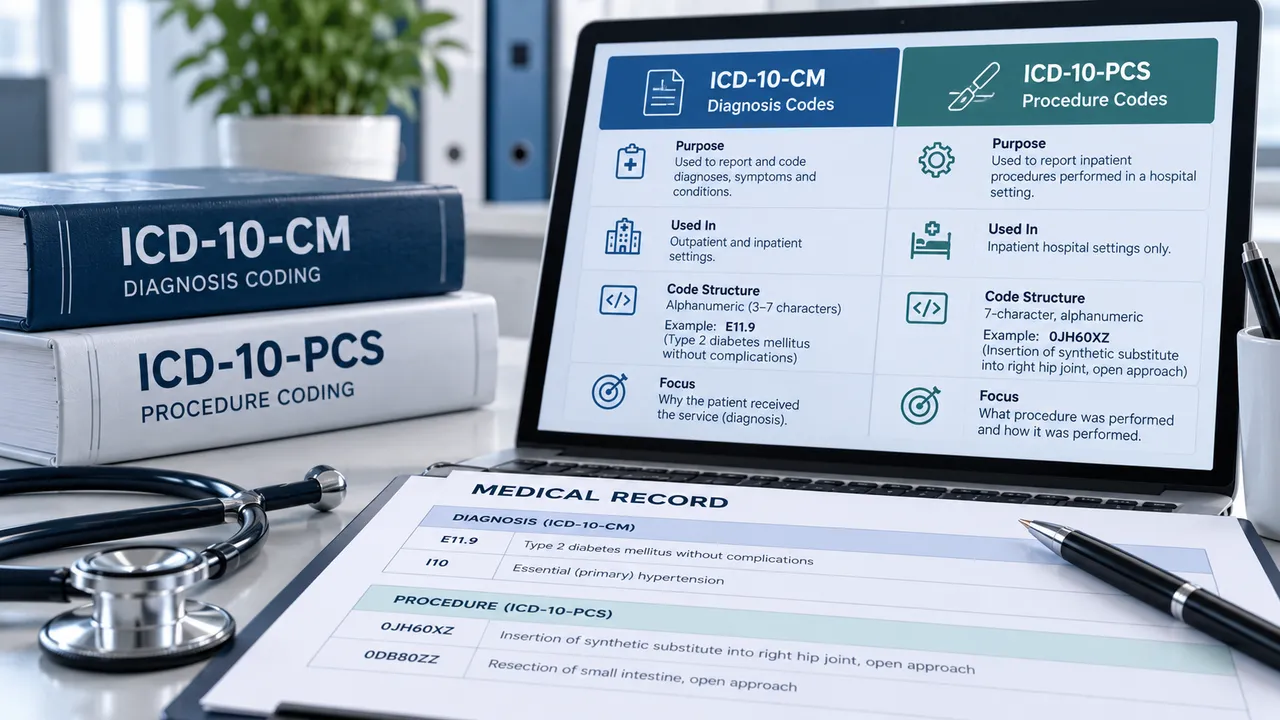
In short, ICD-10-CM is used to classify diagnoses and reasons for healthcare encounters, while ICD-10-PCS is used to report procedures performed in hospital inpatient settings. The two systems serve distinct purposes and aren’t interchangeable.
Not sure which code set to use? Choosing the right code set starts with understanding what you’re reporting, a diagnosis or a procedure performed during an inpatient hospital stay. With that in mind, let’s explore how ICD-10-CM and ICD-10-PCS differ and when to use each.
What ICD-10-CM Is Designed to Represent?
ICD-10-CM (International Classification of Diseases, Tenth Revision, Clinical Modification) is the U.S. classification system used to report diagnoses and reasons for healthcare encounters. It provides standardized codes for representing the medical conditions or clinical reasons relevant to a patient's care.
1. Diagnosis Classification in Relevant Healthcare Settings
ICD-10-CM is used across inpatient and outpatient care, including physician services, to report a patient’s diagnosis or reason for the visit, not the procedure performed.
For example, if a patient visits a doctor for persistent knee pain, the ICD-10-CM code should reflect the diagnosis or symptom documented in the medical record and supported by the applicable coding guidelines. The reported code may vary depending on the findings and the final diagnosis.
2. Why Documentation and Official Coding Guidelines Control Selection
Before reporting an ICD-10-CM diagnosis, the coding team should consider three factors:
- Provider documentation: Does the medical record support the diagnosis being reported?
- Encounter context: Is the diagnosis relevant to the encounter and the applicable reporting requirements?
- Official coding guidance: Do the classification conventions and guidelines support the code assignment?
A payer denial can flag a potential coding issue, but it doesn’t automatically tell you which diagnosis code is correct. Always review the medical record and applicable coding guidelines before making a change.
For the latest code files and official guidance, check the CDC's ICD-10-CM resources and the CMS ICD-10 coding resources.
What ICD-10-PCS Is Designed to Represent?
ICD-10-PCS (International Classification of Diseases, Tenth Revision, Procedure Coding System) is used to code procedures performed during applicable hospital inpatient stays in the United States. It helps hospitals report these procedures on inpatient facility claims, but it isn’t used for every procedure across all healthcare settings.
1. Procedure Reporting in the Applicable Inpatient Setting
ICD-10-PCS is used to report procedures on applicable inpatient hospital facility claims. However, a procedure taking place in a hospital doesn’t automatically mean ICD-10-PCS applies. The encounter setting and claim type also determine which code set to use.
When ICD-10-PCS applies, it describes the procedure performed according to the relevant coding guidelines. The diagnosis is reported separately using the appropriate ICD-10-CM code. Understanding this distinction helps ensure accurate and consistent coding.
2. Why PCS Is Not a Substitute for CPT on Professional Claims
Although ICD-10-PCS and CPT both describe procedures, they’re used for different reporting purposes. ICD-10-PCS is used to report procedures on applicable inpatient hospital facility claims, while CPT generally covers services and procedures performed by physicians and other qualified healthcare professionals on professional claims.
| Reporting context | Code set generally used |
|---|---|
Applicable inpatient hospital facility procedure reporting | ICD-10-PCS |
Physician services and procedures on professional claims | CPT, as applicable |
Outpatient procedures and services | CPT or HCPCS, as applicable |
The right code set depends on the care setting, claim type, and applicable reporting requirements.
For example, if a patient undergoes surgery during an inpatient hospital stay, the hospital reports the procedure on its facility claim using ICD-10-PCS. The surgeon, meanwhile, reports their professional services separately using the appropriate CPT code, where applicable. Both claims relate to the same episode of care, but each captures a different part of the services provided.
For more help identifying CPT and ICD coding mismatches on professional or outpatient claims, check out the CPT/ICD mismatch guide.
For official coding guidance, visit the CMS ICD-10 resources for ICD-10-PCS files and guidelines, and the American Medical Association’s CPT resources for CPT code-set information.
Also Read: CPT, ICD-10 and HCPCS Codes Explained (and Why Claims Deny)
ICD-10-CM vs ICD-10-PCS at a Glance
The key difference between ICD-10-CM and ICD-10-PCS is the information each system classifies and the reporting context in which it applies. Use the comparison below to understand their distinct purposes before determining which code set is relevant to a particular claim.
| Comparison point | ICD-10-CM | ICD-10-PCS |
|---|---|---|
Primary purpose | Standardizes diagnosis reporting. | Standardizes inpatient hospital procedure reporting. |
Information classified | Diagnoses, diseases, conditions, symptoms, and reasons for encounters, as applicable. | Procedures performed during applicable hospital inpatient stays. |
Code format | 3 to 7 alphanumeric characters. For codes with four or more characters, a decimal appears after the third character. See the FY 2027 Official ICD-10-CM Coding Guidelines. | 7 alphanumeric characters, with no decimal. Each character represents an element of the procedure classification. See the FY 2027 Official ICD-10-PCS Coding Guidelines. |
Where reported | Diagnosis reporting on applicable inpatient, outpatient, and professional claims. | Procedure reporting on applicable hospital inpatient facility claims. |
Developed and maintained by | CDC's National Center for Health Statistics (NCHS). Current code files are also available through CMS. | Centers for Medicare & Medicaid Services (CMS). See the official CMS ICD-10 resources. |
Common misconception | That it classifies the procedure performed rather than the diagnosis. | That it applies to every procedure performed in a hospital, regardless of the setting. |
Procedures on professional claims and outpatient services are reported with CPT or HCPCS, not ICD-10-PCS.
Use the Table to Identify the Relevant Code System
When comparing ICD-10-CM vs ICD-10-PCS codes, first establish what the disputed field is intended to report and the context of the claim. The table provides an initial reference, not a final coding determination.
For a specific claim, verify the reporting requirements and code-set version applicable to the encounter or discharge date. The next section explains how to identify the appropriate code-set path.
How to Identify Which Code Set Applies?
To figure out whether ICD-10-CM or ICD-10-PCS applies, start by looking at the claim type and what the field is meant to report. A code’s format tells you which system it belongs to, but not whether that system belongs on the claim.
1. Start With the Claim and Encounter Setting
First, establish where the care took place and which type of claim you are reviewing. Check two details:
- Encounter setting: Was the care provided during a hospital inpatient stay, an outpatient encounter, or another healthcare setting?
- Claim type: Is it the hospital’s facility claim or a physician’s or other qualified healthcare professional’s claim?
These details help you determine which coding rules apply. Remember, a procedure being performed in a hospital doesn’t automatically mean ICD-10-PCS is the right choice. The inpatient reporting context matters, too.
2. Identify Whether the Field Represents a Diagnosis or Procedure
Next, identify the information the disputed field is intended to report.
- Diagnosis or reason for encounter: ICD-10-CM generally applies to diagnosis reporting across healthcare settings.
- Inpatient hospital facility procedure: ICD-10-PCS applies when the procedure and reporting context fall within its scope.
- Professional or outpatient procedure or service: CPT or HCPCS may apply, depending on the service, claim type, and reporting requirements.
If the appropriate code set remains unclear, consult the official guidance and claim-specific reporting requirements for the relevant setting.
Identifying the applicable code set establishes which coding rules to consult. It does not, by itself, confirm that the individual code is correct or adequately supported by the medical record.
What Happens When the Wrong Code System or Code Is Used?
If the reported codes don’t meet the applicable requirements, the claim may need correction or further review, or it could be rejected or denied depending on the issue and payer rules. However, a coding mismatch alone doesn’t necessarily mean a denial is justified.
1. Reporting Does Not Match the Relevant Setting
A code can be valid in its own coding system but still be inappropriate for the claim where it’s reported. For example, if a claim field requires one coding system and a procedure code from another is submitted, the claim may not meet the reporting requirements, even if the code relates to the service provided.
What happens next depends on the issue. A coding mismatch may lead to:
- A request for correction: The submitted information needs to be reviewed and updated to meet the applicable requirements.
- Additional review: The payer may need more information about the service or claim.
- Rejection or denial: The claim may not be processed as submitted, depending on the applicable claim edits and payment rules.
It’s important to distinguish between these outcomes. The payer’s explanation can help you understand what went wrong, but not every procedure-related rejection or denial points to a coding-system mismatch.
2. The Code May Not Represent the Documented Information
Sometimes, the issue isn’t the code system itself but the specific code selected. Even when you’re using the right coding system, the code must accurately reflect what’s documented in the medical record.
For example, an operative report may describe a specific procedure, but the ICD-10-PCS code submitted on the hospital’s inpatient facility claim may not match those details. Choosing the correct code set is only part of the process. The individual code must also align with the documented procedure.
As ICD-10-PCS coding specialist Lynn Kuehn explains in For The Record:
“Unless you follow the logic, you can convince yourself that you've got the right answer, and you don't.”
This is why code selection should be verified against the operative documentation and the applicable official coding guidelines, rather than based on the procedure name alone.
When reviewing a coding concern, check these details:
- Medical record: Does the documentation support the selected code?
- Official coding guidelines: Do the code descriptions, instructions, and applicable guidelines support the assignment?
- Code-set version: Is the correct release being used for the reporting period?
- Payer’s explanation: Does the issue concern code accuracy, reporting requirements, or a separate coverage concern?
Once the coding concern has been checked against the medical record and applicable guidelines, a denial reason may require a separate review: what the payer is objecting to, what supporting evidence is available, and whether the next step is a correction, additional documentation, or an appeal. Platforms such as Bill Matters support this part of the process by helping teams analyze denial and claim details, identify evidence gaps, and prepare appeal drafts for review. The coding decision itself should still be evaluated against the relevant official guidance.
Code set sorted. Denial still stubborn?
Bill Matters helps you dig into the denial, spot evidence gaps, and build an appeal case.
How Structure, Specificity, Sequencing and Updates Affect ICD Coding?
Some ICD-10 questions go beyond choosing the right code set. You may also need to consider code structure, diagnosis specificity, sequencing rules, or annual updates. For more detailed guidance, refer to the specialist guide that covers your specific coding question.
1. Code Structure and Specificity
Choose the guide based on what you need to verify:
- How diagnosis codes are structured: ICD-10-CM codes follow a specific format, with each character helping identify the diagnosis. To use a code correctly, make sure it meets the requirements for a complete and valid code.
- When to use an unspecified code: If the medical record doesn’t provide enough detail for a more specific diagnosis code, an unspecified code may be appropriate, as long as the coding guidelines allow it. Using an unspecified code isn’t automatically an error or a guaranteed reason for denial.
2. Diagnosis Order and Code-Set Version
Two other common questions concern sequencing and the applicable release:
- Which diagnosis should come first? When a claim includes multiple diagnoses, the order of reporting depends on the care setting, the purpose of the encounter, and the applicable coding guidelines. The first-listed or principal diagnosis isn’t always the most serious condition. It should be selected based on the rules that apply to that specific claim.
- Which code-set version should you use? ICD-10-CM and ICD-10-PCS are updated periodically, so it’s important to check which release applies to the claim. Consider the relevant encounter date or inpatient discharge date, as applicable, and refer to the corresponding official code files and guidelines. The latest release isn’t necessarily the right one for every claim.
Where to Go Next When an ICD-10 Issue Affects a Claim?
Different coding questions require different guidance. Use the table below to find the specialist topic that best fits your coding question or reporting issue.
Select the Guide Based on the Exact Disputed Field or Rule
| Your question | Relevant guide or topic |
|---|---|
How is an ICD-10-CM diagnosis code structured? | ICD-10-CM code structure |
Is an unspecified diagnosis code appropriate? | Unspecified ICD-10 codes |
Do inpatient diagnosis and procedure reporting align? | Inpatient diagnosis/procedure discrepancies |
Which diagnosis should be reported first? | ICD-10 sequencing |
Which code-set release applies to the claim? | ICD-10 annual updates |
Does the diagnosis align with the procedure or service reported on a professional claim? | CPT/ICD-10 mismatches |
The main difference comes down to the type of claim you’re reviewing. Inpatient diagnosis and procedure discrepancies relate to hospital facility reporting, while CPT/ICD-10 mismatches involve how diagnoses align with services reported on professional claims.
The Right Code Starts With the Right Reporting Context
ICD-10-CM and ICD-10-PCS may relate to the same episode of care, but they serve different purposes. ICD-10-CM reports diagnoses, while ICD-10-PCS reports procedures on applicable inpatient hospital facility claims. Knowing what the claim needs to report helps you determine which code set applies.
It’s also important to check the code-set version. CMS updates ICD-10-CM and ICD-10-PCS separately, with specific effective dates. Make sure you’re using the release that applies to the relevant encounter or inpatient discharge date.
When reviewing a claim issue, start by checking the reporting context and applicable code-set version. Then compare the selected code with the medical record and official coding guidelines. This helps you determine whether the issue involves an incorrect code, a reporting mismatch, or a separate coverage concern.
Accurate coding means using the appropriate code set and reporting information that matches the requirements of the specific claim.