
Get a summary of this article with your favorite AI
Key Highlights
- •A Florida EOBR records the carrier’s stated reimbursement decision for each billed line; its code does not prove the decision is correct.
- •For a line-by-line EOBR review, match the notice to its claim, isolate the service line, and route unresolved issues correctly.
- •The official Florida EOBR code list distinguishes denied, disallowed, adjusted and paid decisions; each descriptor states the carrier’s reason.
- •When multiple codes appear, preserve their listed priority and keep carrier-specific explanation codes separate from official Florida codes.
- •Check carrier identification, required notice language and format rules; an Electronic EOBR needs agreement and must meet the same content requirements.
- •Bill Matters organizes EOBR and remittance documents into claim- and service-line data, while human reviewers verify uncertain information before further action.
Disclaimer: This blog is for informational purposes only and does not constitute legal, regulatory, or compliance advice.
Does a Florida EOBR tell you what the carrier decided, or whether the decision was correct?
It tells you the carrier’s reimbursement decision. The notice explains whether the carrier paid, adjusted, disallowed, or denied a billed service. It does not, by itself, confirm that the outcome was correct.
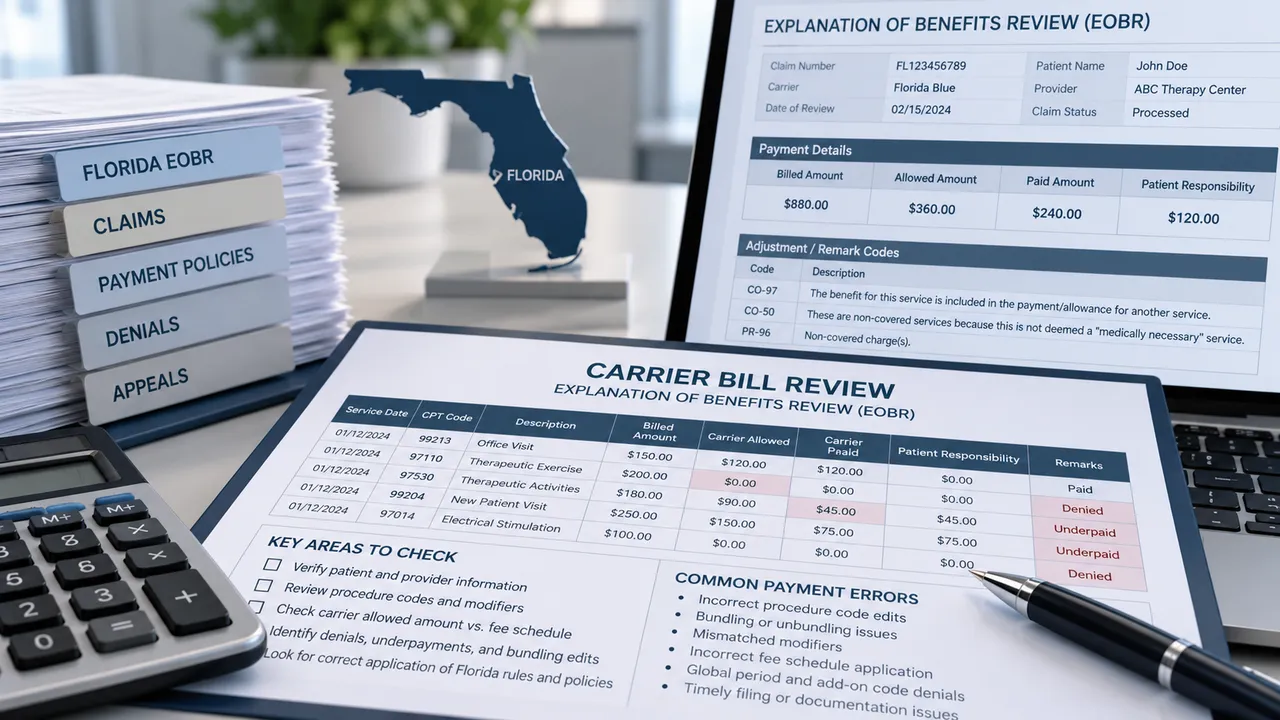
The Florida Department of Financial Services (DFS) defines an Explanation of Bill Review (EOBR) as the carrier’s written notice of its reimbursement decision. DFS requires the decision for each billed line item to be explained with the applicable EOBR code descriptors under Rule 69L-7.740. That distinction matters when a code appears beside a service, but its practical meaning is unclear.
For billing specialists and RCM managers, the task is not simply to find a code. It is to connect the official descriptor to the affected service line without treating a carrier-specific explanation as a replacement for the official code. Florida’s EOBR requirements govern that distinction.
This guide shows how to read a Florida workers’ compensation EOBR line by line, starting with what the notice says about the service in question. Once you identify the carrier’s stated reason, you can tell what the document communicates and what may need a separate review.
Let's Dive in.
How Should You Review and Read a Florida EOBR Before Challenging the Carrier’s Decision?
Review the notice by matching it to the correct claim, isolating the affected service line, capturing the official code and descriptor, and checking the carrier’s stated reason against the relevant records. This gives you a documented basis for deciding whether the decision warrants further review. It does not establish, by itself, that the carrier is wrong.
The DFS Florida requires each billed line item to have an applicable EOBR code that explains the carrier’s reimbursement decision. The requirements in Florida Administrative Code Rule 69L-7.740 provide the regulatory basis for this review.
Here is how to read a Florida workers’ compensation EOBR line by line without confusing the carrier’s explanation with your own assessment.
1. Match the EOBR to the Correct Claim and Bill
Start with claim matching. Before interpreting the carrier’s explanation, confirm that the notice relates to the bill you are investigating. A code can be interpreted correctly but still lead to the wrong follow-up if it is attached to the wrong account or claim.
Compare the identifying details available on the notice with the corresponding billing record:
- The workers’ compensation claim reference and provider account number.
- The injured worker’s identifying information, where available.
- The service date and relevant bill reference.
Resolve any mismatch before evaluating the carrier’s reason. Do not rely on a name or date alone when other identifiers are available to distinguish the claim.
2. Identify the Specific Billed Service Line
A single bill may contain several services, and the carrier’s decision can differ from one line to another. Identify the exact line associated with the explanation rather than assuming one code applies to the entire bill.
Check the original bill alongside the EOBR to establish the connection. Keep each service and its corresponding explanation together in your review record.
For an accurate comparison:
- Match the affected line using its service description and applicable procedure or supply code.
- Keep adjacent lines separate unless the notice explicitly associates the same explanation with them.
- Flag any explanation that cannot be reliably connected to a specific service line.
This step establishes which service the carrier addressed. It does not yet establish whether the reported decision was justified.
3. Capture the Official Code, Descriptor and Any Additional Explanation
Once you identify the affected line, record the code and its full EOBR code descriptor as they appear on the notice. The Florida DFS Medical Services FAQs clarify that each billed line must contain at least one authorized Florida EOBR code. Carrier-specific explanations may supplement the authorized code, but they must remain separate and distinct.
Capture the information in a consistent format:
- Official Florida EOBR codes: preserve the code and its complete descriptor exactly as displayed.
- Additional carrier explanation: record any separate internal code, remark or referenced detail without substituting it for the official descriptor.
- Reviewer note: identify any missing information or unclear wording that needs clarification.
Example: A fictional EOBR service line
The following example illustrates how to organise the information. The placeholders are not actual Florida EOBR codes or regulatory wording.
| Field | Illustrative entry | What the reviewer should do |
|---|---|---|
Claim reference | WC-EX-1042 | Match it to the billing record. |
Service line | Line 2 | Locate the corresponding line on the original bill. |
Official code and descriptor | Copy from the EOBR | Preserve the exact wording for verification. |
Additional carrier explanation | Internal remark, if present | Record it separately from the official code. |
Reviewer finding | Explanation requires verification | Identify the unresolved question without presuming the decision is wrong. |
The aim is to preserve the carrier’s explanation accurately so another reviewer can verify the same information without reconstructing the original review.
4. Separate the Carrier’s Reported Decision from Your Own Assessment
The Explanation of Bill Review records the carrier’s stated reimbursement decision. Your review should distinguish that statement from what the supporting records establish.
For each affected line, maintain two separate entries:
- Carrier’s reported decision: the outcome and explanation stated on the EOBR.
- Reviewer’s finding: whether the available information supports that explanation, leaves a question unresolved, or identifies a potential discrepancy requiring further investigation.
For example, an adjustment reported by the carrier is not automatically proof of an underpayment. Determining whether the reimbursement was correct requires checking the applicable reimbursement basis and relevant claim details.
Once you have established what the notice actually communicates, you can identify the specific code and its meaning without confusing the carrier’s stated reason with a verified conclusion.
What Do Florida Workers’ Compensation EOBR Codes Tell You About a Carrier’s Decision?
Florida workers’ compensation EOBR codes tell you the carrier’s stated reason for paying, adjusting, disallowing or denying a billed service. The code and its descriptor identify the decision recorded for that line. They do not, by themselves, establish whether the carrier applied the correct reimbursement rules.
The Florida Administrative Code Rule 69L-7.740(13)(b) contains the official codes and descriptors. The Florida DFS Medical Services FAQs explain how these codes communicate the carrier’s reimbursement decision for each billed line item.
Different codes can describe different reasons for withholding or changing payment like:
- A Denied service may involve a compensability decision, while
- disallowed service may involve documentation, authorization or a billing issue, and
- payment adjustment reports a different outcome and should not automatically be treated as a denial.
The following curated reference explains selected codes that illustrate these distinctions. The descriptions summarise their meaning in plain language. Use the official rule for the complete wording and any required qualification.
1. Codes for Denied or Disallowed Payment
These codes identify a denied or disallowed service and the reason reported by the carrier. The distinction matters because a compensability decision, an authorization issue and a documentation gap are different types of findings.
| Official code | What the code reports | What to check |
|---|---|---|
10 | Total denial based on the compensability of the injury or illness. | The carrier’s stated compensability reason. |
11 | Partial denial because the diagnosis or procedure code for the billed line is not related to the compensable condition. | The condition identified as non-compensable. |
30 | Disallowance based on the stated lack of required authorization or emergency-treatment notice. | The carrier’s specific authorization-related explanation. |
51 | Disallowance because the required DFS-F5-DWC-25 was not submitted. | Whether the EOBR identifies this documentation issue. |
62 | Disallowance for an incorrect procedure, modifier, units or supply code. | The incorrect code, which the insurer must identify. |
64 | Disallowance because the service is not reimbursable under the applicable workers’ compensation reimbursement manual. | The stated reimbursement basis. The official Florida reimbursement manuals provide the relevant reference material. |
Note: Documentation-related codes need more precise interpretation because different codes identify different gaps. Now,
What does Florida workers’ compensation EOBR code 40 mean?
Code 40 means the carrier reports that the documentation does not substantiate that the billed service was rendered. It identifies a documentation concern, not independent proof that the service did not occur. The reviewer should interpret the code in the context of the relevant service and supporting records.
The official code list under Rule 69L-7.740 should remain the reference for the complete EOBR code descriptor. Do not replace its wording with a shortened internal description when recording the carrier’s reason.
2. Codes for Adjusted Payment
Adjusted payment codes identify circumstances in which the carrier reports changing the payment rather than rejecting the service entirely.
| Official code | What the code reports | What to check |
|---|---|---|
75 | An adjustment associated with specific documentation requested in writing at the time of authorization but not submitted with the medical bill. | The insurer must specify the omitted documentation. |
81 | A payment modification resulting from a charge audit. | The adjustment reason and any available audit information. |
84 | A co-payment applied under section 440.13(13)(c), Florida Statutes. | The stated statutory basis for the co-payment. |
These codes represent different explanations for a change in payment. Code 75 concerns specified documentation, code 81 concerns a charge audit, and code 84 identifies a statutory co-payment. They should not be interpreted as interchangeable reasons.
For workers compensation billing teams, the immediate task is to preserve the reported adjustment and its explanation. Determining whether the resulting amount is correct requires a separate reimbursement review, not just a code lookup.
3. Codes for Paid Services
Paid-service codes identify the reimbursement basis reported by the carrier. The code can tell you which payment arrangement or resource the carrier says it used, but it does not independently verify the amount paid.
| Official code | What the code reports | What to check |
|---|---|---|
90 | Payment under the Florida WC Health Care Provider Reimbursement Manual, without modification to the information provided on the medical bill. | The reimbursement basis reported by the carrier. |
A paid line may instead refer to a contractual arrangement. That distinction matters because Florida’s code list identifies separate codes like EOBR code 93 for different payment bases.
When does Florida EOBR code 93 apply?
Code 93 applies when the carrier reports payment without modifying the information on the medical bill and states that payment was made under a written contractual arrangement. The network or PPO name is required. The code should not be used in place of code 85, which covers payment under a letter of agreement for a specific date of service or procedure.
The official Florida EOBR code list is the source of truth for the code’s complete descriptor and qualification.
The selected Florida EOBR code list above is intended to clarify the differences between the principal decision types, not replace the full regulatory reference.
Not only this, there is practical product-development experience behind this code reference, too. While building Bill Matters, our team compiled a working reference sheet of Florida EOBR codes and their official descriptors. That work gave us a hands-on view of the distinctions billing teams need to preserve when interpreting carrier decisions.
For the complete Florida workers’ compensation EOBR codes and descriptions, consult the current adopted rule and use its official wording when documenting or escalating a specific reimbursement decision.
Still Decoding Codes, The Hard Way?
Get a practical Florida EOBR code cheat sheet to help your team distinguish denials, disallowances, adjustments and paid-service codes
How Should You Interpret Multiple or Carrier-Specific EOBR Codes?
Interpret multiple codes by reading the official Florida codes in their listed order, then treating any additional carrier-specific explanation as supplementary information. Florida allows up to three official EOBR codes and descriptors per billed line. The carrier or its designee determines their order of importance. Internal codes cannot replace or outrank the authorized codes as per Florida Administrative Code Rule 69L-7.740.
Here's how you can interpret them:
1. Read Multiple Official Codes in Their Listed Order
A single service line can have more than one reason attached to its line-item reimbursement decision. When that happens, the order helps you identify which reason the carrier considers most important. It does not prove that the decision is correct.
How many official EOBR codes can appear on one billed line?
Up to three official EOBR codes and descriptors can appear on one billed line. Under Rule 69L-7.740(13)(a), they must be listed from the carrier’s most important reason to its least important reason, as determined by the carrier or its designee.
When documenting the decision, preserve the sequence rather than combining the codes into a single interpretation. This allows another reviewer to understand the carrier’s stated priorities.
For a consistent EOBR review workflow, record the following separately:
- Each official code and its complete descriptor, in the order displayed.
- Any additional explanation attached to the corresponding billed service.
- Any unresolved question that requires further review.
2. Keep Carrier-Specific Explanations Separate from Official Codes
Carriers may use internal codes to provide additional detail, but those codes must remain distinct from the state-authorized codes. The distinction matters because an internal label should not obscure the regulatory explanation of the carrier’s decision.
Can carrier-specific explanation codes replace official Florida EOBR codes?
No. Every billed line must contain at least one authorised Official EOBR code. The authorised codes must take precedence over internal codes, which may be included separately and distinctly. DFS confirms this requirement in its EOBR guidance.
For example, a fictional notice might show:
- Official Florida EOBR code: The authorized code and its official descriptor.
- Carrier-specific explanation: An internal reference and a supplementary note explaining the carrier’s processing context.
The reviewer should preserve both fields without treating the internal explanation as a substitute for the official descriptor. This keeps the carrier-specific EOBR codes distinct from the official Florida EOBR codes and creates a clearer audit trail for subsequent review. Now,
How to interpret multiple EOBR codes on one billed line in Florida?
Retain the official codes in their listed order, distinguish supplementary explanations, and avoid assuming that the code sequence alone establishes whether the reimbursement decision was correct. With that now let's move ahead to next section.
What Information Must a Florida Workers’ Compensation EOBR Include?
A Florida workers’ compensation EOBR must identify the actual carrier, contain the required notice statement under Florida Statutes § 440.13(7), and include designated service-recipient details when applicable. Its title and layout may vary, and electronic delivery is permitted by agreement if the notice meets the same requirements.
The Florida DFS explains these requirements under Florida Administrative Code Rule 69L-7.740. Knowing which details are mandatory helps you distinguish a permitted format variation from a potential compliance concern.
1. Carrier Identification and Claim Administrator Details
Carrier identification must remain clear even when a third party processes the medical bill or communicates the reimbursement decision.
What information about the carrier must appear on an EOBR?
The EOBR must identify the actual workers’ compensation carrier by its name, mailing address, and Division-issued carrier number. A claim administrator’s details cannot replace this required carrier information, according to the DFS Medical Services FAQs.
Two additional details help prevent confusion when reviewing the notice:
- The Division prefers identifying information for the injured employee on the EOBR, but the employer’s name and address are not required.
- If the carrier designates a claim administrator to receive service of a reimbursement-dispute petition on its behalf and for the affected parties, the administrator’s name and mailing address must also appear.
These distinctions form part of the Florida EOBR requirements for carrier identification and notice language. The carrier’s identity remains mandatory even when another organization handles claim administration.
2. Required Notice Language and Designated Service Recipient
The EOBR must state that it constitutes a notice of disallowance or adjustment of payment under Florida Statutes § 440.13(7). DFS confirms that the statement is required, although the carrier may choose where to place it on the document.
The notice must also identify the entity designated to receive service of a copy of a reimbursement-dispute petition, where applicable. This information helps the provider identify the relevant recipient without confusing the carrier’s identity with the designated service recipient.
3. Document Title, Layout and Electronic Delivery
Florida allows flexibility in how a carrier presents its EOBR. The Florida EOBR format requirements focus on compliance with the rule, not on enforcing one universal page design.
Three common questions clarify that distinction.
1. Does a Florida EOBR have to be titled “Explanation of Bill Review”?
No. DFS prefers this title, but it is not mandatory. A differently titled document may qualify if it meets Rule 69L-7.740, conveys the carrier’s disposition decision, and is presented as the EOBR.
2. Can a carrier choose its own EOBR layout?
Yes. The Division does not prescribe one standard visual format. The carrier may choose its layout as long as the document satisfies the applicable requirements.
3. Can a Florida workers’ compensation EOBR be sent electronically?
Yes. An Electronic Florida EOBR is acceptable when the parties agree that the electronic format will serve as the EOBR. It must contain the same required elements as a compliant paper notice and be capable of legible reproduction upon request.
These answers follow the official DFS EOBR guidance. The key distinction is that the carrier may choose the document’s presentation, but it cannot omit required information simply because its system uses a different layout or electronic format.
What Should You Do When an EOBR Explanation Is Unclear?
When an EOBR explanation is unclear, isolate the affected service line, check the official code descriptor and any required supporting detail, then identify what remains unresolved. An unclear explanation alone does not establish that the carrier made an error. The goal is to identify a specific question that the available records can answer, or that requires clarification.
Here exactly what you should do starting with:
1. The Affected Service Line and Unresolved Explanation
Start with the specific line that prompted the question. A healthcare provider or medical billing specialist should be able to identify the carrier’s stated reason and explain exactly what remains unclear.
Keep the following details together in the review record:
- The affected service and date of service.
- The official code and its complete descriptor.
- The exact wording of any additional explanation that appears inconsistent or incomplete.
This creates a clear record of the issue without rewriting the carrier’s explanation or mixing it with the reviewer’s conclusion.
2. Required Detail Missing From the EOBR
Some descriptors require a specific explanation or additional detail. For example, the rule requires insurers to identify omitted documentation for certain documentation-related codes and the incorrect code for specified billing errors. Check the applicable descriptor before deciding whether information is missing.
The distinction matters when a notice contains an EOBR notice of adjustment or an EOBR notice of disallowance. A code may identify the general reason, while the accompanying explanation provides a required qualification.
Use the Official Florida EOBR code list under Rule 69L-7.740 to verify the wording and any applicable specification. Record the missing detail as an unresolved question. Do not treat its absence as automatic proof that the carrier’s entire decision is invalid.
3. The Appropriate Workflow for the Unresolved Issue
Once you establish what remains unclear, identify the process that fits the problem. This keeps medical billing documentation issues separate from authorization questions and payment-verification work.
Use the relevant companion resource when the unresolved issue belongs to a different workflow:
- Missing DWC-25 documentation: Verify whether the required DWC-25 was submitted and whether the issue involves missing, incomplete or mismatched reporting.
- Treatment authorization or utilization review: Confirm whether the carrier’s explanation concerns authorization or utilization review, then check the applicable request and response records.
- Payment amount or possible underpayment: Compare the reported payment basis with the applicable reimbursement manual or written contract before treating the difference as an underpayment.
- Missing carrier response or dispute procedure: Confirm whether the carrier issued an EOBR or other required response, then check the relevant deadline and dispute pathway.
When the review identifies a potentially challengeable denial, the next question is which resolution the available evidence supports. Well, Bill Matters can help you with that.
The multi agent AI workflow of this AI platform assesses the denial against relevant policy and claim evidence, helping distinguish a case for appeal from one that needs a corrected claim or missing documentation. This supports the recovery workflow without replacing Florida’s applicable dispute procedures.
The purpose of this handoff is to establish what needs investigation, not to presume the outcome. Keep the original notice linked to the reviewer’s finding so the next person can verify the issue. Appropriate human review remains necessary when the explanation is ambiguous, or the available evidence does not support a clear conclusion.
Also Read: Florida Workers' Compensation Medical Billing: Denials, Disputes and Deadlines
How Can Billing Teams Standardize EOBR Review Across Carriers?
Billing teams can standardize EOBR review by using one record structure across carriers, preserving each original notice, and applying consistent checks before accepting extracted information. This creates a repeatable process without forcing every carrier’s document into the same visual layout or treating automated extraction as proof that a reimbursement decision is correct.
A consistent carrier explanation of bill review record also helps RCM heads and denial specialists compare how decisions are documented across claims. The aim is to standardize the team’s handling of information, not to reinterpret the carrier’s codes or repeat the reimbursement calculation.
Take a look at what helps you:
1. A Standard EOBR Review Record
Different carriers may present their notices differently. Your team should capture the same core fields from each document so reviewers can locate the relevant claim, service line and decision without learning a new review process for every carrier.
Use a shared record with clearly defined fields:
- Claim reference: the internal claim identifier and bill reference used to match the notice.
- Service-line details: the affected line, date of service and relevant procedure or supply code.
- Carrier’s explanation: the official code and descriptor, plus any distinct carrier-specific explanation.
- Reported outcome: payment, adjustment, disallowance or denial, with the associated amount where available.
- Review status: whether the information is complete, requires clarification, or has been verified by a reviewer.
Keep payment information in the record without turning this process into a fee-schedule calculation. For example, an EOBR notice of adjustment should retain the carrier’s reported outcome and explanation. Whether the adjusted amount is correct is a separate question.
2. Source Document Link and Audit Trail
Structured information is useful only when the team can trace it to the notice it came from. Keep the original EOBR connected to its extracted record so another reviewer can verify the source rather than relying on a summary or manually re-entering the information.
As an internal control, preserve the details needed to reconstruct the review:
- The original document and its unique reference.
- The relevant page and service line, where applicable.
- Any correction to extracted information, with the reason for the change.
- The reviewer’s findings and any unresolved issue requiring follow-up.
This creates an audit trail of how the information was captured and reviewed. It is an operational safeguard, not a claim that Florida’s rule prescribes this exact internal record format.
3. Structured Data Extraction and Human Review
Structured data extraction can reduce repetitive data entry when a team handles large volumes of EOBRs. Document processing tools can capture identifiers, service lines, dates, codes, and payment information, then organise the results into consistent fields.
The value comes from reducing manual handling while retaining the ability to check uncertain information. A document-processing system should flag records that need attention rather than silently treating every extracted value as correct.
A practical division of work looks like this:
- Suitable for automation: extracting available claim identifiers, service-line details, codes, descriptors, dates and payment or adjustment amounts from EOBR, Electronic remittance advice (ERA) and 835 files.
- Requiring verification when uncertain: unreadable text, unmatched service lines, conflicting fields, unclear carrier remarks or information that cannot be confidently extracted.
- Retained for human review: interpreting ambiguous explanations and deciding whether the available evidence supports further investigation.
For teams processing EOBRs across multiple carriers, manually entering claim details, service-line information and payment data can add repetitive work. Structured data extraction supported by an AI tool like Bill matters can reduce that manual effort while keeping the source document available for verification.
Bill Matters processes uploaded EOB, ERA, EOBR and other 835 remittance files into structured claim-level and service-line data. It extracts payment amounts, adjustment codes and key dates. If a field, such as a code, amount or date, cannot be extracted reliably, the information is flagged for review rather than treated as confirmed.
This helps billing teams organise carrier information consistently while retaining human review for details that need verification. The extracted data supports the review process; it does not independently establish whether the carrier’s reimbursement decision was correct.
Still Making Your Team Play Document Detective?
Give repetitive EOBR handling less room on your team’s schedule with Bill Matters and make more time for the cases that need expert attention
What to Take Away from a Florida EOBR Review
A Florida EOBR is most useful when the carrier’s explanation is understood in the context of the specific service and supporting records. The official descriptor tells you why the carrier reports a particular reimbursement decision. It does not, by itself, establish whether that decision is correct.
When workers' compensation EOBR interpretation becomes part of a wider revenue-recovery workload billing, teams need to connect payer explanations with the information needed to review each case. Bill Matters supports this work by helping teams bring claim information, payer responses and supporting evidence together for review.
The goal is not simply to record what the carrier decided. It is to distinguish the reported reason from what the available evidence supports, so your team can make a more informed decision about what needs attention.
Works Cited (information last verified October 22, 2026)
Florida Department of Financial Services, Division of Workers’ Compensation. Florida Workers’ Compensation Health Care Provider Reimbursement Manual. 2024 ed., Rule 69L-7.020, Florida Department of Financial Services, 1 Jan. 2025, https://myfloridacfo.com/docs-sf/workers-compensation-libraries/workers-comp-documents/manuals/health-care-provider/2024-hcp-rm-rule-69l-7-020-final-eff-01-01-25.pdf.
Florida Department of Financial Services, Division of Workers’ Compensation. “Insurer Authorization and Medical Bill Review Responsibilities.” Florida Administrative Code, rule 69L-7.740, effective 2 Sept. 2026, https://flrules.org/gateway/ruleno.asp?id=69L-7.740
Florida Department of Financial Services. “Medical Services FAQs.” Workers’ Compensation, https://www.myfloridacfo.com/division/wc/provider/faq
Florida Department of Financial Services. “Reimbursement Manuals and Fee Schedules.” Workers’ Compensation, https://www.myfloridacfo.com/division/wc/manuals