
Get a summary of this article with your favorite AI
Key Highlights
- •Use an unlisted CPT code only when no listed Category I or Category III code accurately describes the service, following current CPT guidance.
- •To support reimbursement, explain the procedure, justify the code selection, and connect the rationale to the documented service.
- •Relevant supporting documentation may include operative reports, procedure notes, clinical records, and comparable procedure information when appropriate and permitted by the payer.
- •To challenge a denial, address the payer’s specific reason and provide evidence that resolves the disputed issue.
- •Payer-specific policies determine documentation requirements, authorization procedures, submission methods, and appeal deadlines. Strong documentation supports claim evaluation but does not guarantee payment.
Ever had a medical claim denied and felt like you were solving a medical billing mystery?
One minute, you’re reviewing clinical notes; the next, you’re digging through coding guidelines and payer policies, trying to explain why an unlisted CPT code is the right fit. Sound familiar?
Here’s the tricky part, unlisted CPT codes may not have an established payment amount, so additional documentation may be needed to help the payer evaluate the service and determine reimbursement. The Centers for Medicare & Medicaid Services (CMS) identifies certain services as contractor-priced, meaning payment is determined through the applicable pricing process. But pricing rules vary by service and payer, so this approach shouldn’t be assumed for every unlisted CPT code.
So, how do you build a stronger case when an unlisted CPT code is denied?
Think of it as building your evidence file. Explain why no existing code accurately describes the service, document the work performed, include relevant supporting records, and address the payer’s denial reason directly.
Let’s break down how to strengthen your appeal with clear, relevant evidence, without making assumptions about reimbursement.
When Should You Use an Unlisted CPT Code?
An unlisted CPT code is appropriate when no existing CPT code accurately describes the service performed. Before choosing one, review the full code descriptions and guidelines in the current CPT code set rather than relying on titles or keyword searches.
Also, check whether a Category III code applies. According to the AMA, when an appropriate Category III code is available, it must be reported instead of a Category I unlisted code.
Remember: A procedure being unfamiliar, complex, or time-consuming doesn’t automatically make an unlisted code the right choice.
Establish That Listed Options Do Not Fit the Documented Service
Before selecting an unlisted CPT code, compare the service performed with the relevant listed codes. Review the complete descriptors and applicable coding instructions rather than relying on a code’s title or a quick keyword search alone.
Ask yourself:
- Does a listed code describe the actual service? Compare the procedure performed with the full descriptor and its associated guidelines.
- Does another applicable coding option fit? Review related codes and reporting instructions before concluding that an unlisted code is necessary.
- Is the difference in the service itself? A procedure being more complex, taking longer, or involving an unfamiliar technique does not automatically justify an unlisted code.
Example: A Different Technique Doesn’t Always Mean an Unlisted Code
Imagine a provider uses a technique your billing team hasn’t encountered before. Does that automatically mean you need an unlisted CPT code? Not necessarily.
- Check the available codes first: Compare the documented procedure with relevant CPT code descriptions and reporting instructions.
- Use a listed code when it fits: If an existing code accurately describes the service and meets the applicable guidelines, a different technique alone isn’t a reason to use an unlisted code.
- Use an unlisted code when needed: If no listed code accurately describes the service, follow the applicable coding guidance for reporting it.
The key is to explain what makes the service different from the available codes. Simply calling a procedure new or complex isn’t enough to justify an unlisted code.
Also Read: Confused by CPT Code Categories? Avoid Coding Mistakes That Disrupt Medical Billing
How to Justify an Unlisted CPT Code for Reimbursement?
To support reimbursement for an unlisted CPT code, explain what the provider performed, why the code was appropriate, and what evidence supports the claim. The payer needs enough detail to evaluate the service under its applicable coverage and pricing rules.
Build your reimbursement case around three elements:
- Service description: Describe the procedure, its purpose, scope, and work involved using details supported by the medical record.
- Coding rationale: Explain why the available coding options did not accurately represent the service. Be specific rather than simply stating that no suitable code exists.
- Supporting evidence: Include the clinical records and other documentation relevant to the service, following the payer’s submission requirements.
Build Your Rationale Around the Service
Your reimbursement rationale should make it easy for the payer to understand what the provider did and why the unlisted CPT code fits. Here’s what to cover:
- Describe the service: Stick to the facts in the medical record, including the work performed.
- Explain why the code fits: Show why existing CPT codes don’t accurately describe the service, using relevant coding guidelines.
- Compare procedures when appropriate: If the payer requests a comparison, highlight the similarities and differences without assuming it determines reimbursement.
- Follow the payer’s requirements: Include the records and level of detail required for that specific service and claim.
Use the documentation checklist in the next section to make sure you’ve included the supporting evidence the payer needs.
What Documentation Is Needed for an Unlisted CPT Code?
The documentation needed for an unlisted CPT code depends on the service performed and the payer’s requirements. Prepare records that describe the procedure in enough detail for the payer to evaluate the service and, where applicable, determine its value.
1. Prepare Your Supporting Documentation
Before submitting the claim, gather the documents the payer needs to understand and evaluate the service. Use this checklist to keep everything organized:
- Procedure description: Include the operative report or procedure note explaining what the provider did.
- Relevant clinical records: Add notes that support the service and provide the necessary clinical context.
- Work and complexity: Document the procedure’s scope, time, effort, complexity, or resources when relevant and available.
- Coding rationale: Explain why the unlisted CPT code fits and why existing codes don’t accurately describe the service.
- Comparable procedure: If relevant or requested, include a supported comparison highlighting key similarities and differences.
- Additional requirements: Attach any payer-specific forms, narratives, or records required for the claim.
Keep it relevant and consistent. Make sure every detail matches the medical record and addresses the payer’s requirements. More paperwork doesn’t necessarily mean a stronger claim; the right supporting evidence does.
Also Read: CPT, ICD-10 and HCPCS Codes Explained (and Why Claims Deny)
2. Follow Payer-Specific Submission Requirements
Before submitting the claim, check the payer’s current policy, provider manual, or claim instructions to confirm:
| Requirement | What to verify |
|---|---|
Documentation | Which reports, clinical records, and supporting materials are required |
Forms and attachments | Whether a specific form, narrative, or additional attachment is needed |
Submission method | Where and how the claim and supporting records must be submitted |
Comparable procedure details | Whether a comparison is requested and what information it must include |
Filing deadlines | The applicable initial claim or supporting-document submission deadline |
3. Turn Payer Requirements Into a Pre-Submission Check
Before submitting an unlisted-code claim or responding to a denial, verify the requirements that apply to the specific service and claim stage.
- Documentation: Confirm whether the payer requires an operative report, procedure narrative, clinical records, or other supporting material.
- Code reporting: Check the applicable code instructions and any payer-specific requirements for reporting the service.
- Pricing support: Determine whether the payer requests information about a comparable procedure or other details to evaluate the service.
- Submission route: Confirm whether the information belongs with the original claim, a documentation response, a corrected claim, or an appeal.
- Deadline: Verify the filing or response deadline that applies to the action being taken.
Record the applicable requirements and confirm that the submission addresses them before sending the claim. Requirements differ by payer, service, and claim stage, so use the governing instructions rather than a universal checklist.
Submission requirements vary by payer, so check the rules before sending your claim.
- Medicare claims: Review the relevant CMS guidance and Medicare contractor instructions for the service and setting.
- Commercial claims: Check the payer’s latest provider manual, reimbursement policy, and appeal guidelines.
- Before submitting: Confirm which documents you need, how to submit them, and the applicable deadline.
How to Appeal a Denied Unlisted CPT Code?
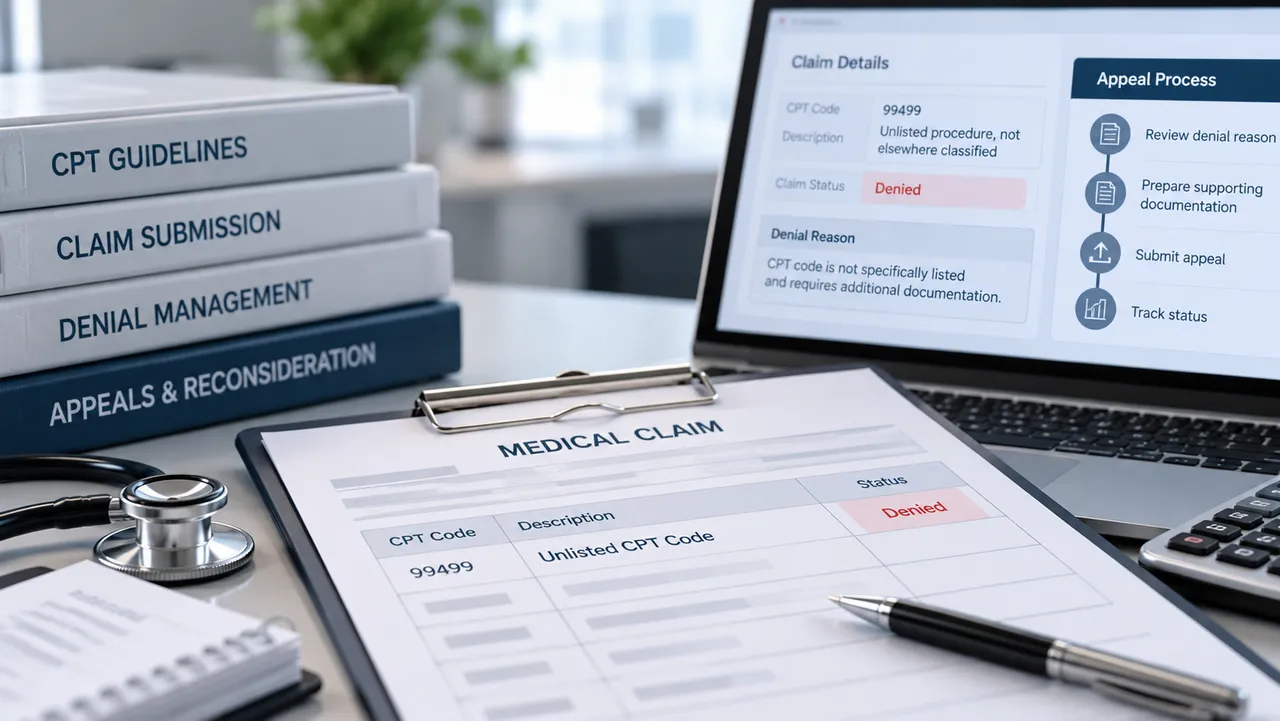
To appeal a denied unlisted CPT code, identify the payer’s stated reason for denial, respond to the specific issue, and connect your response to evidence that supports reconsideration. The appeal should resolve the payer’s concern rather than repeat the original claim narrative.
When an unlisted CPT code is denied, the challenge is often explaining the service clearly enough for the payer to reconsider its decision. Instead of starting an appeal from scratch, medical billing companies can use Bill Matters to work through the denial details and build an appeal draft around the issues that need to be addressed. The focus then shifts to refining that response with the procedure documentation, coding rationale, and payer-specific requirements needed to support the case.
1. State the Disputed Determination and Code Rationale
Start with the denial notice or remittance advice. Identify what the payer disputed and tailor your argument to that finding.
| Payer’s concern | How to address it | Evidence to attach |
|---|---|---|
Insufficient information | Identify the missing details and explain where the supporting information appears in the record. | The specific record or detail requested, with the page referenced |
Question about code selection | Explain why the reported code fits the documented service, using relevant coding guidance. | The description of the service and the CPT guidance relied on |
Reimbursement or pricing dispute | Address the payer’s stated pricing concern and the applicable reimbursement policy. | A comparable procedure analysis where the payer permits it, plus the policy or contract section cited |
Missing authorization or another requirement | Establish whether the requirement applied and provide relevant supporting records, if available. | The authorization, referral or claim form that addresses it |
Keep the argument factual. Distinguish a disagreement about coding from a coverage, authorization, documentation, or pricing issue, since each requires a different response.
2. Attach Evidence That Resolves the Payer Question
Select appeal attachments based on the denial reasons, not simply on the volume of records available.
- For a documentation dispute, provide the specific record or missing detail requested by the payer.
- For a coding dispute, include the relevant reporting guidance and explain how it applies to the service in question.
- For a pricing dispute, provide a comparable procedure analysis if the payer permits it. Explain relevant differences in scope, work, time, or resources where supported by the record.
- For an authorization or administrative dispute, include the relevant authorization, referral, claim form, or other record that addresses the issue.
Reference the relevant page or passage in each attachment so the reviewer can find the evidence quickly. Follow the payer’s appeal instructions for required documents, submission method, and deadline.
A focused appeal gives the reviewer a clear path from the denial reason to the evidence and the requested reconsideration. It supports review of the claim but does not guarantee payment.
Turn a denial into a stronger case.
Explore how Bill Matters can help your team organize denial details and prepare an appeal draft for review.
Should You Correct the Claim, Request Prior Authorization, or Appeal?
The correct action depends on the claim’s current stage and the issue that needs to be resolved. Prior authorization comes into play before the service, a corrected claim fixes billing errors, and an appeal challenges the payer’s decision after the claim has been processed.
When dealing with an unlisted CPT code denial, the next step depends on what went wrong. Was information submitted incorrectly, does the payer need additional documentation, or is the payment decision worth challenging? Bill Matters helps billing teams assess the denial reason alongside claim details, applicable policies, and available evidence to identify the appropriate resolution path. This helps keep the response focused on the actual issue, whether that means correcting the claim, providing missing information, or pursuing an appeal when the evidence supports it.
Determine Where the Claim Is in the Lifecycle
| Claim status | Next step |
|---|---|
Service has not yet been performed, and authorization is required | Request prior authorization through the payer’s process. |
Claim has not been submitted | Prepare and submit the original claim. |
Submitted claim contains an error | Determine whether a corrected claim is appropriate. |
Claim has been denied or underpaid | Check whether reconsideration or a formal appeal is the appropriate route. |
Payer requests additional information | Follow the instructions for responding to the request. |
A corrected claim and an appeal serve different purposes. Correct a claim when its submitted information needs fixing. When challenging a denial or payment decision, follow the applicable dispute process.
Check the Governing Payer Process
Before submitting anything, confirm three things:
- Required process: Does the payer require a corrected claim, reconsideration, or formal appeal for this issue?
- Submission channel: Where and how must the claim correction or dispute be submitted?
- Filing deadline: What deadline applies to this specific action?
Check the payer’s provider manual, claim instructions, or denial notice for these details. Medicare and commercial payers have different procedures, so verify the rules that apply to the claim rather than relying on a general timeline.
Not sure what your next move should be?
See how Bill Matters can help your team work through denial details and prepare for the appropriate next step.
Common Mistakes That Lead to Unlisted CPT Code Payment Disputes
Small gaps in an unlisted-code claim can create bigger problems during payer review. Four common mistakes can leave the service unclear, the coding decision unsupported, or the claim incomplete.
| Common mistake | Why it can weaken the claim |
|---|---|
Providing an insufficient service description | Leaves the payer unclear about what the provider performed and can prompt requests for additional information. |
Failing to explain the unlisted-code selection | Leaves the coding decision unsupported and raises questions about whether the code appropriately represents the service. |
Using unsupported comparisons with other procedures | Makes it harder to evaluate the service’s relative work or value when the comparison lacks evidence or overlooks important differences. |
Category III check | Confirmation that no Category I or Category III code accurately describes the service |
Ignoring payer-specific requirements | Missing forms, attachments, or submission instructions can delay processing or prevent the payer from completing its review. |
Review these four areas before submitting an unlisted-code claim. Clear documentation, a supported coding rationale, relevant comparisons, and compliance with payer instructions help reduce preventable gaps that can complicate claim review.
A Reusable Unlisted-Code Evidence Checklist
Use this checklist before submitting an unlisted CPT code claim or appealing a denial to confirm that the essential information and supporting evidence are in place.
| Check | What to have ready |
|---|---|
Service details | A precise description of the procedure performed, its key components, scope, and relevant work involved. |
Coding rationale | An explanation of why the selected code is appropriate and why no listed option adequately describes the service. |
Coding guidance | The relevant CPT instructions and other applicable coding guidance for the date of service. |
Supporting records | The operative report, procedure notes, clinical records, or other documents relevant to the service and claim. |
Comparable procedure information | A supported comparison of relevant work or value, when appropriate and permitted by the payer. |
Payer requirements | Verified documentation requirements, forms, attachments, submission method, and applicable filing deadline. |
Denial response, if applicable | The payer’s stated reason for denial, a direct response to the disputed issue, and evidence addressing that issue. |
Not every claim requires every item. Use the checklist alongside the applicable payer instructions and tailor the evidence to the service and the stage of the claim.
Build a Stronger Case for Unlisted CPT Code Reimbursement
To justify reimbursement for an unlisted CPT code, explain why no existing code fits and support your claim with clear documentation. You need to show the payer what service was performed, why an existing code doesn’t accurately describe it, and how the documentation supports your claim. As AAPC explains in Unlisted but Not Unpaid, a clear procedure description and relevant supporting information are key to the reimbursement process.
For Medicare claims, check the applicable CMS guidance for the specific service and payment setting. For other payers, review their individual billing and reimbursement policies before submitting the claim.
If the payer questions the claim, address the exact reason for the denial with clinical documentation, a clear coding rationale, and any additional information requested. The goal is to make it easy for the payer to understand what was done, why the unlisted code applies, and how the claim should be evaluated.