
Get a summary of this article with your favorite AI
Key Highlights
- •CPT, ICD-10-CM, ICD-10-PCS, and HCPCS Level II serve different purposes in healthcare billing, from reporting services and diagnoses to classifying inpatient procedures and identifying certain products and supplies.
- •Correct coding does not guarantee claim payment. Documentation, medical necessity, coverage, authorization, and payer-specific requirements can also affect claim adjudication.
- •Coding-related denials can have multiple causes, including code and documentation mismatches, diagnosis-service relationships, modifier errors, code-pair edits, unit limits, and outdated coding or policy guidance.
- •Denial codes are diagnostic clues, not proof of coding errors. Billers should review the complete payer explanation, affected claim details, medical record, and applicable rules before choosing a corrective action.
- •Reducing repeat denials requires consistent pre-bill checks and verified root-cause tracking. Bill Matters helps billing teams analyze denials, identify relevant supporting evidence, and prepare appeals for review.
Why can a claim be denied even when the service was performed and the documentation is complete? The answer may lie in how the diagnosis, procedure, or product was coded, or in how the claim meets payer requirements.
A February 2026 report from the Massachusetts Health Policy Commission found that 80% of denied professional medical and surgical claims were denied for administrative reasons, including coding errors and incomplete claims. The findings show why identifying the specific cause matters.
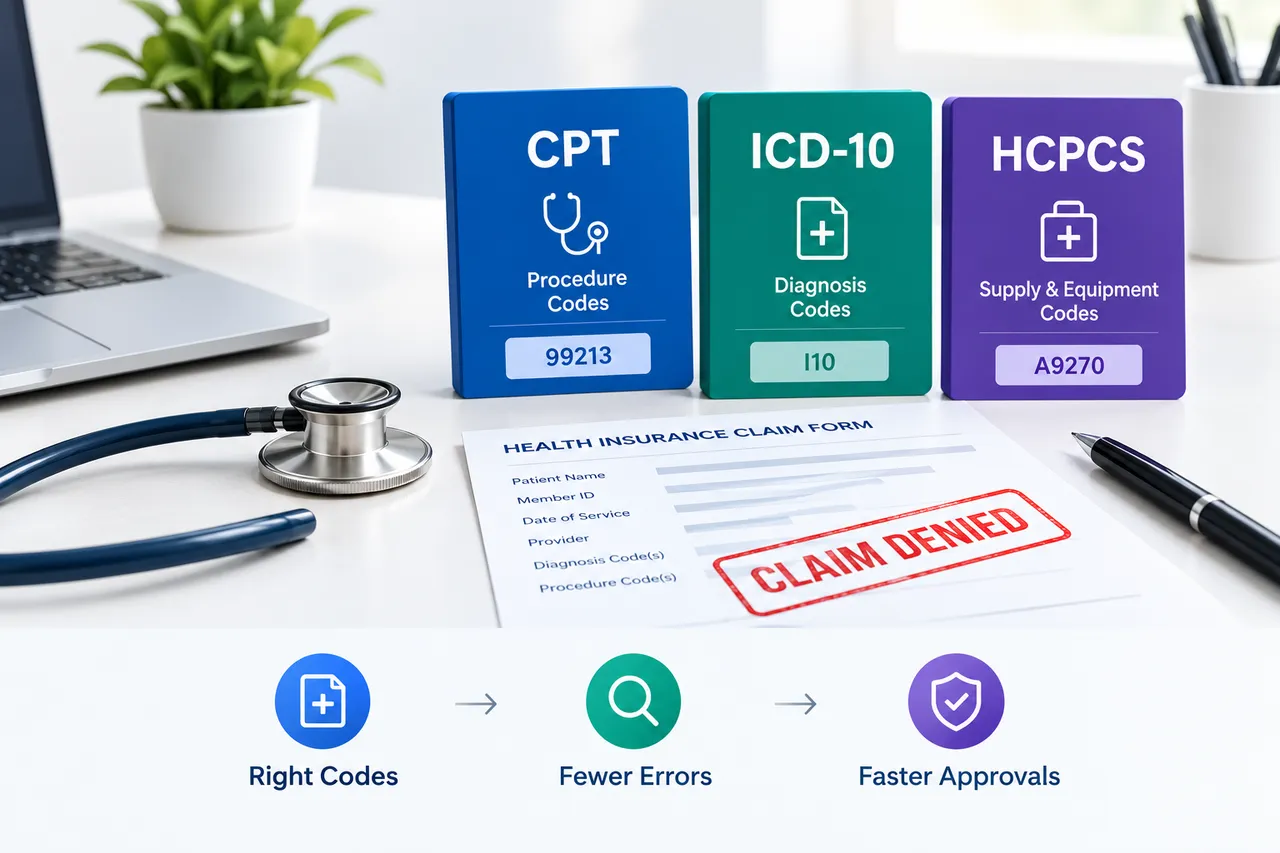
For medical billing teams, that means looking beyond the fact that a claim was denied and examining what the submitted information actually represents. CPT, ICD-10, and HCPCS codes serve different purposes, from describing the services provided to classifying diagnoses and identifying certain products or supplies. When these details are misunderstood, reported incorrectly, or assessed against the wrong requirements, they can become part of the reason a claim is denied.
To understand where these issues begin, it helps to look first at why a single healthcare claim can contain several kinds of codes.
Why A Single Healthcare Claim Can Contain Several Kinds of Codes?
A healthcare claim may need to identify the patient’s condition, the service performed, and any separately reported products or supplies. Each type of information serves a different purpose.
Consider a patient who visits a physician for knee pain, receives an examination, and is provided with a knee brace.
| Claim information | What it communicates | Code system |
|---|---|---|
Documented knee condition | Why the patient received care | ICD-10-CM |
Physician examination | What service was performed | CPT (HCPCS Level I) |
Knee brace, when separately reportable | What product was provided | HCPCS Level II |
This example is illustrative. Actual coding and reporting depend on the documentation, claim setting, item provided, and applicable requirements.
1. Diagnosis Codes Communicate the Condition or Reason for the Encounter
ICD-10-CM classifies diagnoses and reasons for healthcare encounters. The reported diagnosis must be supported by the medical record and follow the applicable coding guidelines.
In this example, the diagnosis describes the documented reason for the visit. It does not identify every service performed or establish whether the knee brace is covered.
2. Procedure and Service Codes Identify What Was Performed or Reported
Current Procedural Terminology (CPT) codes describe medical services and procedures. CPT is also known as HCPCS Level I and is maintained by the American Medical Association.
In this example, the service code describes the physician’s reported examination. The diagnosis and service codes communicate different information, and the reported service must reflect the documentation.
3. Other Codes May Identify Products, Supplies, Drugs, or Transport Services
Healthcare Common Procedure Coding System (HCPCS) Level II identifies certain products, supplies, drugs, equipment, and services, including applicable durable medical equipment and ambulance services.
A knee brace may require a HCPCS Level II code when it is separately reportable. The appropriate reporting depends on the item and claim circumstances. A valid code alone does not establish coverage or payment.
Identifying which type of information is involved gives billing teams a clearer starting point when reviewing a claim.
What Is the Difference Between CPT, ICD-10-CM, ICD-10-PCS, and HCPCS Level II?
These code systems describe different parts of healthcare services and claims. The right system depends on what is being reported and the setting in which care was provided.
| Code system | Primary purpose | What it represents | Common reporting context | Authoritative reference | What code assignment alone does not establish |
|---|---|---|---|---|---|
CPT / HCPCS Level I | Report medical services and procedures | Services and procedures performed by physicians and other healthcare professionals | Professional claims and other applicable service-reporting contexts | That the service is covered, medically necessary, correctly documented, or payable | |
ICD-10-CM | Classify diagnoses and reasons for encounters | The documented condition or reason for healthcare services | Diagnosis reporting across applicable healthcare settings | That the reported diagnosis is supported by the record or that a service meets coverage requirements | |
ICD-10-PCS | Classify procedures performed in hospital inpatient settings | Procedures reported for inpatient hospital care | Hospital inpatient facility procedure reporting | That the procedure is correctly represented without reference to the record and applicable coding guidelines, or that a claim will be paid | |
HCPCS Level II | Identify certain products, supplies, and services not represented in the same way by CPT | Items and services such as durable medical equipment, prosthetics, orthotics, supplies, certain drugs, and ambulance services | Applicable claims for products, supplies, and services | That an item or service is covered, meets payer criteria, or qualifies for a particular payment |
Code sets and guidelines can change, so verify the version that applies to the service date or inpatient discharge date, along with payer requirements. A valid code alone does not guarantee coverage or payment, which also depends on documentation, medical necessity, and payer rules.
The practical distinction: ICD-10-CM classifies diagnoses, CPT reports services and procedures, ICD-10-PCS classifies inpatient hospital procedures, and HCPCS Level II identifies certain products, supplies, and services.
How the Code Systems Work Together on a Claim?
A healthcare claim brings together information about the encounter, the diagnosis, and the services or items reported. These details must be consistent with the medical record and the rules that apply to the claim’s setting.
1. The Encounter Record Is the Evidence Base
The medical record supports the diagnosis reported and the services performed. Products, supplies, or drugs may also require additional coding and billing information.
Codes should reflect the documented encounter, not simply the options available in a code set. If the claim and record do not align, the issue may involve code selection, documentation, or reporting requirements.
2. Diagnosis and Service Information Must Be Linked Appropriately
Diagnosis codes and service codes describe different aspects of care, but they need to make sense together on the claim. The diagnosis information should reflect the record, and the reported service should match what was performed and documented.
A mismatch does not automatically mean the diagnosis code is wrong. The relevant claim details and payer rationale help identify whether the issue concerns coding, diagnosis association, documentation, or a separate coverage requirement. Detailed CPT-to-diagnosis mismatch reviews belong in the specialist guide.
3. Claim Setting Changes the Reporting Context
The applicable code systems depend partly on the type of claim. Professional claims commonly use CPT to report services, while ICD-10-PCS is used to classify procedures for hospital inpatient reporting. ICD-10-CM is used to classify diagnoses.
These systems are not interchangeable. Before reviewing a coding issue, identify the claim type and care setting, then check the official guidance that applies. Products, supplies, and certain drugs may also involve HCPCS Level II reporting, depending on the item and circumstances.
What a Correct Code Does and Does Not Tell the Payer?
A correctly selected code does not guarantee claim payment. Payers may also consider eligibility, authorization, benefit coverage, medical necessity, documentation, contractual terms, and applicable claim edits. These are separate questions from whether the code itself is valid.
1. Code Selection Is Not the Same as Medical Necessity
A code classifies a diagnosis, service, or item under the relevant coding system. Medical necessity is a separate determination based on the criteria that apply to the patient and service.
A diagnosis code alone does not prove that a service meets medical necessity requirements. When a claim is denied on these grounds, billing teams should review the applicable coverage policy and supporting clinical documentation to determine whether the service meets the payer’s criteria.
2. Code Presence Does Not Establish Coverage or Payment
A code’s presence in an official code set does not mean every payer covers the associated service or item. Payment may depend on the patient’s benefits, the provider’s contract, and the applicable payer policy.
A code can be valid while the claim remains ineligible for payment. Coding validity and payment eligibility must therefore be assessed separately.
3. Documentation and Payer Rules Still Matter
The medical record must support the reported diagnosis, service, or item. The claim must also meet the reporting and other requirements that apply to the payer, plan, and setting.
When a claim is denied, identify the requirement the payer says was not met before deciding what to correct or investigate. A valid code is one part of the review, not a substitute for it.
How Do Coding-Related Issues Lead to Medical Claim Denials?
Coding-related denials can occur when information on a claim conflicts with the medical record or fails to meet an applicable reporting requirement. However, not every denial involving a code means the code itself is wrong. The payer’s explanation helps distinguish coding errors from documentation gaps, claim-edit issues, and separate coverage requirements.
1. The Reported Code Does Not Match the Documented Service
The service or procedure reported on a claim should reflect what the medical record supports. If the submitted code describes a service that differs from the documented encounter, the payer may question or deny the claim.
Before changing a code, billing teams should compare the reported service with the documentation. This helps determine whether the issue involves code selection, insufficient documentation, or another claim requirement.
2. The Diagnosis and Reported Service Do Not Align
Diagnosis and service codes describe different aspects of care, but their relationship can affect claim review. A payer may question whether the reported diagnosis meets the applicable requirements for the service.
This does not automatically mean the diagnosis code is wrong. Review the reported diagnosis, the documented service, and the payer’s stated reason for denial. If the concern involves medical necessity, the applicable coverage criteria must be assessed separately.
3. A Reporting Rule or Claim Edit Is Not Met
Some denials involve how codes are reported together, whether a modifier is appropriate, or whether submitted units or service frequency meet applicable limits. The requirements can vary by code, claim setting, and payer or program.
In these cases, the issue may lie in how the claim was reported rather than in the validity of an individual code. The specific edit or reporting requirement cited by the payer should guide the investigation.
4. The Code-Set Version or Applicable Rule Is Incorrect
A claim may be assessed against a code-set version, payer policy, or claim edit that does not apply to the relevant date, setting, or payer. These requirements can change on different schedules, so the latest available guidance may not be the version applicable to the claim.
Confirm that the cited code, policy, or edit was in effect for the claim under review. This helps distinguish an outdated coding reference from a payer-specific rule or another reporting issue.
Before deciding how to respond to a coding-related denial, billing teams need to establish why it occurred and what evidence supports the claim. Bill Matters helps bring these steps together through its multi agent AI workflow, analyzing the denial reason, assessing relevant medical code sets, and identifying supporting evidence for an AI-generated appeal draft. This gives teams a clearer starting point for reviewing the case and refining the response before submission.
Denied again? Let’s get to the why.
A denial is a plot twist, not the end of the story. See how Bill Matters helps your team connect denial reasons with supporting evidence and build stronger appeals for review.
See how Bill Matters works
How to Identify the Source of a Coding-Related Claim Denial?
A denial code is a clue, not proof that a CPT, ICD-10, or HCPCS code is wrong. Begin with the payer’s complete explanation, identify the affected claim information, and compare it with the supporting record. The goal is to establish what was questioned before choosing a corrective action.
1. Read the Complete Payer Response
Review the full remittance advice or denial explanation, rather than relying only on an adjustment code or short description. Identify the affected claim line, the service or item reported, the payer’s stated reason, and any policy or edit referenced.
This establishes the scope of the issue. A denial affecting one line may require a different review from a claim-wide issue. If similar denials recur, comparing cases from the same payer can also help reveal whether the problem points to a broader pattern rather than an isolated claim.
Bill Matters’ payer insights capability help teams identify these patterns by tracking denial trends, payer response times, and recovery outcomes separately for each payer. Over time, recurring issues, such as frequently triggered bundling edits or specific documentation requirements, can give teams useful context for investigating new denials.
2. Compare the Submitted Information with the Record
Compare the reported diagnosis and service information with the medical record and other relevant source documents. Depending on the payer’s explanation, the review may also involve modifiers, units, diagnosis associations, or required documentation.
Do not change a code simply because the claim was denied. First determine whether the submitted information conflicts with the record or whether the payer’s rationale points to another requirement.
3. Classify the Likely Issue
Use the available evidence to identify the most likely category. These categories can overlap, so treat the initial classification as a working conclusion rather than a final determination.
| Likely issue | What to establish first |
|---|---|
Coding | Does the reported code or code relationship reflect the documented diagnosis, service, or item? |
Billing data | Is a submitted claim field inaccurate or incomplete? |
Documentation | Does the record support the reported information and meet the applicable documentation requirements? |
Coverage or medical necessity | Is the dispute about whether the service meets the applicable coverage criteria, rather than code validity alone? |
Authorization or eligibility | Does payment depend on a separate authorization, benefit, or eligibility requirement? |
Once the likely category is clear, use the relevant specialist resource instead of applying a generic fix.
4. Choose the Next Specialist Guide
Use the payer’s explanation and your initial findings to identify the next question to investigate.
| Initial signal | What to check |
|---|---|
Reported service appears inconsistent with the record | Compare the submitted code with the service documented in the medical record. |
Diagnosis and service relationship is questioned | Check the reported diagnosis, the documented service, and the payer’s stated requirements. |
A modifier or code-combination edit is mentioned | Review the applicable reporting rules and the specific edit cited by the payer. |
Quantity or frequency is questioned | Verify the reported units or frequency against the requirements that apply to the claim. |
Diagnosis-code specificity or an update may be involved | Confirm that the code reflects the documented details and that the correct code-set version applies. |
Coverage or medical necessity is questioned | Review the applicable coverage criteria and supporting documentation. |
The issue appears unrelated to code selection | Check the payer’s explanation and the relevant eligibility, authorization, benefit, contract, or billing requirements. |
Use these signals as a starting point, not as a definitive diagnosis of the denial. Confirm the payer’s rationale and the requirements that apply before correcting the claim or deciding whether to dispute the decision.
One denial is a case. A pattern is a clue.
Spot recurring payer issues before they keep showing up on your claims. Explore how Bill Matters uses payer insights to help your team turn denial trends into more informed next steps.
Why Coding Rules Can Differ by Healthcare Setting and Payer?
A code set does not determine every reporting or payment requirement. The claim’s setting, payer program, and applicable policy also matter. A rule that applies to one type of claim should not automatically be applied to another.
1. Professional, Outpatient Facility, and Inpatient Reporting Can Differ
Professional claims, outpatient facility claims, and inpatient hospital claims can follow different reporting requirements. CPT is commonly used to report professional services, while ICD-10-PCS classifies procedures performed in hospital inpatient settings. ICD-10-CM is used to classify diagnoses.
Before treating a denial as a coding error, identify the claim type and care setting. Then verify that the reported codes and applicable requirements match the circumstances of the claim.
2. Medicare, Medicaid, and Commercial Rules Must Be Scoped
Official code-set guidance does not replace payer-specific requirements. Medicare has program-specific billing and coverage policies. Medicaid requirements can vary by state, and commercial plans may have their own coverage, reimbursement, and claim-processing rules.
Check the requirement that applies to the payer, plan, service, setting, and date of care. Do not assume that a Medicare policy applies to a commercial claim or that Medicaid requirements are identical across states. When the payer cites a coverage or payment rule, verify the relevant policy before deciding whether the issue is coding-related.
How Code Updates and Policy Changes Affect Claim Review?
Coding requirements change over time, but code sets, payer policies, and claim edits do not necessarily follow the same update schedule. A claim can use a valid code and still be affected by a requirement that applies to a particular date, setting, or payer.
1. Code Requirements Can Change Over Time
The applicable code-set version depends on the claim’s reporting context and relevant date. For many professional and outpatient claims, this is the date of service. For inpatient hospital procedure coding, the applicable ICD-10-PCS version generally depends on the discharge date.
Using a code-set version that does not apply to the claim can create a reporting issue, even if the code appears in a current reference.
2. Payer Rules May Change Independently
Payer policies and claim edits can have effective dates that differ from code-set updates. A code update does not automatically change coverage criteria, reimbursement rules, or claim-processing requirements.
When reviewing a denial, distinguish a code-set issue from a payer-specific requirement. The relevant question is whether the rule cited by the payer applied to that claim, not simply whether the code itself was valid.
How Billing Teams Can Reduce Repeat Coding-Related Denials?
Reducing repeat denials starts with consistent checks and a reliable feedback process. Billing teams should verify claim information before submission, record confirmed denial causes, and route corrective actions to the people responsible for the underlying process.
Feed Verified Causes Back Into the Right Workflow
- Correct the individual claim first. Review the payer’s explanation, compare the submitted information with the supporting record, and verify the applicable coding or billing requirement. Correct confirmed errors or pursue an appropriate review when the evidence supports a dispute.
- Record the verified cause. Capture the affected claim field, the payer’s rationale, the evidence reviewed, the action taken, and the responsible owner. Avoid assigning a root cause based only on a denial code or an initial assumption.
- Look for recurring patterns. If the same verified issue appears across multiple claims, determine whether it points to a broader process gap. For example, repeated errors involving a particular field may warrant a change to pre-bill checks, staff guidance, documentation procedures, or the handoff between coding and billing.
- Assign ownership and confirm follow-through. Route each process issue to the appropriate team, set a review date, and document whether the corrective action was completed. Coding questions may need a coder’s review, while documentation, authorization, or claim-data issues may belong to different teams.
- Review updates regularly. Check relevant code-set changes, payer policies, and claim edits when they become effective. Update internal procedures and staff guidance where necessary, while keeping the applicable payer, setting, and effective date clear.
A corrected claim resolves an individual case; a process improvement addresses the conditions that caused similar errors to recur. Track whether the change reduces repeat instances, and reassess when the evidence shows it has not. These checks can help teams prevent avoidable errors, but they cannot guarantee payment or eliminate every denial.
A Denial Is a Signal. Find Out What It Actually Means.
CPT, ICD-10-CM, ICD-10-PCS, and HCPCS Level II each play a different role in healthcare billing. Understanding which code system applies is the starting point, but resolving a denial means looking beyond the code itself. The medical record, claim details, payer rules, and reason for denial all matter.
For billing teams, the challenge is bringing those pieces together without wasting time on the wrong fix. A code change will not resolve a coverage issue, and an appeal will be harder to support if the underlying cause has not been verified.
Bill Matters brings claim information and denial analysis into a single workflow, helping billing teams understand the issues behind unpaid claims and determine what needs further review. Its AI-powered approach supports more informed decisions about the next steps in the denial management process.
The aim is to understand why the claim was denied before deciding how to respond, and use what each review reveals to help prevent the same problem from recurring.