
Get a summary of this article with your favorite AI
Key Highlights
- •J-code billing units are based on the drug amount defined in the HCPCS descriptor, not vial size or package quantity.
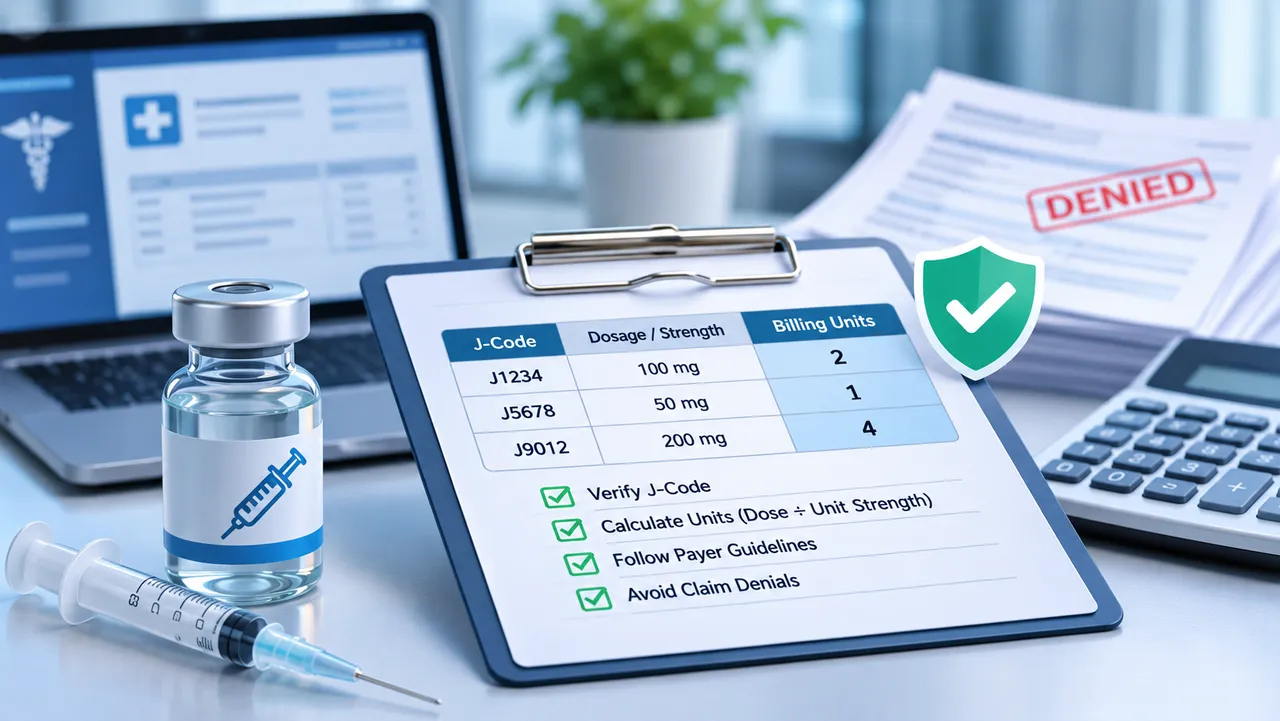
- •Calculate units by converting the administered dose into the descriptor's measurement and dividing by the amount represented by one billing unit.
- •Verify the drug, formulation, concentration, HCPCS code, and date of service before calculating claim quantities.
- •Keep administered doses, discarded amounts, HCPCS units, and NDC quantities separate. Follow applicable payer rules for JW and JZ modifiers.
- •Investigate unit denials by reviewing the HCPCS descriptor, administration records, NDC details, MUEs, and payer instructions. Correct inaccurate claims or appeal when documentation supports the reported units.
You have the medication administration record in front of you. The dose is documented in milligrams, but the J-code descriptor uses a different unit of measurement. So, what quantity should you bill: the administered dose, the vial quantity, or something else?
The answer is the amount of drug actually administered, converted into the billing unit specified in the applicable HCPCS descriptor. You'll need to check the drug's concentration, calculate the amount administered, and follow the applicable reporting instructions.
Things get a little more complicated when there's unused medication. A 2026 study published in JAMA Network Open reported $934 million in Medicare Part B spending on discarded drugs in 2023. This highlights why eligible discarded amounts need to be documented and reported separately from administered doses.
Let's break it all down, from calculating J-code billing units to reporting discarded drug amounts and avoiding common billing mistakes.
What Does a J-Code Tell You When You Bill an Injectable Drug?
A J-code in medical billing is a five-character HCPCS Level II code, usually beginning with the letter J, used to identify a specific injectable drug or biological on a medical claim. These codes help healthcare providers and medical billers report drugs that are administered during medical treatment.
Each J-code has a specific drug description and billing unit. The unit tells you how much of the drug is represented by one billable unit, such as 1 mg, 10 mg or 100 units. This distinction matters when calculating the claim quantity. Always check the full HCPCS descriptor before billing to make sure you're reporting the correct number of units.
1. The J-Code Identifies the Drug Reported on the Claim Line
When an injectable drug is separately reportable, the applicable HCPCS drug code identifies the medication on the claim. The drug line and the administration service are not necessarily the same thing. Depending on the service and applicable coding rules, the administration may be reported separately.
A few points to keep in mind:
- Not every injectable medication uses a J-code.
- The appropriate code depends on the drug, formulation, claim setting, and payer instructions.
- Some drugs may use another HCPCS code family or a different reporting approach.
- A drug code does not, by itself, establish coverage or guarantee payment.
Also Read: HCPCS Level II vs. CPT and How Medical Billers Can Choose the Right Code to Avoid Claim Denials
2. The Full Descriptor Defines the Billing Unit
When calculating J-code units, always refer to the full HCPCS descriptor. Shortened descriptions may leave out important dosage details, so check the official descriptor for the code that applies to your date of service.
Let's take an example to understand what is j-code in medical coding. Consider J3301, which describes an injection of triamcinolone acetonide, not otherwise specified, in a 10 mg unit. This means each billing unit represents 10 mg of the drug, and the reported claim quantity is calculated based on the amount administered.
The descriptor alone is not enough to calculate the dose. You also need the product details and administration record to establish the actual amount of drug administered.
| What you're checking | What it tells you |
|---|---|
HCPCS code | Which drug or product is being reported |
Full code descriptor | How much drug represents one billing unit |
Product label | The product's strength and concentration |
Administration record | The amount actually given to the patient |
Claim instructions | How to report the calculated quantity |
Always verify the code and descriptor against the current CMS HCPCS quarterly updates and applicable payer guidance.
Also Read: CPT, ICD-10 and HCPCS Codes: Why Claims Get Denied and What Medical Billers Should Check First
How Do You Convert an Administered Drug Dose Into J-Code Billing Units?
You convert an administered dose into J-code billing units by dividing the amount of drug administered by the amount represented by one unit in the HCPCS descriptor. Both amounts must use the same measurement.
Follow these steps before entering the quantity on the claim.
1. Verify the Defined Unit for the Exact Code
First, find the HCPCS code that matches the drug and date of service. Then, check the full descriptor in the applicable code file to confirm the billing unit.
For the J3301 example above, the descriptor's dosage amount is the basis for calculating the units. A different J-code may represent 1 mg, 10 mg, 100 mg, or another quantity.
The unit definition is code-specific, so never carry a calculation from one drug code over to another. Make sure the code matches the exact drug and formulation being administered. Even if two drugs have similar names, they may not share the same HCPCS code.
2. Convert the Administered Quantity Into the Descriptor's Measurement
Next, check the administration record and product label. You need the amount administered and, if the dose is recorded by volume, the drug's concentration.
Use this formula when the administered volume and product concentration are known:
Drug amount administered = Volume administered × Drug concentration
For example, suppose the product contains 40 mg per mL and the documented administered volume is 0.5 mL.
| Calculation detail | Amount |
|---|---|
Product concentration | 40 mg/mL |
Documented volume administered | 0.5 mL |
Drug amount administered | 0.5 × 40 = 20 mg |
The calculation converts volume into the actual amount of drug. It does not treat 0.5 mL as 0.5 mg.
3. Calculate the HCPCS Billing Units
Once the drug amount is expressed in the same measurement as the descriptor, use:
HCPCS billing units = Drug amount administered ÷ Drug amount represented by one HCPCS unit
Using the administered amount calculated above:
| Calculation detail | Amount |
|---|---|
Drug amount administered | 20 mg |
J3301 unit definition | 10 mg |
Calculated HCPCS units | 20 ÷ 10 = 2 units |
So, the documented 20 mg dose converts to two J3301 units before any additional payer-specific reporting instructions are applied.
The product concentration in this scenario is consistent with the Kenalog-40 prescribing information. The code definition and product details should be checked against the sources applicable to the date of service.
This example demonstrates how to calculate units for the stated dose and product. For an actual claim, make sure the drug, formulation, code, and date of service match the records you're using.
Why Do Administered Drug Doses and J-Code Billing Units Disagree?
The dose given to the patient and the quantity reported on the claim aren't always the same. The medical record shows how much drug the patient received, while HCPCS units convert that amount into the measurement defined by the code. Vial contents and any discarded medication also need to be accounted for separately.
1. Vial Quantity Is Not the Same as Administered Dose
When billing a drug, focus on how much medication the patient actually received. A vial may contain more medication than the administered dose, so calculate the billing units based on the amount given.
For example, a product may contain 40 mg in each mL, but the documented administered amount may be only 20 mg. The biller must calculate from the administered amount and the code-defined unit.
The vial's contents can help establish how much medication was available, but they do not tell you how much the patient received. Always trace the billed administered quantity back to the administration record.
2. Concentration and Measurement Conversions Can Change the Result
You may see the drug strength listed as mg/mL on the medication label, while the HCPCS descriptor uses mg. In that case, first convert the volume administered into the actual amount of drug, then use that amount to calculate the billing units.
Common errors include:
- Treating the administered volume as the drug amount.
- Using the package's total strength instead of the amount administered.
- Mixing milligrams and micrograms without converting them.
- Using a concentration that does not match the product administered.
Each can produce an incorrect claim quantity.
3. Administered and Discarded Amounts Must Be Distinguished
When some medication is left unused, the administered amount and the discarded amount need to be considered separately. Unused medication needs separate attention during billing, as the amount you can report as discarded depends on the drug's packaging and the payer's specific guidelines.
For Medicare Part B, specific requirements apply to eligible drugs from single-dose containers or single-use packages. The unused amount must meet the policy's definition of discarded drug, and the required documentation and claim reporting rules must be followed. See CMS discarded-drug guidance.
Which Administration Records Support J-Code Units on Your Claim?
Your documentation should clearly show how you arrived at the billed quantity, including the product used and the amount administered. Just entering a code and calculated units isn't enough, the records should support the quantity reported on the claim.
1. Confirm the Product and Its Concentration
Verify the drug name, formulation, strength, concentration, and product identification against the packaging or appropriate product record. Where required, capture the National Drug Code (NDC), which identifies the specific drug product and manufacturer.
The NDC and HCPCS code serve different purposes:
| HCPCS billing information | NDC reporting information |
|---|---|
Reports the drug using its code-defined billing unit | Identifies the specific drug product |
Uses the quantity defined by the HCPCS descriptor | Uses the applicable NDC unit of measure and quantity |
May be reported on the drug claim line | May be required as additional claim information |
Do not copy the HCPCS unit quantity into the NDC quantity field without checking the applicable instructions.
Medicaid also has specific reporting requirements for physician-administered drugs, including NDC details. Since these requirements can vary by state, check the relevant CMS guidance along with your state's Medicaid billing instructions.
2. Confirm the Dose in the Administration Record
The medication administration record (MAR) or other applicable clinical documentation should support what was actually given.
Check for:
- Documented dose and measurement.
- Route and date of administration.
- Product strength and concentration.
- Any relevant preparation or administration details.
When the record lists the administered volume, check that you're using the correct concentration for the product given. If the product or concentration changes, you'll need to adjust the calculation accordingly.
Also, compare the administration record with the billing worksheet. If the amounts don't match, sort out the difference before submitting the claim.
3. Reconcile Any Discarded Amount Separately
If you're reporting unused medication, make sure the documentation clearly shows how much was discarded and why it qualifies for reporting under the applicable payer policy.
Before calculating drug wastage by subtracting the administered dose from the vial's labeled contents, check the following:
- The product came from a qualifying single-dose container or single-use package.
- The unused amount was actually discarded.
- The amount meets the applicable reporting requirements.
- The documentation supports the administered and discarded quantities.
Medication used for another patient is not discarded drug for this purpose.
When Should You Report JW or JZ on an Injectable Drug Claim?
The JW and JZ modifiers are used in specific Medicare Part B discarded-drug reporting situations. They are not general modifiers for every injectable drug claim. Their use depends on the drug, packaging, setting, and applicable Medicare instructions.
This is also where the administered and discarded amounts need to be considered separately. An unused amount is not automatically reportable as discarded drug. Its eligibility depends on the applicable policy and supporting documentation.
1. Use JW to Report Eligible Discarded Drug
The JW modifier identifies eligible drug amounts that were unused and discarded. Under applicable Medicare rules, the discarded amount is generally reported on a separate claim line using the same HCPCS drug code with the JW modifier. The administered amount is reported on a separate line without JW.
The American Academy of Ophthalmology's Kenalog billing example describes a 40 mg single-use vial and illustrates reporting one J3301 unit for the administered amount and three J3301-JW units for the discarded amount.
| Claim line | Drug amount | HCPCS units |
|---|---|---|
J3301, administered amount | 10 mg | 1 |
J3301-JW, discarded amount | 30 mg | 3 |
Important: The AAO describes the administered dose as up to 10 mg. That wording should not be interpreted as meaning the same JW reporting applies to every dose below 10 mg. The CMS Medicare Claims Processing Manual, Chapter 17, Section 40 explains that when the administered dose is below one billing unit and the discarded remainder is already included in that unit, a separate JW line is not permitted. The appropriate reporting depends on the actual dose and the code's unit definition.
Before reporting discarded drug, confirm that the product and claim qualify under the applicable Medicare policy, that the unused amount was actually discarded, and that the medical record supports the administered and discarded quantities. Medication used for another patient does not qualify as discarded drug.
Do not calculate reportable wastage automatically by subtracting the administered dose from the vial's labeled contents. Follow the applicable CMS requirements and claim instructions.
2. Use JZ When No Eligible Amount Was Discarded
The JZ modifier indicates that no amount requiring discarded-drug reporting was discarded. For applicable Medicare Part B claims, it is required on separately payable drugs from qualifying single-dose containers or single-use packages when no eligible discarded amount exists.
The medical record should support the administered dose and the absence of an eligible discarded amount. Missing wastage details alone do not establish that JZ is appropriate.
CMS provides a JW/JZ policy code list, but identifies it as non-exhaustive. The policy also has setting and drug-related exceptions. For example, it does not generally apply to drugs from multiple-dose containers or drugs that are not separately payable, such as packaged OPPS or ASC drugs. Check the current CMS discarded-drug guidance before applying either modifier. Commercial payers and Medicaid programs may have different requirements.
Also Read: How Medical Billers Can Fix HCPCS Modifier and Billing Unit Errors to Prevent Claim Denials
How Should You Investigate a J-Code Billing-Unit Denial?
Take a closer look at the denied claim quantity and compare it with the HCPCS descriptor and the documented administered dose. The payer's unit calculation may need a second look, but it's equally important to verify that the original claim was calculated correctly. Check the supporting records before making any changes.
1. Compare the Denied Quantity With the Code Descriptor
Check the code billed, its full descriptor, and the code's effective date for the date of service.
Confirm that:
- The drug and formulation match the code.
- The descriptor's billing unit is correct.
- The code was effective on the date of service.
- The submitted quantity follows the descriptor's unit definition.
A short descriptor or outdated code reference may have led to an incorrect calculation.
2. Recalculate From the Documented Dose and Product Concentration
Use the actual administered amount from the MAR and the concentration shown on the product record. Convert the dose into the measurement used in the HCPCS descriptor and recalculate the billing units.
If discarded drug was reported, verify the separate claim line and supporting documentation against the applicable discarded-drug reporting rules.
3. Review NDC Details and Applicable Claim Edits
If the payer requires NDC reporting, verify the product identifier, unit qualifier, and reported quantity against the product record and claim instructions.
It's also worth checking the applicable Medically Unlikely Edits (MUEs). These are code-specific edits that set limits on the units of service that may be reported for a single date of service. They don't tell you how to convert an administered drug dose into HCPCS billing units.
Remember:
- Not every HCPCS code has an MUE.
- An MUE does not replace the dose-to-unit calculation.
- A correct unit calculation does not automatically mean the claim will pass every other edit.
Also Read: CPT Unit and Frequency Limit Denials: How to Check MUEs, Fix Errors, and Appeal
Check the applicable CMS Medicare NCCI MUE guidance.
When we were shaping Bill Matters, one thing became clear: identifying a denial is only half the job. A remittance advice may flag a unit discrepancy, but understanding the denial reason means looking at the claim, code details, and supporting records together. For medical billing companies and RCM heads managing multiple claims, connecting these details across records can take considerable time.
That's the problem we wanted Bill Matters to help address. Its AI-powered denial intelligence helps teams interpret denial reasons, connect claim details with supporting evidence, and spot potential documentation gaps. If the denial needs to be challenged, it can also help prepare an appeal draft for human review.
The idea is simple, help billing teams spend less time piecing information together and more time deciding what to do next.
Also Read: What Should You Do First When Facing a Healthcare Claim Denial?
Denials keep coming. Your investigation process doesn't have to go in circles.
Let Bill Matters help your team make sense of denial reasons, find supporting evidence, and prepare appeal drafts for human review.
What Should You Do When a J-Code Billing-Unit Denial Is Incorrect?
Once you've reviewed everything, decide how to move forward. If you find an error in the code, unit calculation, quantity, or required reporting details, correct the claim. If your documentation and calculations support the billed units but the payer's decision seems incorrect, consider filing an appeal and include the records that support your claim.
1. Correct the Claim When Its Reported Information Is Wrong
If the wrong drug code was used, the dose was converted incorrectly, or the claim quantity does not match the documented amount, follow the payer's correction process.
Review related information at the same time:
- HCPCS code and descriptor.
- Administered and discarded quantities.
- NDC details, if required.
- JW/JZ modifier use, where applicable.
- Other payer-specific reporting fields.
Correcting the unit quantity without checking the underlying records can leave the original discrepancy unresolved.
2. Challenge the Denial When the Records Support the Calculation
If the HCPCS descriptor, product details, administered dose, and billed units all match, take a closer look at the payer's reason for denying the claim.
Check whether the payer followed the correct guidelines for the date of service, claim setting, and drug product. If something doesn't line up with the applicable policy, use your supporting documentation and relevant billing guidelines to explain why you're disputing the denial.
Having the correct unit calculation strengthens your case, but it does not by itself guarantee payment.
What Should You Reconcile Before Submitting a J-Code Drug Claim?
Before submitting the claim, make sure the drug, code, dose, and reported quantity agree.
Use this checklist:
- Confirm the drug and applicable HCPCS code.
- Verify the full descriptor and billing-unit definition for the date of service.
- Match the product strength and concentration to the product administered.
- Confirm the actual administered dose in the MAR.
- Convert the dose into the descriptor's measurement before calculating units.
- Check payer-specific rounding and reporting instructions.
- Document and report eligible discarded amounts separately, where required.
- Verify JW/JZ applicability under the relevant Medicare rules.
- Check NDC details and any payer-required quantity information.
- Review applicable MUEs and other payer edits.
Accurate J-Code Units Start With the Documented Dose
Getting J-code billing right comes down to three things: the drug product administered, the dose documented in the medical record, and the billing unit defined by the HCPCS descriptor. All three should line up. If something doesn't match, it's worth taking another look at the reported quantity.
As Sue Vicchrilli, COT, OCS, OCSR, and Joy Woodke, COE, OCS, OCSR, coding and reimbursement specialists at the American Academy of Ophthalmology, explain, “Each J-code’s descriptor includes a dosage amount ... which is the billable unit for that code.” Their guidance reinforces why billers should calculate from the code-defined dosage rather than the vial's package size.
Before you submit your next claim, take a moment to check your calculations. Can you trace every billed unit back to the actual drug, administered dose, and supporting documentation? Have you checked the required claim details and applicable reporting instructions?
When all these details line up, you're in a much better position to submit accurate drug claims and handle unit-related denials with confidence.