
Get a summary of this article with your favorite AI
Key Highlights
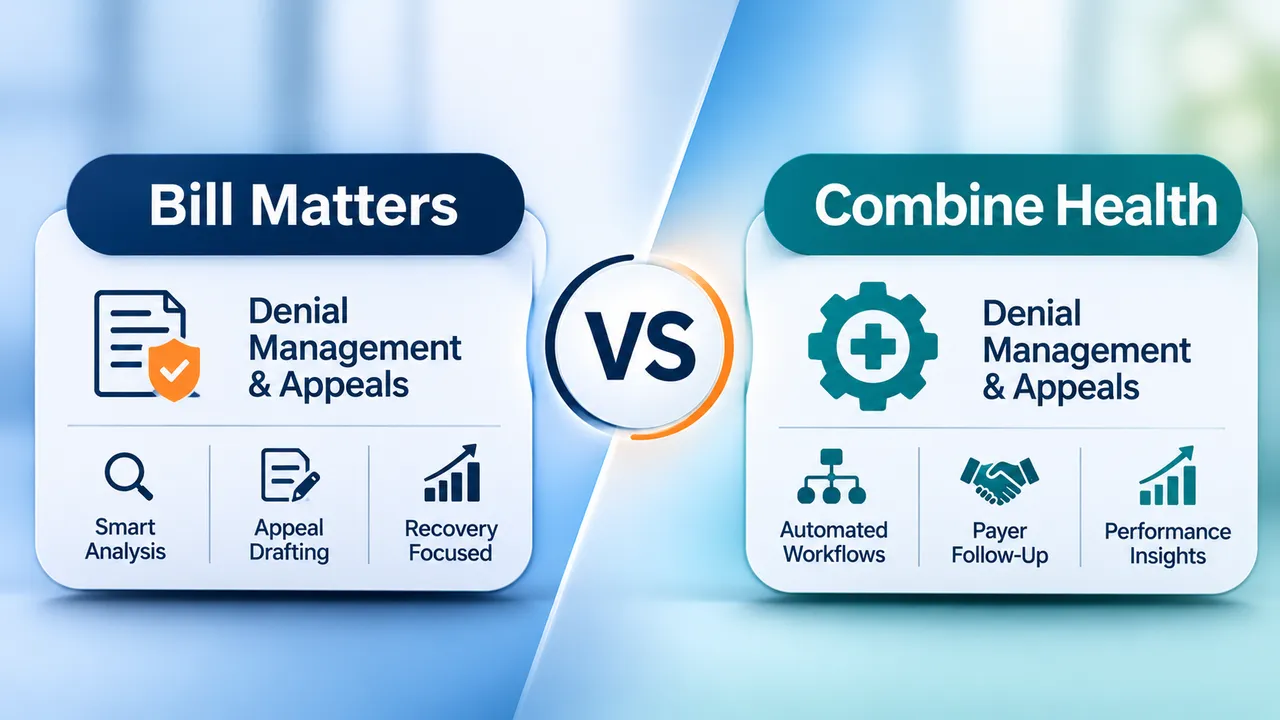
- •Bill Matters vs. CombineHealth examines two AI solutions: Bill Matters' denial-management offering and CombineHealth's Adam and Rachel agents.
- •Bill Matters' AI denial management platform connects denial interpretation, payer-contract checks, fee-schedule intelligence and evidence-backed appeal preparation.
- •CombineHealth pairs Adam's denial analysis and payer follow-up with Rachel's medical billing appeals software within its wider RCM platform.
- •Bill Matters uses uploaded remittance files, not direct ERA feeds; CombineHealth documents EHR connections and payer-side automation with human oversight.
- •Bill Matters case studies report recovered underpayments and reduced rework; CombineHealth publishes agent-level metrics and wider denial-reduction outcomes.
- •Compare net collections, appeal overturns and staff costs, then verify pricing, PHI safeguards, BAAs and independent security evidence before choosing.
Bill Matters uses AI to interpret uploaded EOBs and denial records to:
- identify payer reasoning
- map evidence gaps, and then
- draft payer-specific AI appeals for human review.
CombineHealth also uses AI across RCM where:
- Adam, its AI denial manager investigates denial causes and manages A/R follow-up; and
- Rachel, its AI appeals specialists prepares appeals using clinical documentation and payer guidelines.
In Bill Matters vs. CombineHealth, the key distinction is how each supports recovery after a payer decision. Now,
Does faster appeal drafting mean more denied revenue gets recovered?
Not automatically. A draft still needs payer-specific evidence and human review.
That gap matters as 75% of providers surveyed reported rising claim denials in Experian Health’s 2026 State of Claims survey. This pressure makes healthcare denial management more than a drafting exercise.
With that on table, this blog will explore the key differences between the two popular platforms, Bill Matters and CombineHealth providing RCM heads, denial specialists, WC billing teams insights on which one they should choose for their operations.
But before we get into detail, let's take a quick look at both the platforms.
Bill Matters vs. CombineHealth: Comparison at a Glance
| Comparison Aspect | Bill Matters | CombineHealth |
|---|---|---|
Product focus | AI denial intelligence, evidence identification and payer-specific appeal generation. | Adam handles denial management and A/R follow-up; Rachel handles appeal preparation. |
Denial investigation | AI Interprets uploaded denial and EOB information, identifies the reason for denial and connects it with relevant claim context. | Adam checks claim status, identifies denial patterns and root causes, prioritizes claims and follows up with payers. |
Appeal preparation | Maps denial reasons to supporting documentation and generates evidence-backed AI appeal drafts for review. | Rachel prepares evidence-based appeals using clinical documentation, payer guidelines and appeal strategies. |
Information context | Uses uploaded denial documents, EOBs and supporting records. Direct ERA feeds are not currently supported. | Adam works with claim status and payer-specific information. Rachel's published workflow describes connections to EHR, PM and billing systems. |
Human involvement | Bill Matters, lets an authorized team member review and submit every appeal. | Rachel requests human review when uncertain and flags complex cases. The product does not clearly specify responsibility for every final appeal submission. |
What Do Bill Matters and CombineHealth Offer for Denial Management and Appeals?
Bill Matters groups its work under two connected offerings: AI Denial Agent and Appeal Generation. CombineHealth assigns the relevant work to Adam for denial management and A/R, and Rachel for appeals, within its wider agent-based RCM platform. The distinction lies in how each product organizes its denial-recovery capabilities and supporting intelligence.
1. Bill Matters: A Connected Denial-Management and Appeals Solution
Bill Matters is structured around two principal customer-facing offerings, rather than presenting every AI capability as a separate product. The AI Denial Agent coordinates case-level reasoning and determines the appropriate response to a denial.
When an appeal is justified, Appeal Generation prepares a case-specific draft using the available evidence and applicable payer requirements.
The supporting intelligence connects these offerings:
- Denial decoding and root-cause intelligence help interpret the payer's decision
- Denial analytics and prioritization help identify patterns and focus attention on relevant recovery opportunities
- Evidence intelligence and output validation support the preparation and review of appeal drafts
These are supporting components of the same recovery model, not unrelated products. Bill Matters is designed to work alongside existing billing and practice management systems. It does not require medical billing companies to replace their core billing environment to use its denial recovery capabilities.
2. CombineHealth: Adam and Rachel Within an Agent-Based RCM Platform
CombineHealth organizes its AI capabilities around specialized agents. For this comparison, Adam and Rachel are the relevant offerings:
- AI Denial Manager, handles denial analysis, A/R follow-up, claim prioritization and payer communication. Its role extends beyond medical claim denial management software that only categorizes denials.
- AI Appeals Manager, focuses on appeal preparation. It uses clinical documentation, payer guidelines, and appeal strategies to prepare AI-powered medical billing appeals.
Together, Adam and Rachel cover distinct parts of the denial and appeal function. They operate within CombineHealth's wider RCM platform, which also addresses upstream activities such as coding, eligibility and claim creation. This comparison remains focused on these two agents, not the platform's other offerings.
How Do Bill Matters and CombineHealth Handle a Denied Claim from Investigation to Appeal?
Both products use AI to move denied claims towards resolution, but they approach the work differently. Bill Matters connects denial interpretation, recovery assessment and evidence preparation through its AI Denial Agent. CombineHealth uses Adam for denial investigation and payer follow-up, then Rachel for appeal preparation. The difference becomes clearer when you examine the decisions each product supports at every stage.
1. Denial Identification and Root-Cause Analysis
The first challenge is understanding what actually caused the payer to deny the claim. So,
How does Bill Matters and CombineHealth approach denied-claim investigation and root-cause analysis?
Bill Matters interprets the denial using the CARC and its paired RARC, rather than treating the adjustment code as the complete explanation.
- Its Claim Denial Decoder translates those codes into the underlying issue.
- The AI Denial Agent then checks that finding against claim details, payer requirements and available evidence.
- A separate AI model validates the initial analysis before the result moves forward.
CombineHealth's Adam identifies denial patterns and categorizes their likely causes.
- Its categories include clinical documentation, authorization and eligibility, coding and billing, and payer-specific requirements
- It also checks claim status and provides explanations for its denial-analysis decisions
Both support denial root cause analysis. Bill Matters' published process makes the connection between code interpretation, claim context, evidence and the appropriate resolution particularly explicit.
Also Read: What Should You Do First When Facing a Healthcare Claim Denial
2. Recovery Assessment and Denial Prioritization
Identifying the cause is only useful when it helps your team choose the right response. Denied claim recovery should not mean appealing every claim that carries a denial code.
- Bill Matters' AI Denial Agent assesses whether a denial presents a recovery opportunity and identifies the appropriate resolution.
- Adam's prioritization model explicitly considers claim age, dollar value and payer, helping teams work higher-value claims first. Its payer calls can also clarify whether a denial is appealable and what the payer needs next.
The investigation should lead to a specific action:
| Investigation finding | Appropriate response |
|---|---|
Correctable claim error | Correct and resubmit |
Missing supporting record | Obtain the required documentation |
Unclear payer status or reason | Request payer clarification |
Disputed decision with supporting evidence | Consider an appeal |
No valid recovery route | Document the finding and close the case appropriately |
This is the distinction behind automated denial management: identify the right action instead of sending every case into the same appeal process.
3. Evidence Preparation and Appeal Generation
When an appeal is justified, its strength depends on how well the argument addresses the payer's specific reason.
Bill Matters' Billing Evidence Finder checks the available records against the requirements associated with the denial and payer. It identifies missing documents and explains why they matter.
Therefore, the multi-agent AI workflow of Bill Matters connects denial reading, evidence checks, strategy and drafting. The appeal then uses the claim's actual facts, supporting records and applicable policy references. Unsupported citations are not supposed to be presented as established facts.
CombineHealth's Rachel approaches preparation through clinical documentation, payer guidelines and appeal strategies. Its published workflow includes medical necessity, coding and coverage determination appeals. It also uses denial reasons and payer history to predict appeal success and prioritize high-value cases.
For these medical billing appeals system, the practical difference is whether the draft reflects the evidence behind the individual claim. Strong evidence-based medical claim appeals must address the disputed requirement, not simply restate that the service was appropriate, and Bill Matters brings that to you.
4. Appeal Review, Payer Follow-Up and Outcome Tracking
The final distinction is who controls submission and how the payer's response is handled.
Bill Matters requires an authorized team member to review, edit, and approve every appeal before submission. Its tracks payer responses, manages required follow-ups, records outcomes, and reconciles recovered payments. It does not claim to submit appeals automatically rather requires a human reviewer to validate the drafted appeal.
CombineHealth documents more specific communication automation through Adam and deadline management through Rachel:
- Adam makes AI-driven payer calls, navigates IVRs and live agents, summarizes conversations and tracks appeal deadlines and submission status.
- Rachel monitors filing deadlines, escalation stages and payer response times. It requests human review when uncertain or when a case is complex.
For RCM heads and denial specialists, the distinction is worth checking during a product demonstration.
- Bill Matters clearly defines human approval and describes post-submission appeal tracking.
- CombineHealth publishes more detail about automated payer calls and deadline reminders. Its public product pages do not fully clarify who authorizes and submits every final appeal, so buyers should confirm that responsibility.
Stop Letting Denials Set the Pace
Share the pressure points slowing your billing operation and assess where Bill Matters could support your team
What Claim, Remittance and Payer Information Supports Bill Matters and CombineHealth's Workflow?
Bill Matters uses uploaded claim and remittance documents, then checks the extracted information against denial codes, payer requirements and the applicable reimbursement rules.
CombineHealth describes a different information path through Adam's claim-status and payer-related activity, alongside Rachel's clinical documentation and remit-processing context. The key distinction is how specifically each product documents its data inputs and how those inputs support payment and appeal decisions.
Information inputs at a glance
| Information area | Bill Matters | CombineHealth |
|---|---|---|
Claim and denial records | Uploaded denial letters, EOBs and supporting claim documents | Adam checks claim status and analyze denial codes |
Remittance information | Uploaded EOB, ERA, EOBR and ASC X12 835 files | Rachel identifies high value appeals during remit processing; specific file formats are not published |
Payer and reimbursement context | CARC/RARC interpretation, payer insights, contracts and state fee schedules | Adam uses payer-specific rules; Rachel uses payer guidelines and policy interpretation |
Clinical and billing evidence | Billing Evidence Finder checks available records against denial-specific requirements | Rachel extracts clinical evidence and uses it to prepare appeals |
1. Claim Documents, Denial Codes and Remittance Inputs
The quality of the analysis depends on what the system can actually read.
Bill Matters accepts uploaded denial letters and EOBs, with supporting clinical records available for the case.
- Its document processing also handles uploaded EOB, ERA, EOBR and ASC X12 835 remittance files
- It extracts claim-level and service-line details, including payment amounts, adjustment codes and key dates.
Note: An ERA is the electronic explanation a health plan sends about claim payment. The ASC X12 835 is the adopted transaction format for that remittance information. A CARC explains a claim adjustment, while a RARC adds further information about it. The CMS remittance guidance and X12 RARC definitions establish how these details work together.
There is one important intake distinction:
- Bill Matters processes these remittance formats when they are uploaded.
- Its current Terms and Conditions state that it does not connect directly to ERA feeds.
This matters when evaluating EOB and ERA analysis because file processing and live data integration are different capabilities.
CombineHealth documents Adam's claim-status checks and payer follow-up activity. Rachel connects with EHR, Practice Management and billing systems, and identifies high-value appeals during remit processing.
However, its public product pages do not specify whether it processes every format listed for Bill Matters, including EOBR and ASC X12 835 uploads.
Also Read: Why was a Health Insurance Claim Denied? 10 Common Denial Reasons Explained
2. Payer Policies, Reimbursement Rules and Contract Context
The remittance explains what the payer processed. The applicable contract or fee schedule helps establish whether the payment was correct.
Bill Matters connects payment information with the reimbursement source governing that claim.
- Its Contract and Fee Schedule Intelligence extracts rates, modifiers and exceptions from negotiated payer contracts.
- For Workers' Compensation, it uses the applicable state fee schedule and carrier rules instead of assuming a commercial contract applies.
- Payer Insights also track denial patterns, response times and recovery outcomes by payer.
For workers compensation billing teams, this distinction is especially relevant. A carrier payment must be checked against the applicable state reimbursement rules, not an unrelated commercial contractual allowance.
CombineHealth documents Adam's database of payer-specific rules and requirements. Rachel uses payer guidelines and policy interpretation when preparing appeals. Its published pages do not describe equivalent extraction of negotiated payer contracts or state fee schedules.
This creates a meaningful difference for underpayment detection in medical billing. Bill Matters describes flagging payments below the applicable fee schedule even when no denial code exists. That gives teams a way to identify a reimbursement discrepancy that a denial-only review could miss.
Also Read: How to Appeal Utilization Review Denials Under State Rules
3. Clinical and Billing Documentation and Evidence Gaps
A policy reference alone cannot establish that a particular claim meets the payer's requirements. The supporting records must connect the billed service to the reason for payment or denial.
Bill Matters' Billing Evidence Finder checks the available documents against the specific denial type and payer requirements. It identifies the missing document and explains why it matters before appeal generation. This creates a denial recovery platform with clinical evidence mapping, rather than relying on a general document checklist.
Bill Matters
The records may include:
- Clinical notes supporting medical necessity.
- Prior authorization records and approval details.
- Coding information and documentation supporting the billed service.
- Additional billing records required for the specific denial.
Rachel's published workflow extracts clinical evidence from provider notes and uses it with payer guidelines.
- It supports medical necessity, coding and coverage determination appeals.
- Its public description does not provide the same level of detail about a document-by-document evidence-gap check.
For teams evaluating payer-specific medical claim appeal management software, this distinction matters. The system needs to connect each document to the exact requirement it supports. A collection of clinical records is not automatically a complete appeal package.
The practical distinction: Bill Matters publicly documents a connected information model covering uploaded remittance files, code interpretation, reimbursement benchmarks and denial-specific evidence checks.
CombineHealth documents payer-related claim activity, remit processing and clinical evidence extraction through Adam and Rachel. Buyers should verify the exact data formats, contract access and evidence-matching depth during a product demonstration.
Also Read: How to Write a Medical Necessity Appeal Letter
How Do the Two Solutions Fit into Existing Medical Billing Operations?
Bill Matters is designed to sit alongside existing billing operations, with teams supplying case documents through uploads. CombineHealth describes connections with EHR, Practice Management and billing systems, alongside payer-portal and IVR automation through Adam. The practical difference is how each solution accesses operational data and where your team must manage the handoffs.
1. Existing Billing Systems and Integration Requirements
Bill Matters does not replace your billing or practice-management system. It adds a denial recovery layer to the process your team already follows.
However, its current Terms specify document-upload intake, not direct ERA-feed integration. Your staff must therefore identify the relevant cases and upload their supporting documents.
CombineHealth describes a more connected implementation model. Rachel's product page says it connects with EHR, Practice Management and billing systems.
Its FAQ identifies APIs, HL7 and custom interfaces as supported integration methods. Adam adds a separate form of connectivity by navigating payer portals and IVRs to retrieve claim updates and contact payers.
These connections serve different purposes. An EHR integration provides access to practice data; payer-portal automation handles communication with insurers. Before implementation, confirm:
- Whether your existing EHR and billing systems are supported.
- Which data moves automatically and which still requires staff action.
- Whether payer portals and IVR workflows cover your actual payer mix.
2. Human Review and Operational Accountability
Both solutions retain human involvement, but buyers should examine how responsibility is assigned and recorded.
Bill Matters provides an organization-level account structure. An Admin can invite team members, who share the organization's case queue. Its Terms also require multi-factor authentication. The Privacy Policy describes audit trails that record user actions, AI outputs and edits with timestamps and user IDs.
CombineHealth describes human-in-the-loop AI through configurable review requirements. Its platform allows teams to review, approve, or override AI recommendations and track exceptions. Its FAQ also describes role-based staff training for supervising outputs and handling cases that need human intervention.
For either implementation, assign clear ownership for document uploads, exception handling, approval and final payer communication. AI automation does not remove the need for accountable staff.
Also Read: Human-in-the-Loop Requirements: Why AI Should Flag, Not Auto-Decide?
3. Fit for Medical Billing Companies and Specialty Practices
The two solutions address different operating priorities.
Bill Matters explicitly targets medical billing companies, healthcare billing professionals and medical practices. Its billing-company model describes handling claims across client practices and reporting results client by client.
This makes it relevant to independent billing companies managing denial workloads across multiple provider accounts. Its stated claim scope also includes Workers' Compensation, which matters to workers compensation billing teams.
CombineHealth publicly targets independent practices, multi-specialty clinics and physician groups. Its broader revenue cycle management automation model may suit organizations seeking connected workflows across more RCM functions, especially where its published EHR and Practice Management integrations match their existing systems.
For a practical fit assessment, consider:
- Billing companies: client-level reporting, user access and workload across provider accounts.
- Specialty practices: support for specialty workflows and the systems already used by the practice.
- Multi-specialty physician groups: integration requirements, review responsibilities and the scope of automation needed across departments.
The right choice depends on whether your priority is focused denial recovery or wider RCM workflow automation. Check the actual implementation requirements before treating either platform's published integration claims as a confirmed fit for your environment.
What Do Bill Matters and CombineHealth Published Results and Commercial Information Tell RCM Buyers?
Bill Matters has helped customers recover previously missed revenue and reduce denial-related rework. CombineHealth publishes more numerical performance claims for Adam and Rachel, alongside wider platform-level customer results.
These figures offer useful evidence, but they do not establish a direct performance winner. Buyers should also examine pricing, actual collections and security commitments before selecting healthcare revenue recovery software.
1. Reported Product Performance and Customer Outcomes
For a fair comparison, distinguish actual customer outcomes from vendor-reported product metrics and internal targets.
What customer results and performance figures are publicly available for Bill Matters and CombineHealth?
Bill Matters' published customer examples show recovered underpayments, fewer resubmission cycles and existing teams handling workloads without additional hires. CombineHealth publishes specific processing and appeal-performance figures.
Let's have a look at what was achieved:
Bill Matters
- Reduced missing-documentation rework from two resubmission cycles to one. The billing team recovered revenue from previously unworked claims without adding staff.
- Recovered underpayments on claims that had already been accepted as paid. The practice identified amounts that had no denial code and recovered revenue without hiring dedicated billing staff.
- Flagged underpayments across multiple carriers, including payments with no denial code. It also standardized EOB review across scanned, faxed, and digital documents.
CombineHealth
Its product pages publish the following figures:
| Performance measure | Adam | Rachel |
|---|---|---|
Average processing time | 30 minutes | Appeals processed in minutes |
Published appeal success rate | 95%+ | 42% |
Preventable denials stopped | 75%+ | Not specified |
Increase in collections | 15% | Not specified |
CombineHealth also reports 20% fewer denials across 10,000+ claims, identifying 250+ false denials with 97.4% accuracy at a health center. This is a wider platform result, not an outcome attributed specifically to Adam or Rachel.
2. How RCM Teams Should Validate Performance and Financial Value
Published performance figures become useful when you can connect them to actual cash recovery. A faster draft or higher appeal volume does not automatically improve net collections.
Before evaluating an AI denial management platform for healthcare providers, measure these outcomes using your own claim data:
- Appeal overturn rate: Overturned appeals divided by appeals receiving a final decision.
- Approved versus collected amount: Track how much the payer approves and how much the provider actually receives.
- Net recovery value: Cash recovered after platform fees and the internal cost of working those claims.
- Staff time per appeal: Include evidence retrieval, review, correction, submission and follow-up.
- A/R aging and repeat denials: Check whether outstanding balances fall and the same denial reasons become less frequent.
Ask vendors to provide the reporting period, claim volume, payer mix and baseline behind every quoted result. This makes the financial value of AI medical appeals software easier to verify.
3. Pricing, Security and Commercial Terms Buyers Should Confirm
The current commercial information is different for each product.
| Commercial consideration | Bill Matters | CombineHealth |
|---|---|---|
Public pricing | Free during early access; three free appeal generations per organization | Performance-based pricing advertised for clinics and physician groups |
Future pricing | Paid pricing to be communicated before charges apply | Specific rates and calculation method require a proposal |
Export access | Appeal download and export currently require contacting the team | Confirm deliverables and access terms with the vendor |
Security disclosures | AES-256 encryption, TLS 1.2+, MFA, role-based access and audit logs | AES-256 encryption, SSO, role-based access and exportable audit logs |
Independent assurance | Public privacy policy describes HIPAA-aligned safeguards | SOC 2 report available on request, according to its FAQ |
Before signing an agreement, check the following:
- Bill Matters: Its Privacy Policy specifies document deletion at session end, appeal-letter retention for 30 days and permanent audit-log retention. It also describes BAAs with vendors processing PHI. Confirm the customer-level BAA and export arrangements.
- CombineHealth: Its Privacy Policy describes US-based AWS hosting and role-based access. Request its current SOC 2 report, customer BAA, and complete data-retention schedule.
For buyers considering denial management software with A/R follow-up and appeal tracking, the final decision should rest on verified recovery value, operating costs and contractual terms, not headline percentages alone.
Ready to Make Your Next Move Count?
Bring your team's biggest recovery challenge and establish whether Bill Matters is the right fit for your operation
Making the Right Denial-Recovery Decision
Bill Matters vs. CombineHealth ultimately comes down to which approach better fits your recovery priorities and operating model. Bill Matters brings denial management and appeals together in a focused solution, while CombineHealth addresses these functions through Adam and Rachel within its wider Revenue Cycle Management (RCM) platform. Neither choice should rest on product claims alone.
Consider each provider’s relevant experience, the expertise behind its approach, and whether published outcomes and commercial terms stand up to scrutiny. The right healthcare revenue recovery software should earn trust through evidence and deliver value against your team's actual results. That is what makes a decision informed, practical and sustainable.