
Get a summary of this article with your favorite AI
Key Highlights
- •An ICD-10-CM diagnosis code contains 3 to 7 characters, with a decimal after the third character, depending on its code family.
- •A category may be a complete code, while other classifications require additional characters.
- •ICD-10-CM Placeholder X and a seventh character are required only when specified by the code's structure.
- •Use the Alphabetic Index to locate a candidate code and the Tabular List to confirm the complete code and applicable instructions.
- •The code must match the medical record and follow the coding requirements for the applicable code-set version.
Have you ever come across an ICD-10-CM diagnosis code that looks perfectly fine, only to realize a required character is missing? It might seem like a small detail, but it can make a real difference in accurate coding.
ICD-10-CM codes do not all follow the same pattern. Depending on the code family, a complete code may require additional characters, an ICD-10-CM placeholder X, or a seventh character.
According to the CDC, ICD-10-CM includes nearly five times as many diagnosis codes as ICD-9-CM, allowing for greater specificity.
For medical coding, billing, and denial-management teams, understanding ICD-10-CM code structure helps identify potentially incomplete codes before reporting a diagnosis. The first step is to understand how the code is organized and when additional characters are required. Let's dive in.
How Is an ICD-10-CM Diagnosis Code Structured?
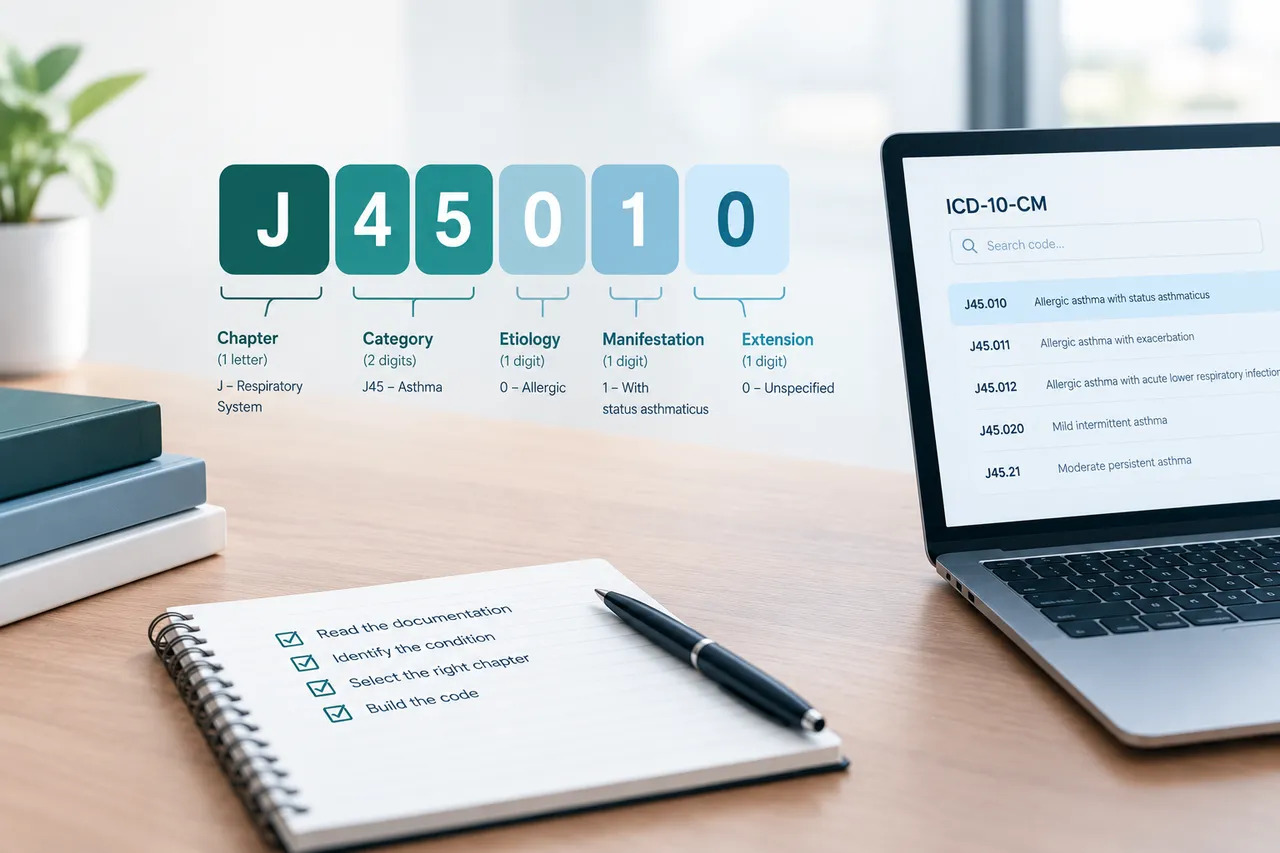
An ICD-10-CM diagnosis code contains three to seven characters, with a decimal placed after the third character. The first three characters identify the diagnosis category, while the following characters provide greater specificity, such as the condition’s site, laterality, or severity.
Some codes require a seventh character to indicate details such as the encounter type. The code must include all required characters to be valid for reporting.
1. From Category to Complete Code
The ICD-10-CM tabular list groups diagnoses into categories, subcategories, and complete codes. The FY 2027 Official ICD-10-CM Coding Guidelines explain how these levels are structured.
| Classification level | Character length | What it means |
|---|---|---|
Category | 3 characters | Groups related diagnoses under a broader classification. |
Subcategory | 4 or 5 characters | Adds more detail within a category. |
Complete code | 3 to 7 characters | Provides the required level of detail for reporting the diagnosis. |
ICD-10-CM codes use a combination of letters and numbers. When a decimal point is present, it appears after the third character and does not count as a character.
Some categories can be reported as complete codes on their own. Others have further subdivisions or require additional characters. For those codes, you need to follow the structure to the required level before reporting them.
2. Why the Required ICD-10-CM Code Length Matters
A code can look complete at first glance and still be missing a required character. For example, if you’re reviewing a claim for an unspecified fracture of the lower end of the right radius, S52.501 might look correct, but it needs a seventh character. S52.501A identifies the initial encounter for a closed fracture.
That’s why counting characters isn’t enough. Check the Tabular List to confirm what the code requires before reporting it.
Next, let’s look at what each character position tells you and when you need a placeholder or seventh character.
Also Read: ICD-10-CM vs. ICD-10-PCS: How Medical Coders Can Avoid Coding Errors and Choose the Right Code
What Do the Characters in an ICD-10-CM Code Structure Tell You?
In ICD-10-CM, a character’s role depends on its position and the code family. Some characters add diagnostic detail, while others serve a specific function in completing the code. Looking at the full code helps you understand how these parts work together.
1. How the Characters After the Category Add Detail
Characters beyond the first three can distinguish between diagnoses within a category or fulfill a required role in the code’s structure. Their meaning varies across code families, so the same character or position does not necessarily serve the same purpose in every code.
2. What T36.0X5A Shows About Character Positions
Consider T36.0X5A, which represents an adverse effect of penicillins, initial encounter. Each part serves a specific purpose:
- T36 identifies the category for poisoning, adverse effects, and underdosing of drugs, medicaments, and biological substances.
- 0 identifies penicillins within that category.
- X acts as a placeholder to preserve the required character position.
- 5 identifies an adverse effect.
- A is the seventh character, indicating the initial encounter.
Note: Check CMS Medicare Coverage Database for T36.0X5A and its description.
This example shows why you need to check the full code and the instructions for its specific category. Since requirements vary by code family, always verify the details in the Tabular List before assigning a code.
Next, let’s look at when to use an ICD-10-CM placeholder X and when an ICD-10-CM seventh character is required.
When Is a Placeholder X or Seventh Character Required?
An ICD-10-CM placeholder X or ICD-10-CM seventh character is required only when the code family’s instructions call for it. The X holds an unused position open so the seventh character lands in the seventh position. A code may need an X, a seventh character, both, or neither, and the Tabular List shows which.
1. When Is the ICD-10-CM Placeholder X Used?
The placeholder X preserves a required character position (Section I.A.4, “Placeholder character,” in the FY 2027 Official Guidelines). In T36.0X5A (adverse effect of penicillins, initial encounter), the X occupies the fifth position so the 5 and the seventh character A fall where the code structure expects them. It is part of the code, not optional, and omitting it makes the code invalid.
2. When Is an ICD-10-CM Seventh Character Required?
Some code families require a seventh character, and its meaning varies by family (Section I.A.5, “7th characters,” in the FY 2027 Official Guidelines). S52.501 is incomplete on its own; S52.501A adds the seventh character A for the initial encounter for a closed fracture. Add a placeholder before the seventh character only when the code structure requires it, as in T36.0X5A, where the X sits ahead of the A.
How to Check an ICD-10-CM Diagnosis Code for Completeness and Validity?
Before reporting an ICD-10-CM code, confirm that it is complete, supported by the medical record, and appropriate for the encounter. Use the Alphabetic Index to find a candidate code, then verify it in the Tabular List and review the applicable coding guidance.
1. Look Up the Diagnosis and Confirm the Full Code
Follow these steps to check the code before reporting it:
- Start with the Alphabetic Index. Look up the documented diagnosis using the main term and any relevant subterms to identify a candidate code.
- Confirm the code in the Tabular List. Check the full code and its description. Review applicable inclusion terms, Excludes notes, and other instructional notes.
- Check the code’s required characters. Confirm that the code is complete, including a placeholder X or seventh character when required by that code family.
- Review the Official Coding Guidelines. Check the relevant general and chapter-specific guidance for the diagnosis and care setting.
- Compare the code with the medical record. Make sure the selected code reflects the documented diagnosis and does not claim a level of specificity the record fails to support.
These checks can help you catch missing characters, incorrect codes, and gaps in documentation before reporting. Even if a code is complete, make sure it matches the diagnosis documented in the medical record.
2. Check Which ICD-10-CM Code-Set Version Applies
ICD-10-CM codes and guidelines change over time, so always use the version that applies to the encounter or discharge date. Check that the Alphabetic Index, Tabular List, and Official Coding Guidelines all match that release.
For example, the FY 2027 ICD-10-CM release applies to applicable encounters and discharges from October 1, 2026, through September 30, 2027. For other dates, visit the official CMS ICD-10 codes and files page to find the correct release and any updates that apply.
Before submitting the claim, check any payer-specific or program-specific reporting requirements that apply. Just because a code is included in the official ICD-10-CM code set doesn’t mean the service is covered or payment is guaranteed. Coverage and payment depend on the relevant policies and details of the claim.
How Can an Incomplete or Incorrect ICD-10-CM Code Structure Affect a Claim?
When an ICD-10-CM diagnosis code is incomplete or does not match the diagnosis documented in the medical record, it can create problems during claim processing. The claim may fail a validation check, come back for correction, take longer to process, or be denied. What happens depends on the issue and the payer's requirements.
How Different Coding Issues Affect Claims
| Coding issue | Possible claim impact | What may be needed |
|---|---|---|
Missing required character | The code may fail a claim validation check. | Correct the code according to the applicable coding rules and documentation. |
Unsupported diagnostic specificity | The diagnosis code may be questioned during review. | Review the medical record and seek provider clarification when appropriate. |
Code does not match the documented diagnosis | The claim may require correction or further review. | Reassess the code against the documented diagnosis and applicable guidelines. |
Missing authorization or another payer requirement | The claim may remain denied even when the diagnosis code is valid. | Address the specific requirement identified by the payer. |
What Matters During Denial Review
When reviewing a denial, start by identifying the exact denial reasons. Even a complete diagnosis code may not resolve the issue if supporting documentation or authorization is missing. The next step depends on what you find: correct coding errors, seek provider clarification if the documentation doesn’t support the code, or submit the required documents for authorization-related denials.
This way of looking at the problem informs our approach to denial analysis and appeal preparation through Bill Matters. By reviewing the payer's stated reason alongside claim details and supporting documentation, we help medical billing companies and billing teams identify what needs to be addressed and prepare appeal drafts for human review.
Also Read: What Should You Do First When Facing a Healthcare Claim Denial
The Code Looks Fine. So Why Is the Claim Still Side-Eyeing You?
Let’s find the missing piece. Bill Matters helps organize denial evidence and prepare appeal drafts for review.
Quick Checklist: Is Your ICD-10-CM Diagnosis Code Ready to Report?
Before reporting an ICD-10-CM diagnosis code, use this checklist to catch common code structure and validation issues.
| Check | What to confirm |
|---|---|
Diagnosis and documentation match | The code reflects the documented diagnosis and the specificity supported by the medical record. |
Alphabetic Index and Tabular List checked | The candidate code has been confirmed in the Tabular List, including applicable instructions and notes. |
Complete code selected | The code includes all required characters, including a placeholder X or seventh character when applicable. |
Coding guidelines reviewed | Relevant Official Coding Guidelines and chapter-specific guidance have been considered. |
Correct code-set version used | The applicable ICD-10-CM release has been selected for the relevant encounter or discharge date. |
Reporting requirements checked | Relevant payer or program-specific reporting requirements have been reviewed. |
Use this checklist as a final check before reporting the diagnosis code.
Verify the ICD-10-CM Code, Not Just Its Length
Counting the characters in an ICD-10-CM code structure is a good first step, but there’s more to check. The code must match the diagnosis documented in the medical record and meet the specific requirements of its code family.
Consider a fragility fracture. Does it automatically mean the patient has osteoporosis? Not necessarily. In an ACDIS discussion on clarifying the etiology of a fragility fracture, Lynette Byerly, a CDI education specialist at ACDIS/HCPro, explains why clarifying the cause of the fracture matters rather than assuming a diagnosis. The same principle applies to coding: a code may be complete, but the medical record must support the diagnosis being reported.
That’s why verifying an ICD-10-CM code structure goes beyond counting characters. Check the code’s structure for missing elements, then review the Tabular List and medical record to confirm it’s appropriate for the diagnosis. Both steps help support accurate coding and reduce avoidable claim issues.