
Get a summary of this article with your favorite AI
Key Highlights
- •CO-11 denial code means the payer considers the diagnosis inconsistent with the procedure, not that the diagnosis is automatically wrong.
- •Diagnosis pointer errors, documentation gaps, specificity gaps, payer diagnosis edits, or inaccurate procedure reporting can all warrant review.
- •Check the original remittance, transmitted claim, line-level diagnosis association, encounter documentation, and payer policy effective on the service date.
- •Effective CO-11 denial resolution matches the action to evidence: correct supported errors, clarify uncertain records, or appeal disputed decisions.
- •Prevent repeat CO-11 denials through pre-bill linkage checks, current payer-specific rules, and trend reviews across payers and procedures.
- •Bill Matters helps teams interpret denials, analyze remittances, identify missing evidence, and prepare source-backed appeals for human review.
The CO-11 denial code means the payer considers the diagnosis inconsistent with the procedure billed, as stated in X12’s CARC 11 descriptor. Now,
How can a valid diagnosis still trigger CO-11 denial?
Because a valid code does not prove that the diagnosis linked to a service supports the procedure. CO-11 identifies the payer’s concern; it does not establish whether the diagnosis, procedure, claim reporting, or payer decision is wrong.
A diagnosis-to-procedure mismatch denial describes the broader issue as,
- CO-11 is the adjustment reason reported for it
- CMS explains that Medicare adjustments may apply at service-line, claim, or provider level
Medical billing teams must identify what was adjusted and compare the submitted claim with the encounter documentation before choosing a CO-11 denial resolution. The code alone does not determine whether correction or appeal is appropriate.
The research behind this guide grew from the work involved in building Bill Matters. Our team studied diagnosis-related claim adjustments and how billing professionals trace discrepancies across remittances, claims, and clinical records. We consulted billing professionals, denial specialists, and appeal managers about the evidence they assess before recommending action. So, let's dive in to understand the details.
What Does CO-11 Mean on an Insurance Remittance?
CARC 11 means “The diagnosis is inconsistent with the procedure.” According to the official X12 CARC list, this code also directs users to the 835 Healthcare Policy Identification Segment in Loop 2110, when present.
A Claim Adjustment Reason Code explains why a claim or service line was adjusted. It communicates the payer's determination, not proof of a clinical or coding error. Diagnosis-to-procedure edit logic evaluates whether the reported diagnosis supports the billed service. A valid diagnosis code does not automatically establish an accepted diagnosis-to-procedure relationship.
| Remittance element | What it communicates |
|---|---|
CO | Contractual Obligation group code |
11 | CARC: diagnosis inconsistent with procedure |
RARC | Additional explanation, when reported |
Policy reference | Payer policy identifier, when supplied |
Note: Use the Remark Code and Policy Reference to Narrow the Investigation. A RARC supplements a CARC with additional explanation.
Now, let's answer some of your question:
1. Where does the payer identify the policy behind a diagnosis-related adjustment in an 835?
Check the Healthcare Policy Identification Segment in Loop 2110, when supplied. X12 specifically identifies this reference for CARC 11. Use the identifier to locate the applicable payer policy.
2. Can CO-11 affect one service line while the remaining claim lines are paid?
Yes. CMS explains that adjustments can occur at the service-line, claim, or provider level. Examine where the adjustment appears before treating the entire claim as denied. Provider-level adjustments use separate Provider-Level Balance (PLB) reason codes.
3. Does a CO group code automatically mean the patient can be billed?
No. X12 defines CO as Contractual Obligation and PR as Patient Responsibility. For Medicare, CMS specifies that beneficiaries may be billed only when Group Code PR accompanies an adjustment. Other plans require review of the applicable contract and billing rules.
One Code Shouldn't Tell the Whole Story
Bring remittance decisions into sharper focus with Bill Matters, so your team can act on the right financial responsibility
What Causes a CO-11 Denial?
CARC 11 identifies the payer's concern, not its underlying cause. The discrepancy may involve claim reporting, clinical documentation, coding specificity, payer requirements, or procedure information. Each possibility requires separate verification.
| Possible finding | What it means | What to verify |
|---|---|---|
Incorrect diagnosis pointer | Service links to another diagnosis | Line-level association |
Documentation mismatch | Submitted diagnosis differs from encounter | Encounter record |
Specificity gap | Code lacks required detail | ICD-10-CM instructions |
Payer diagnosis edit | Pairing fails an applicable payer rule | Policy and effective date |
Procedure reporting issue | Reported service differs from documented work | CPT/HCPCS details |
1. Incorrect Diagnosis Pointer
A claim can contain the correct diagnosis yet link the affected service to another one. This creates incorrect diagnosis linkage and makes diagnosis pointer errors worth investigating.
For independent doctor practices and practice owners, checking each service-line association is particularly important. On professional claims, the pointer appears in CMS-1500 Item 24E.
Can a diagnosis be correct even when the payer rejects its association with a procedure?
Yes. Code validity does not establish that the diagnosis was linked to the correct service.
Also Read: CPT Diagnosis Code Mismatch Denial: What’s Actually Wrong and How to Fix or Appeal It
2. Documentation Mismatch and Diagnosis-Specificity Gaps
These are two distinct issues. A documentation mismatch occurs when the submitted diagnosis does not reflect the encounter. A specificity gap occurs when the reported code lacks required detail.
Check the encounter documentation against applicable diagnosis specificity requirements and the FY 2027 ICD-10-CM Official Guidelines. This supports documentation integrity without adding unsupported clinical details.
Also Read: What Documentation Should Be Included with a Medical Claim Appeal?
3. Payer Diagnosis Edits and Coverage-Policy Differences
Payer diagnosis edits apply plan-specific requirements. A valid ICD-10-CM code may still fail an applicable coverage or billing rule.
Does CO-11 always indicate a medical necessity problem?
No. CARC 11 identifies an inconsistency. Whether medical necessity is also involved depends on the applicable policy and stated denial basis.
Also Read: How to Write a Medical Necessity Appeal Letter
4. Incorrect Procedure Reporting
An incorrect ICD-10-CM and CPT code pairing or CPT and HCPCS procedure classification may make the reported service appear different from the documented work. These are possible service-line coding discrepancies, not automatic explanations for CARC 11.
Before attributing the discrepancy to the diagnosis alone, check:
- Whether the procedure code represents the documented service.
- Whether the submitted service details match the medical record.
Can a CO-11 denial result from incorrect procedure information rather than an incorrect diagnosis?
Yes. Incorrect procedure reporting may contribute when it changes the diagnosis-to-procedure relationship evaluated by the payer.
Are Medicare NCCI edits responsible for diagnosis-to-procedure denials?
No. CMS confirms that Medicare NCCI edits are not based on diagnosis codes and are not medical necessity edits.
Also Read: CPT, ICD-10 and HCPCS Codes Explained (and Why Claims Deny)
How Do You Investigate a CO-11 Denial Before Correcting or Appealing?
Start by reconstructing what the payer received and evaluated. The billing system’s current view may include later edits.
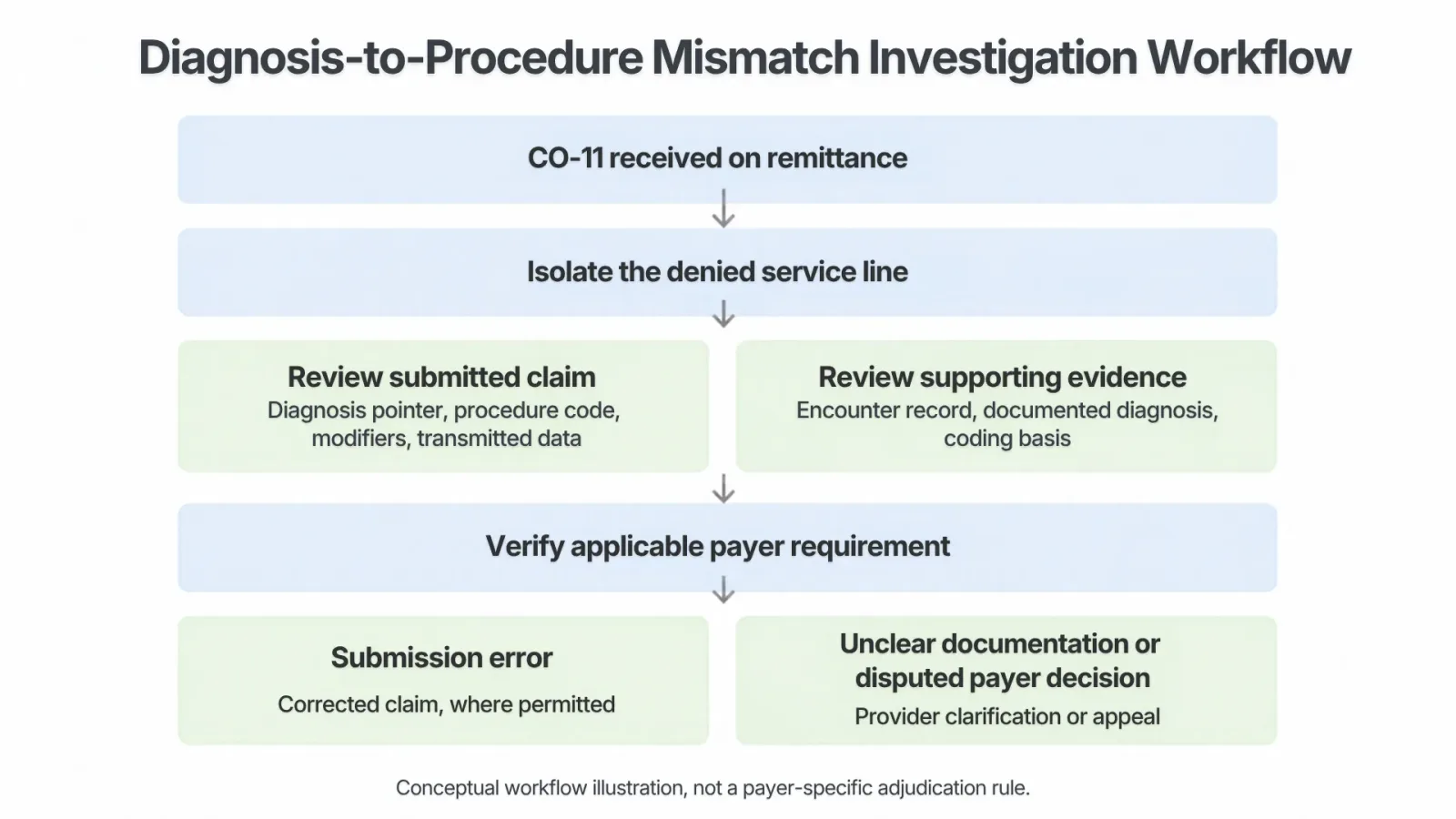
Here's the step-by-step framework for investigation
1. Retrieve the Full Remittance and Transmitted Claim
Compare the original claim with the full remittance. Preserve service-line details and the 835 Healthcare Policy Identification Segment, if supplied. This helps assess a CO-11 denial due to an incorrect diagnosis pointer.
Collect:
- Complete ERA/EOB and payer portal explanation.
- Original claim, submission and response dates, affected adjustment, RARC, and policy identifier, if reported.
2. Verify the Diagnosis Association in the Correct Claim Format
Check the line-level diagnosis association in the submitted format. On professional claims, CMS-1500 Item 24E maps to 837P Loop 2400 SV107. Confirm the transmitted pointer. These checks support steps to resolve a CO-11 diagnosis-to-procedure mismatch on a professional claim.
| Claim type | Submission format | What to review |
|---|---|---|
Professional | CMS-1500 / 837P | Item 24E / Loop 2400 SV107 |
Institutional | CMS-1450 / UB-04 / 837I | Institutional diagnosis and service-line data |
CMS maps the professional pointer in itsCMS-1500/837P guidance, while its CMS-1450/837I guidance explains the institutional format.
How should a billing team investigate CO-11 on an institutional claim rather than a professional claim?
Review the submitted 837I or CMS-1450 and institutional diagnosis reporting, not professional pointer fields.
3. Compare the Submitted Diagnosis With Encounter Documentation
Compare the transmitted diagnosis and procedure with the encounter documentation.
- Confirm the record supports the diagnosis and service
- Refer unresolved discrepancies for authorized coding or provider review
4. Verify the Payer Requirement and Its Effective Date
Search the Medicare Coverage Database for the applicable Local Coverage Determination (LCD), National Coverage Determination (NCD), and related MAC Billing and Coding Article. Check payer-specific diagnosis requirements, jurisdiction, status, and effective date.
CMS says NCDs do not list diagnosis or procedure codes or billing instructions. Local code lists generally appear in related Articles.
Does an NCD provide the specific ICD-10-CM codes required for a Medicare claim?
No. Check the related Billing and Coding Article and CMS implementation instructions.
What proves that a payer applied an outdated diagnosis requirement to a claim?
Match the policy version and effective dates to the service date, payer, plan, and jurisdiction. Retain the denial reference and request clarification if needed. Workers' compensation billing teams should verify state and carrier requirements rather than apply Medicare policies.
Also Read: How Medical Billers Can Verify ICD-10-CM Codes Against Medicare LCD and NCD Requirements
How Should You Resolve a Confirmed CO-11 Denial?
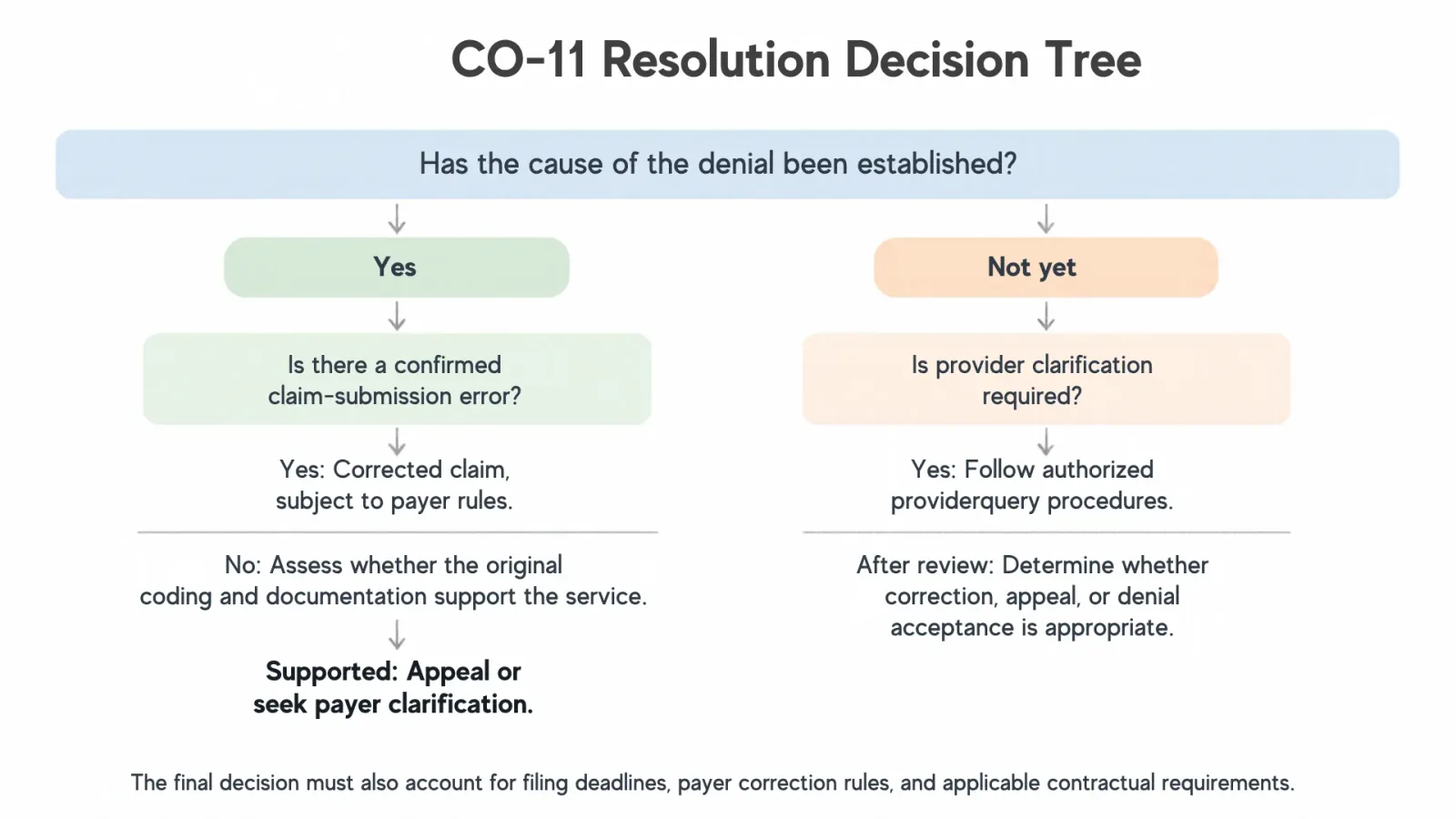
An appropriate CO-11 denial resolution depends on the established finding: correct a claim error, clarify an incomplete record, or appeal to a disputed payer decision.
1. Submit a Corrected Claim When a Reporting Error Is Confirmed
A corrected claim submission is appropriate when submitted data is wrong, and existing documentation supports the correction. Change only affected fields. Follow the payer's corrected-claim route and filing limits.
- Use the payer's designated corrected claim process
- Include required claim identifiers and supporting information
2. Request Provider Clarification When the Documentation Is Inconclusive
- Use a provider clarification query when the record does not support a clear coding decision
- A provider query workflow for a CO-11 diagnosis specificity gap should identify relevant clinical indicators and ask a neutral, non-leading question
- Authorized coding staff should review the response before changing the claim. This protects documentation integrity
3. Appeal When the Submitted Claim Is Supported but the Payer's Determination Is Disputed
For diagnosis-related denial appeals, appeal substantiation should connect the submitted service, supporting records, and applicable payer rule. Evidence needed for a CO-11 diagnosis-to-procedure mismatch appeal includes:
| Appeal element | Evidence | Purpose |
|---|---|---|
Denied service | Claim and remittance | Identify the denial |
Clinical basis | Encounter records and coding guidance | Support the service |
Payer rule | Applicable policy version | Establish the requirement |
Appeal rationale | Explanation and attachments | Request reconsideration |
Building a defensible appeal requires more than identifying the denial code. Teams must interpret the payer's response, connect it to the claim, identify missing evidence, and establish the applicable rule
How Bill Matters Supports Evidence-Backed Denial Recovery?
Bill Matters is a dedicated denial-recovery platform that works alongside existing billing and RCM systems. It supports this work through specialized multi agent AI workflow:
- AI Claim Denial Decoder: Reads the CARC and paired RARC, when available, and translates the adjustment into its plain-language explanation.
- Document & EOB Processing: Converts EOBs, ERAs, EOBRs, and 835 files into structured claim-level and service-line data, extracting adjustment codes, payment amounts, and key dates.
- Remittance Management: Links remittances and subsequent payments to their respective claims, preserving the payment history for further review or appeals.
- Billing Evidence Finder: Compares available records against the documentation requirements for the specific denial and payer. It identifies missing documents and explains why each is needed.
- AI Denial Agent: Evaluates the denial against available evidence and applicable requirements to identify the appropriate next action, whether an appeal, corrected claim, or request for missing information.
- AI Appeal Generation: Builds a claim-specific appeal using the actual denial reason, gathered evidence, and governing policy. Supporting facts and references are traceable to their sources.
The workflow also includes independent AI validation. Medical billing professionals retain control to review, edit, and export the appeal before submission.
Also Read: Human-in-the-Loop Requirements: Why AI Should Flag, Not Auto-Decide?
4. Validate the Submission and Record the Outcome
Confirm the approved action, required attachments, payer channel, and deadline. Then:
- Retain submission confirmation and reference details.
- Record the payer response and final disposition.
- Update the denial record.
Give CO-11 Less Room to Linger
Bring greater discipline to denial follow-through while your team retains control over every claim decision and submission with Bill Matters
How Can Billing Teams Prevent Repeat CO-11 Denials?
Preventing repeat CO-11 denials requires controls that address recurring claim and coding errors before submission. Medical practices should use verified denial patterns to strengthen pre-bill checks rather than apply generic diagnosis-to-procedure rules.
| Recurring issue | Preventive control |
|---|---|
Diagnosis pointer errors | Validate service-line diagnosis associations before submission |
Specificity gaps | Strengthen documentation and coding guidelines |
Payer diagnosis edits | Maintain payer-specific rules and effective dates |
Repeated coding inconsistencies | Standardize coding guidance across teams |
1. Strengthen Pre-Bill Diagnosis-Linkage Checks
Pre-bill validation should confirm that each service line carries the diagnosis association supported by the encounter. Targeted claim edits can flag incorrect associations before submission.
What controls can prevent valid medical services from being denied because of incorrect diagnosis linkage?
Validate diagnosis pointers against documented services and applicable coding requirements. Avoid universal ICD-10-CM and CPT pairing lists that ignore payer and service differences.
2. Maintain Current Payer-Specific Coding Requirements
Payer diagnosis edits must reflect the correct plan, service, and effective date. Use the CMSMedicare Coverage Database for applicable Medicare coverage guidance. Keep commercial payer requirements separate. This gives independent practices consistent checks without creating unnecessary billing complexity.
3. Monitor Recurring Denial Patterns
Tracking recurring CO-11 denials by payer and procedure code helps RCM heads and denial specialists identify patterns across billing operations.
Maintain records of:
- Payer, plan, and procedure category.
- Denial codes and verified root causes.
- Frequency and affected service lines.
How should RCM teams document and monitor recurring diagnosis-related payer denials?
Use consistent categories and review trends periodically to identify where preventive claim controls need improvement.
CO-11 Denial Resolution Starts with the Evidence
A CO-11 denial code should prompt a closer look at the diagnosis-to-procedure relationship, not an automatic change to the submitted diagnosis. The right response must reflect what the claim, encounter documentation, and applicable payer requirements actually support.
That evidence-led approach also matters when choosing a recovery partner. Bill Matters brings a dedicated denial-recovery approach to existing RCM workflows, with human review remaining central to claim decisions. Its product development reflects the operational demands of healthcare billing and appeals teams.
Whether addressing a reporting error or preparing diagnosis-related denial appeals, the priority remains the same: make decisions supported by evidence.
FAQ's
1. Does a diagnosis appearing in a Medicare Billing and Coding Article guarantee that the claim will be covered?
No. A diagnosis listed in a Medicare Billing and Coding Article may satisfy a coding condition, but coverage still depends on the applicable LCD or NCD, policy conditions, and supporting documentation for the service date.
2. What should a billing team do when the payer's remittance does not identify the policy behind CO-11?
Check the denial notice and payer portal, review any 835 policy reference and applicable provider guidance, then request written clarification from the payer if the governing requirement remains unidentified for that service.
3. Can a CO-11 denial be corrected without changing the diagnosis?
Yes. If the diagnosis is supported but linked to the wrong service line, the provider may correct the claim's pointer or other inaccurate data without changing the documented diagnosis, subject to payer rules.
4. Who should approve a diagnosis-related correction before a claim is resubmitted?
An authorized coding or billing reviewer should approve the resubmission under the organization's documented process. Only the appropriate provider can supply clinical clarification or an amendment to the clinical record when appropriate.
5. How is CO-11 different from CO-50?
CO-11 reports that the diagnosis is inconsistent with the procedure; CO-50 identifies services the payer does not consider medically necessary. Check the exact CARC and policy rationale before classifying or appealing the adjustment.
6. Can more than one adjustment reason code appear on the same claim or service line?
Yes. An 835 CAS segment can report up to six adjustment reason codes for the same adjustment group. Each code has its own adjustment amount, so review them separately on the affected claim or service.