Get a summary of this article with your favorite AI
Key Highlights
- •The N130 remark code directs providers to plan benefit documents or guidelines; it does not, by itself, confirm a denial.
- •Review the ERA's service line, adjustment amount, CARC and group code; N130 alone does not establish patient responsibility.
- •Compare the plan provision with the billed service, date of service, and records to identify coverage limits or missing evidence.
- •For N130 denial resolution, correct claim errors, appeal supported disputes, follow applicable plan terms, or reroute misdirected claims when appropriate.
- •Use N130 denial tracking by payer and service to log policy sources, findings, gaps, owners, deadlines, and recurring patterns.
- •Bill Matters interpret paired CARC/RARC codes and help organize appeal evidence; staff must review drafts and submit appeals.
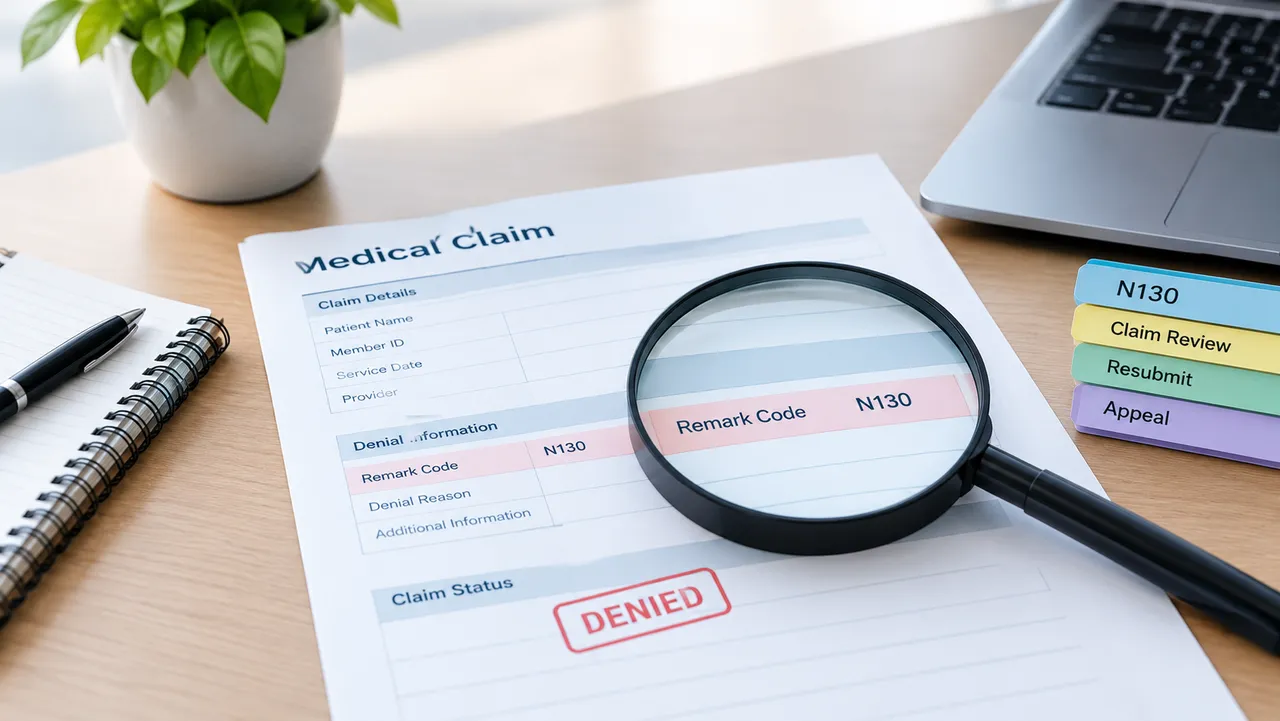
The N130 remark code means: “Consult plan benefit documents/guidelines for information about restrictions for this service.” This is the official wording in X12’s Remittance Advice Remark Codes list, which classifies N130 as a RARC.
In plain language, the remark points the provider toward benefit information about possible restrictions on the billed service.
Does N130 on ERA automatically mean the service is not covered?
No. The remark does not, by itself, confirm that the service is excluded or that the claim was denied.
That distinction matters because N130 alone does not establish:
- Whether the payer applied the relevant restriction correctly.
- Whether the patient is responsible for the remaining balance.
For medical billing professionals, an N130 ERA adjustment review checklist should keep the remark's meaning separate from conclusions that require additional claim information. The following sections in the blog will examine what the code tells you, what remains uncertain, and how to interpret the claim without assuming that every N130 remark represents a denial.
What Should You Check When N130 Appears on an ERA?
Start with the complete provider remittance and identify the exact claim or service line associated with the adjustment. The N130 remark code is only one part of that record.
The Centers for Medicare & Medicaid Services (CMS) explains that an Electronic Remittance Advice (ERA) reports adjustment reasons and amounts at the claim or service-line level.
Reviewing the full record helps you understand what was adjusted before investigating the applicable benefit restriction.
1. Review the Full Remittance and the Affected Service Line
An ERA can contain adjudication information for multiple claims. Start by locating the claim in question and identifying the precise service associated with the adjustment. This prevents you from investigating the wrong line or overlooking other information that affects the payment outcome.
As you review the remittance, identify:
- The claim and service-line adjustment associated with N130.
- The adjustment amount and payment information reported for that claim or line.
- Other remarks or adjustment codes accompanying N130.
- Whether the adjustment applies to a specific service line, the entire claim, or the provider level.
The last distinction matters because a provider-level adjustment may not relate to an individual claim. CMS explains that these adjustments can be reported separately through Provider Level Balance (PLB) reason codes.
2. Read N130 With the Accompanying CARC and Group Code
Once you identify the relevant adjustment, examine the CARC and Claim Adjustment Group Code alongside the RARC. Each code communicates different information.
| Code component | What it tells you |
|---|---|
Group code | The financial-responsibility category associated with the adjustment |
CARC | The general reason for the financial adjustment |
RARC | Additional explanation for the adjustment or information about remittance processing |
The official X12 RARC list explains the role of remark codes, while CMS describes how the three code types work together.
Bill Matters also offers a claim denial decoder that reads a CARC alongside its paired RARC and translates the coded information into plain language. This can help clarify the adjustment message, but the applicable plan restriction still needs to be verified.
Also Read: Why was a Health Insurance Claim Denied? 10 Common Denial Reasons Explained
3. Separate the Remark from the Claim's Payment Outcome
The presence of N130 does not establish the final outcome of the claim. The complete remittance provides the adjustment and payment details needed to determine whether the claim or a particular service line was adjusted.
Keep three questions separate during your review:
- What adjustment does the remittance report?
- What additional information does N130 provide?
- What conclusion can you support from the available claim and payment records?
This distinction prevents an informational remark from being treated as proof of a specific coverage decision or financial responsibility.
4. Confirm the Payer, Plan and Date of Service
Before consulting benefit documents, verify that you are looking at the correct coverage information for the claim being investigated. The applicable requirements can depend on the plan and the service involved.
Confirm the following details before proceeding:
- Payer and plan: Identify the insurer and applicable member plan.
- Date of service: Establish the date against which the relevant benefit terms must be checked.
- Billed service: Confirm the procedure, item or service associated with the adjustment.
- Claim details: Match the remittance to the correct claim and provider records.
These checks establish the right context for investigating the restriction referenced by N130, without assuming what that restriction is or what action the claim requires.
Still Letting One Remark Run the Show?
Put Bill Matters into your denial workflow to support evidence-led decisions without treating every adjustment as an automatic appeal
How Do You Identify the Restriction Referenced by N130?
To identify the restriction referenced by N130, locate the applicable plan benefit documents or payer coverage guidelines, match the relevant provision to the billed service, and compare its requirements with the claim and supporting evidence.
The goal is to establish which restriction applies and whether the available records support the payer's determination. This N130 plan benefit restriction verification process also helps distinguish a genuine coverage issue from a claim error or payer-processing problem.
1. Locate the Applicable Plan Benefit Documents or Guidelines
Start by locating the document that governs coverage for the service. The appropriate source depends on the payer, plan and type of coverage. Do not assume that every insurer uses the same document or policy format.
Depending on the plan, relevant material may include a benefit booklet, Certificate of Coverage, or a Summary Plan Description (SPD) for an applicable employer-sponsored plan. The U.S. Department of Labor's plan information guidance explains the role of an SPD in describing covered benefits and plan procedures.
- For Medicare claims, check the applicable coverage guidance when the service and claim circumstances require it.
- A Local Coverage Determination (LCD) may establish coverage criteria for a particular item or service within a MAC jurisdiction.
- For relevant Durable Medical Equipment (DME) MAC claims, Noridian also directs suppliers to review the applicable LCD, policy article and documentation checklist when pursuing certain reviews.
Before using a document to assess the claim, establish that it applies to the payer, plan and date of service under investigation.
2. Match the Restriction to the Billed Service
Once you find the relevant document, identify the specific provision that could explain the adjustment. A reference to plan restrictions is not enough to conclude that an exclusion or limit applies.
Look for the actual requirement governing the billed service. Depending on the plan, this could involve a benefit exclusion, a frequency or quantity limit, a coverage condition or another coverage limitation.
To make the comparison precise, establish:
- The service, procedure or item associated with the adjustment.
- The exact benefit provision or policy requirement that may apply.
- Any stated conditions, limits or exceptions relevant to the service.
- The policy's effective period and the circumstances under which the restriction applies.
For example, a frequency limit matters only if the applicable plan imposes that limit and the claim falls within its scope. Do not assume a restriction applies simply because similar services are limited under another plan.
3. Compare Claim Details and Supporting Evidence with the Restriction
After identifying the relevant provision, compare its requirements with the information reported on the claim and the supporting records. This comparison should establish whether the claim meets the stated conditions, contains an error or lacks information needed to demonstrate eligibility for coverage.
Focus the review on the requirement itself:
- If the policy calls for a specific diagnosis or modifier, verify the corresponding claim information
- If the determination depends on clinical documentation, compare the relevant medical records with the applicable criteria.
The investigation should distinguish three possible findings for medical billing teams:
- Requirement met: The available records appear to support compliance with the relevant provision.
- Requirement not met: The records indicate that a stated condition or limit applies to the service.
- Evidence insufficient: The available information does not establish whether the requirement was met.
The third finding does not automatically mean the service is noncovered. It means the reviewer must identify the missing information or unresolved issue before reaching a conclusion.
4. Distinguish a Benefit Restriction from a Claim or Payer-Processing Problem
The accompanying adjustment reason can point to an issue that requires a different investigation. Noridian's Medicare DME guidance provides two useful examples.
N130 with CARC 50: In its JD DME guidance for reason code 50 and remark code N130, Noridian identifies examples such as a required diagnosis code or KX modifier. It also describes an upgrade scenario involving an Advance Beneficiary Notice of Noncoverage (ABN). These examples show why the reviewer must examine the applicable requirements and actual claim details rather than assume every case has the same cause.
N130 with reason code 109: Noridian's JD DME guidance for reason code 109 and remark code N130 identifies an incorrectly submitted contractor and the beneficiary's inpatient status as possible issues. Its instructions include resubmitting to the correct contractor when appropriate or investigating the relevant date-of-service circumstances.
These are specific Medicare DME scenarios, not universal rules for every N130 adjustment. The N130 CARC 50 Medicare DME follow-up scenario requires attention to the applicable coverage and claim requirements. The N130 reason code 109 incorrect contractor resubmission scenario instead illustrates why the reviewer must investigate payer or contractor responsibility when the accompanying reason points in that direction.
5. Record the Policy Source, Findings and Evidence Gaps
Once the comparison is complete, document enough detail for another reviewer to understand the conclusion without repeating the entire investigation.
A useful case record should capture:
- policy or benefit document reviewed, including the applicable version or effective date.
- specific provision relevant to the service.
- claim details and supporting records compared with that provision.
- any missing information, conflicting evidence or unresolved questions.
- investigation finding and the next action proposed for review.
This record creates a clear basis for the subsequent claim-resolution decision. It also gives the next reviewer a traceable explanation of the restriction, the evidence considered, and any issue that remains unresolved.
How Should You Resolve an N130-Related Claim?
The correct N130 denial resolution depends on what the investigation establishes. Correct the claim when its submitted information is wrong, consider payer review when the determination can be challenged, and follow the applicable coverage and financial-responsibility requirements when the restriction is valid.
If the claim went to the wrong payer or contractor, follow the appropriate submission route instead. Each action should match the documented finding, not the N130 remark alone.
1. Correct or Resubmit When the Submitted Information Is Wrong
A corrected claim or resubmission may be appropriate when the investigation identifies an error in the submitted information. The key distinction is whether the claim needs correction or whether you disagree with the payer's decision.
Before changing the claim, identify the specific error and confirm that the payer permits correction or resubmission for that situation. Depending on the finding, the next action may involve:
- Correcting inaccurate claim information or a missing required detail.
- Updating a diagnosis or modifier when the applicable billing rules support the change.
- Following the payer's instructions for a corrected claim or reopening when the issue qualifies.
Do not resubmit an unchanged claim simply because it carries N130. The correction must address the identified problem.
Also Read: What Should You Do First When Facing a Healthcare Claim Denial
2. Pursue Payer Review or an Appeal When the Determination Can Be Challenged
Sometimes the claim information is correct, but the payer's determination appears inconsistent with the applicable coverage requirements or supporting evidence. In that situation, an appropriate review or appeal may be warranted.
Can an N130-related claim be appealed?
Yes, when the underlying determination can be challenged under the applicable payer's procedures and the available evidence supports that challenge. N130 alone does not establish that an appeal is justified.
Example: Noridian's N130/CARC 50 guidance for Medicare DME claims distinguishes circumstances that may call for correction or reopening from those that may warrant a redetermination request. The appropriate route depends on the actual issue and the contractor's instructions.
For N130 claim documentation for payer reconsideration, include the records that directly address the disputed requirement.
Bill Matters can support this work when a denial warrants an appeal. Its multi-agent AI workflow checks available records against evidence requirements, and prepares an evidence backed AI appeal while ensuring the right applicable policy. The draft should be reviewed against the case and payer requirements before submission.
3. Follow the Applicable Requirements When the Restriction Is Valid
If the relevant restriction applies and the available evidence supports the payer's determination, an appeal may not be the appropriate response. Follow the applicable plan terms, contractual requirements, and financial responsibility rules.
Before closing the claim, establish what the verified outcome means for the remaining balance. Contractual Obligation (CO) and Patient Responsibility (PR) are different adjustment group classifications, and they should not be treated as interchangeable.
For N130 group code patient balance verification, check the applicable group code and payer requirements before transferring a balance or recording a write-off. N130 alone does not authorize patient billing. The adjustment, coverage terms and applicable rules must support that decision.
4. Use the Correct Payer or Contractor Route When Routing Is the Issue
If the investigation establishes that the claim was sent to the wrong payer or contractor, follow the verified submission instructions for the correct destination. An appeal to the original payer may not resolve a claim that belongs elsewhere.
Noridian's N130 guidance for reason code 109 illustrates this distinction for Medicare DME claims. Its instructions address incorrect-contractor submissions and other specific circumstances that may require correction, reopening or resubmission.
The N130 corrected claim versus appeal routing decision should therefore depend on the established cause and the applicable procedure, not simply on the presence of the remark.
Match the Finding to the Appropriate Resolution
Use this N130 denial resolution workflow for provider billing teams to connect the investigation outcome with the next action
| Investigation finding | Resolution direction |
|---|---|
Incorrect claim information | Correct or resubmit under the applicable payer rules. |
Restriction appears incorrectly applied | Evaluate the appropriate payer review or appeal process and supporting evidence. |
Restriction is confirmed and applicable | Follow the governing contractual and financial responsibility requirements. |
Wrong payer or contractor is confirmed | Follow the correct destination's submission instructions. |
This approach keeps medical billing denial resolution tied to the actual claim findings. It also creates a clearer record of why a particular action was selected, helping the next reviewer continue the case without repeating the same investigation.
Ready to Stop Second-Guessing Every Claim?
Give your denial-resolution process a clearer path from payer decision to next action, without treating every case alike
How Can Medical Billing Teams Reduce Repeat N130 Rework?
Billing teams, RCM head and denial specialists can reduce repeat N130 denial resolution work by preserving investigation findings in a consistent case record and tracking recurring patterns by payer and service. This helps reviewers understand previous decisions without repeating the same research for every similar claim.
1. Standardize Case Documentation and Follow-Up
A useful case record should preserve the reasoning behind the decision, not just the final status. Use a consistent format to capture the information another reviewer needs to understand the case and continue the follow-up.
A practical N130 plan policy evidence mapping worksheet should capture:
- The applicable policy source and relevant provision.
- The evidence reviewed and any unresolved information gaps.
- The investigation outcome, next action, assigned owner and follow-up deadline.
This record helps maintain continuity when a case changes hands or requires further payer communication.
2. Track Recurring Restrictions by Payer and Service
Individual claim records become more useful when teams can identify patterns across similar cases. Maintain N130 denial tracking by payer and service to identify repeated restrictions, recurring documentation gaps or similar adjustment outcomes.
Review these patterns periodically to identify where benefit verification, claim preparation or follow-up processes may need attention.
For example: repeated cases involving the same service and missing documentation may justify an earlier documentation check. A recurring payer-specific issue may warrant further investigation before similar claims are submitted.
Treat these patterns as signals for review, not proof that every similar adjustment has the same cause. Each claim still requires an appropriate assessment of its circumstances.
Evidence Should Determine the Next Action
Resolving an N130 remark code requires a reasoned decision, not an automatic response to the remark. The applicable payer coverage guidelines should support the conclusion, with the claim's circumstances guiding the next step. Bill Matters AI denial agent checks denial information against the applicable payer coverage policy and available evidence, then identifies a suitable resolution instead of defaulting every case to an appeal. Ultimately, reliable medical billing denial resolution depends on a documented rationale and human review of the proposed action.
Works Cited (information last verified October 29, 2026)
Centers for Medicare & Medicaid Services. “Health Care Payment and Remittance Advice.” CMS.gov, https://www.cms.gov/medicare/coding-billing/electronic-billing/health-care-payment-remittance-advice
Centers for Medicare & Medicaid Services. “Local Coverage Determinations.” CMS.gov, https://www.cms.gov/medicare/coverage/determination-process/local
Noridian Healthcare Solutions. “Reason Code 109 | Remark Code N130 - JD DME.” Noridian Medicare, 25 Oct. 2024, https://med.noridianmedicare.com/web/jddme/topics/ra/denial-resolution/n130-109
Noridian Healthcare Solutions. “Reason Code 50 | Remark Code N130 - JD DME.” Noridian Medicare, 20 Dec. 2023, https://med.noridianmedicare.com/web/jddme/topics/ra/denial-resolution/n130-50
U.S. Department of Labor. “Plan Information.” U.S. Department of Labor, https://www.dol.gov/general/topic/health-plans/planinformation
X12. “Remittance Advice Remark Codes.” X12, https://x12.org/codes/remittance-advice-remark-codes