
Get a summary of this article with your favorite AI
Key Highlights
- •The CARC 19 denial code means the payer considers treatment work-related and workers' compensation responsible but does not confirm carrier acceptance.
- •A workers' compensation denial may involve reported workplace injuries, inaccurate insurer information, or Medicare MSP records linking diagnoses to work injuries.
- •Review the ERA/EOB, adjustment group, CARC, RARC, affected service lines, WC claim details, and Medicare SBR02 information when applicable.
- •Bill the correct WC carrier, correct inaccurate claims, follow Medicare MSP procedures, or submit a CARC 19 appeal when the determination is unsupported.
- •Support disputes with patient statements, employer incident reports, clinical records, carrier decisions, and claim submission evidence. Accurate intake also helps prevent recurring errors.
- •Bill Matters prepares evidence-backed AI appeal drafts for human review and approval. Authorized staff retain control over final submission.
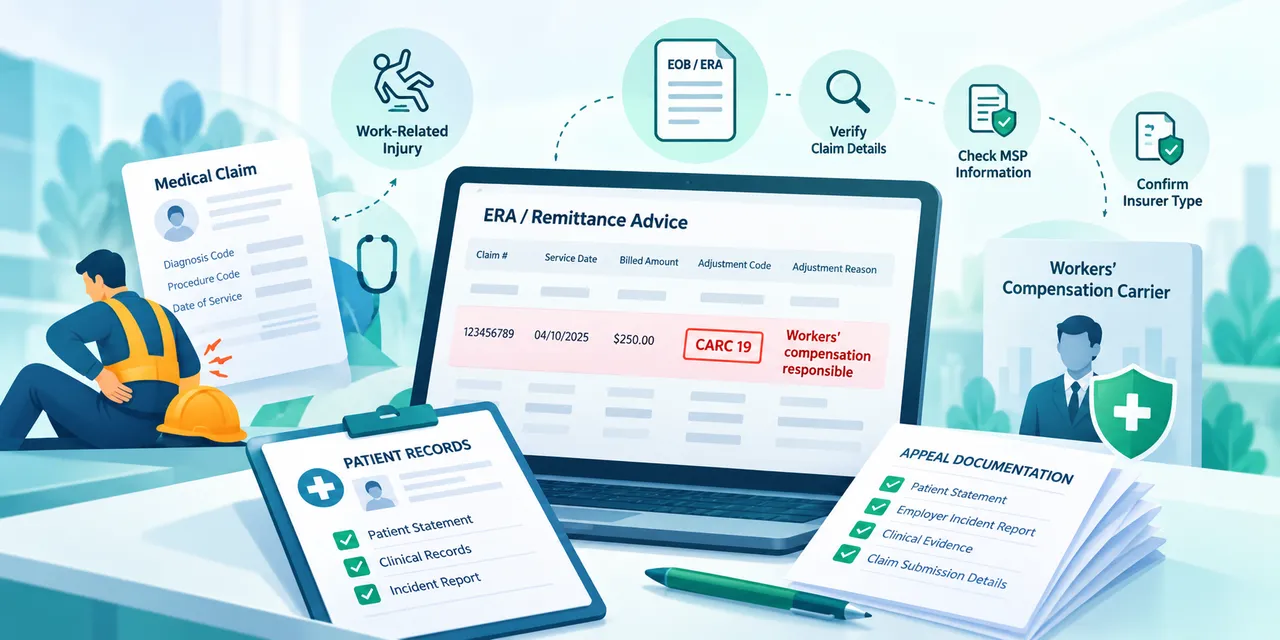
The CARC 19 denial code means the payer has classified the billed care as related to a work-related injury or illness and considers the workers' compensation carrier responsible for it. The X12 Claim Adjustment Reason Codes list identifies workers' compensation as the liable carrier under this code.
Does CARC 19 mean the workers' compensation carrier has accepted the claim?
No. The code records the payer's adjustment reason. It does not confirm that the carrier has accepted the specific claim or approved the treatment.
For workers' compensation billing teams, this distinction matters when a work-related injury claim involves multiple services or an existing injury record. CARC 19 alone does not establish:
- Which workplace incident the payer associated with the billed care.
- Whether every service on the patient's account relates to that injury.
- Whether the adjusted amount may be billed to the patient.
The code states the payer's position. Understanding its limits is the starting point for a CARC 19 denial resolution workflow. So, let's dive in.
Why Do Medical Claims Receive CARC 19 Adjustments?
Medical claims receive a CARC 19 denial code when the payer's information identifies the service as related to a workplace injury or illness and considers workers' compensation responsible. In Medicare claims, the Noridian CO-19/M418 guidance identifies three common reasons for the message: missing MSP insurance type, incorrect insurer type, and diagnosis codes matching the Common Working File.
1. The Injury or Illness Is Reported as Work-Related
A work-related injury claim may receive CARC 19 when the submitted information identifies the treatment as related to an occupational injury or illness.
For example, a patient reports back pain after lifting equipment at work. The provider records the condition as work-related and submits the claim to commercial health insurance. The payer then considers workers' compensation responsible for the service.
This classification may arise from different types of reported workplace conditions:
- An acute injury sustained during a workplace accident.
- An occupational illness associated with workplace exposure.
- Treatment connected to a previously reported workplace injury.
2. Medicare Secondary Payer Insurance Type Is Missing
For Medicare claims, missing Medicare Secondary Payer (MSP) insurance-type information is one reason Noridian identifies for CO-19/M418. The ASC X12 837 claim carries insurance information used during processing.
When the relevant MSP insurance type is absent, Medicare's records may not contain the information needed to process the claim under the reported payer arrangement.
3. An Incorrect Insurer Type Is Reported in SBR02
Another cause is an incorrect insurer type in the electronic claim. Noridian specifically identifies an incorrect insurer type as a common reason for CO-19/M418. The relevant SBR02 element identifies the insurance type reported in the 837 claim's subscriber information.
An 837 SBR02 workers' compensation insurance type error can therefore contribute to an incorrect payer classification, particularly when the submitted information does not accurately represent the coverage arrangement.
4. Diagnosis Codes Match a Work-Related Record in the Common Working File
A diagnosis associated with an earlier workplace injury may also create a Medicare processing issue when it matches an existing Common Working File (CWF) record.
Why did an insurer classify a non-work-related visit as workers' compensation?
In a Medicare CO-19/M418 situation, one possible reason is that the submitted diagnosis codes match the CWF. This match can trigger the adjustment even when the current treatment is unrelated to the earlier injury. Noridian identifies this as a common reason for the message.
For workers' compensation billing teams, this distinction matters because a Medicare record match does not, by itself, establish a clinical relationship between the current service and the workplace injury.
Also Read: Why was a Health Insurance Claim Denied? 10 Common Denial Reasons Explained
What Should You Verify When a Remittance Shows CARC 19?
When CARC 19 appears on a remittance, verify the adjustment codes, identify the affected claim line, confirm the workers' compensation claim details, and check Medicare information when applicable. These checks help medical billing companies establish what the payer adjusted, and which records support its determination before selecting a response.
1. Review the Complete ERA/EOB and Distinguish the Adjustment Codes
Start with the complete Electronic Remittance Advice (ERA) or Standard Paper Remittance (SPR) rather than interpreting CARC 19 alone. The CMS guidance on Health Care Payment and Remittance Advice explains that these records can contain three different code elements:
| Remittance element | What it communicates |
|---|---|
Claim Adjustment Group Code | Assigns financial responsibility for the adjustment |
Claim Adjustment Reason Code (CARC) | Explains why the payment differs from the billed amount |
Remittance Advice Remark Code (RARC) | Provides additional information about the adjustment |
A RARC can add detail to a CARC, but it does not necessarily appear with every adjustment.
Two distinctions are particularly important when interpreting the codes.
Which adjustment group code accompanies CARC 19?
In Noridian's Medicare guidance, the combination appears as CO-19. Here, CO represents Contractual Obligation, while 19 is the reason code. The group code and CARC are separate elements, so always check the actual combination reported on the remittance.
Does CARC 19 automatically make the patient responsible for the bill?
No. The group code identifies financial responsibility, not the CARC alone. CMS identifies CO as provider responsibility and PR as Patient Responsibility. For Medicare beneficiaries, CMS states that they may be billed only when the PR group code is used with the adjustment.
It also helps to distinguish CARC 19 from other injury-related adjustment reasons:
| CARC | Responsibility identified |
|---|---|
19 | Workers' compensation carrier |
20 | Liability carrier |
21 | No-fault carrier |
22 | Possible coverage by another payer under coordination of benefits |
The official X12 Claim Adjustment Reason Codes list defines these as separate adjustment reasons.
2. Identify the Affected Claim and Verify the Service Details
The remittance must be matched to the exact claim and service that received the adjustment. A CARC 19 entry may apply at the claim or service-line level, so reviewing the entire account without identifying the affected line can lead to an incorrect interpretation.
Start by matching the remittance against:
- Original claim number and patient account.
- Date of service and affected service line.
- Billed procedure and diagnosis codes.
- Billed amount and corresponding adjustment amount.
- Date of injury, where relevant.
CMS explains that remittance adjustments can occur at the claim or service-line level. Provider-level adjustments may also appear separately and are reported using Provider Level Balance (PLB) reason codes.
This distinction helps establish exactly which billed service the payer adjusted instead of treating every service on the patient's account as part of the same issue.
3. Confirm the Workers' Compensation Carrier and Claim Status
Once the affected service is identified, compare the payer information against the patient's actual workers' compensation carrier and claim records. A carrier name alone is not enough to establish that the correct claim has been identified.
Check the available records for:
- Employer name and insurance carrier.
- Workers' compensation claim number.
- Claims administrator, where applicable.
- Assigned adjuster and contact information.
- Current claim status, including pending, accepted, or denied status where confirmed.
The distinction matters because a patient may have more than one reported injury or workers' compensation claim. The carrier and claim identifiers must correspond to the injury associated with the billed service.
This is also reflected in Bill Matters' workers' compensation billing multi agent AI workflow. Its coverage and claim verification process checks the employer, carrier, claim number, and adjuster before a charge is submitted. The underlying principle is straightforward: the billing record needs to identify the specific WC claim, not merely a possible payer.
4. Verify Medicare Secondary Payer and Electronic Claim Information When Applicable
For Medicare claims, review the submitted ASC X12 837 information alongside the beneficiary's Medicare Secondary Payer (MSP) records. Pay particular attention to the insurance-type information in loop 2000B, segment SBR02.
Noridian's CO-19/M418 guidance specifically directs providers to verify the correct MSP insurance type in this segment.
The verification should establish whether:
- The submitted SBR02 value accurately represents the insurance arrangement.
- The beneficiary's current Medicare eligibility information is available for review.
- The relevant MSP record corresponds to the payer information associated with the claim.
- The claim's primary payer information is consistent with the available records.
This check is specific to Medicare processing. Do not apply Noridian's SBR02 instructions as a universal correction requirement for commercial insurance claims.
Still Letting Payer Confusion Set the Pace?
Bring Bill Matters into your workflow before inconsistent claim information creates another cycle of avoidable follow-up
How Should You Resolve or Appeal a CARC 19 Denial?
The correct way to resolve a CARC 19 denial code depends on why the claim was adjusted and which payer is responsible for the service. If workers' compensation is responsible, the provider should bill the appropriate carrier.
If the submitted information is inaccurate, a corrected claim may be necessary. Medicare MSP issues require their own correction process, while an unsupported payer determination may warrant an appeal.
1. Submit the Claim to the Correct Workers' Compensation Carrier
When workers' compensation is responsible for the billed treatment, the appropriate action is to submit the medical bill to the designated WC carrier or claims administrator rather than appeal the commercial insurer's adjustment.
This is a key consideration in workers' compensation medical billing. The correct payer must receive the bill through its applicable submission process. For effective commercial health plan workers' compensation billing coordination, follow the relevant jurisdiction's requirements and the carrier's billing instructions.
Before submitting the bill, ensure the applicable requirements are met:
- Use the WC carrier's prescribed medical billing format.
- Include the required claim and authorization information.
- Follow the applicable submission deadline.
- Retain proof of submission and subsequent carrier correspondence.
The objective is to direct the bill to the payer responsible for the service rather than repeatedly pursuing reimbursement from the wrong insurer.
2. Submit a Corrected Claim When the Original Information Is Inaccurate
A corrected claim is appropriate when the original submission contains an actual error. An appeal is different because it challenges the payer's decision based on the submitted claim and applicable supporting information.
For a claim resubmission after incorrect CO-19 adjustment, the provider should correct the inaccurate information and follow the payer's replacement-claim instructions. Do not change accurate claim information simply to bypass an adjustment.
The submission should preserve the connection with the original claim. Depending on the payer's requirements, this may involve:
- Identifying the original claim control number.
- Using the applicable corrected-claim or replacement-claim indicator.
- Retaining the corrected submission and electronic acknowledgment.
When the submitted information was already accurate but the payer processed it incorrectly, request the appropriate reprocessing or reconsideration instead of altering the original claim.
For WC denial specialists and RCM heads, this distinction also matters when deciding which cases should move to an appeal workflow. Bill Matters' AI Denial Agent is designed to evaluate the denial, applicable policy, and available evidence before identifying whether a case requires an appeal, corrected claim, or missing-information request. It does not treat every denial as an automatic appeal.
Also Read: What Should You Do First When Facing a Healthcare Claim Denial
3. Follow Noridian's Medicare Correction Process for CO-19/M418
For Medicare claims, Noridian provides a specific process when CO-19/M418 results from incorrect or missing MSP information or when the service is unrelated to the reported work injury.
According to Noridian's Medicare Secondary Payer guidance, providers have two relevant options:
- Resubmit the claim with corrected information when the submitted MSP insurance type is incorrect or missing.
- Submit an MSP form when the claim does not relate to the reported work-related injury or illness. Noridian instructs providers to complete the top portion and explain this in the Reason for Request field.
If the Medicare beneficiary's coordination-of-benefits record itself contains incorrect information, Noridian states that the patient must contact the Benefits Coordination & Recovery Center (BCRC) to request the necessary file correction.
This distinction is central to the CO-19 M418 Medicare claim correction process and Medicare MSP record correction for work injury claims. Correcting the submitted claim and correcting the beneficiary's Medicare record are not the same action.
4. Submit the Claim to Medicare for Consideration When WC Denies Payment
A workers' compensation claim denial does not automatically establish that Medicare will pay. However, CMS allows providers to submit a claim to Medicare for consideration when WC denies all or part of the claim, subject to Medicare coverage and applicable requirements.
The CMS provider billing responsibilities guidance also explains when Medicare may make a conditional Medicare payment if WC payment is not expected within 120 days. Such payments are subject to recovery when the primary payer subsequently pays, or a settlement or award establishes payment.
Providers should therefore distinguish between:
- A formal WC denial of all or part of a medical claim.
- A situation where WC is not expected to pay promptly.
- A service that is not covered by WC but may qualify for Medicare coverage.
These situations follow different Medicare Secondary Payer considerations. The provider must also follow the applicable Medicare billing and coordination of benefits (COB) requirements.
5. Appeal When the Payer's Work-Relatedness Determination Is Unsupported
A CARC 19 appeal is appropriate when the provider has a defensible basis for challenging the payer's determination. The appeal should explain why the billed service should not be associated with the reported workplace injury or why the payer's adjustment is otherwise incorrect.
A focused appeal should:
- Identify the disputed claim and CARC 19 adjustment.
- State the specific point of disagreement.
- Explain why the payer's work-relatedness determination is unsupported.
- Connect the relevant supporting records to the argument.
- Clearly request reconsideration or reprocessing.
- Follow the payer's appeal instructions and applicable filing deadline.
The appeal should address the actual disagreement rather than simply state that the provider disputes the adjustment. Avoid attaching unrelated records that do not support the requested outcome.
What Evidence Can Support a CARC 19 Denial Appeal?
A strong CARC 19 denial appeal requires records that support the provider's position about the relationship between the billed service and the reported workplace injury. These may include patient statements, employer incident reports, clinical records, workers' compensation correspondence, and original claim submissions. Each document should support a specific point in the dispute.
For a medical billing team, one question is particularly important:
Which records show that treatment is unrelated to a work injury?
No single document necessarily establishes this. The strongest work-related injury payer responsibility dispute documentation connects the reported incident, the condition treated, and the actual service billed.
The following records can help establish that connection.
1. Patient Statements and Employer Incident Reports
Patient statements and employer records establish the circumstances of the reported workplace injury. They provide context for understanding which incident occurred and what condition was initially associated with it.
Relevant records may include:
- Patient-reported injury statements collected during registration.
- Employer incident reports describing the workplace accident.
- First reports of injury documenting the incident date and circumstances.
These records help establish the original injury context. However, they do not independently determine whether the workers' compensation carrier is legally responsible for the medical service.
2. Clinical Notes and Treatment Records
Clinical documentation helps establish what condition the provider actually treated and whether it relates to the reported workplace injury. For a medical service unrelated to workplace injury evidence file, the medical chronology can be particularly relevant.
Useful records include:
- Initial evaluation and clinical examination notes.
- Diagnosis history and relevant medical records.
- Imaging or diagnostic reports.
- Treatment plans and follow-up notes.
The documentation should support the distinction between the condition being treated and the workplace injury associated with the adjustment.
3. Workers' Compensation Carrier Decisions and Correspondence
Written carrier communications establish the insurer's position on the specific WC claim. These records are particularly relevant when the provider disputes whether the carrier has accepted responsibility.
Consider including:
- WC claim acceptance or denial letters.
- Adjuster correspondence explaining the carrier's decision.
- Claim-status communications.
- Relevant coverage or authorization correspondence.
A carrier's written denial can establish its stated reason for refusing payment, while acceptance correspondence may clarify the scope of the accepted claim.
4. Original Claim, Submission and Medicare Secondary Payer Records
The original submission records help establish what information the provider reported and what the payer received. This is particularly relevant when the dispute involves inaccurate work-relatedness or MSP information.
Relevant records include the original ASC X12 837 claim, electronic submission acknowledgments, previous ERA/835 records, and applicable MSP correspondence.
For federal OWCP cases, the U.S. Department of Labor's medical documentation guidance also explains how providers submit medical records and supporting documents electronically through the applicable program portal. Requirements vary by program and should not be treated as universal WC rules.
Collecting documents is not the same as establishing that they support an appeal. Bill Matters' Billing Evidence Finder checks available records against the documentation requirements associated with the denial type and payer. It identifies missing documents and explains why they matter.
Its AI Appeal Generation then uses the denial reason, supporting evidence, and applicable policy or rule to prepare a traceable appeal draft. However, AI does not replace the final human decision. Under Bill Matters' terms, every appeal must be reviewed and submitted by an authorized member of the provider's team. The provider retains control over the final appeal and its submission.
This keeps the process focused on evidence-backed appeals while preserving human judgment and accountability.
Also Read: Human-in-the-Loop Requirements: Why AI Should Flag, Not Auto-Decide?
Has the Paperwork Become the Whole Job?
Put Bill Matters into your revenue recovery strategy when complex payer disputes consume more attention than the cases deserve
See How It Works
How Can Medical Billing Teams Prevent Incorrect CARC 19 Adjustments?
Medical billing teams can reduce avoidable CARC 19 adjustments by capturing accurate injury information, checking payer details before submission, and monitoring recurring claim patterns.
These practices cannot prevent a valid workers' compensation adjustment, but they can reduce errors caused by incomplete or inaccurate information. For WC billing teams, doctors and practice owners, prevention starts with how injury and insurance information is recorded and maintained.
1. Capture Accurate Employment and Injury Information During Registration
Registration staff should distinguish between a general medical complaint and an injury the patient reports as work-related. Incomplete intake information can lead to incorrect assumptions about the responsible payer.
During registration, capture relevant details such as:
- Whether the patient reports that the condition resulted from workplace activity.
- Employer information and reported date of injury.
- The affected body part or condition.
- Workers' compensation information provided by the patient.
Record what the patient actually reports rather than assuming that an injury is work-related because of their occupation.
2. Verify Payer Information Before Claim Submission
Before submitting a claim, confirm that the recorded insurance information reflects the applicable coverage arrangement. A patient's existing health insurance should not automatically be treated as the primary payer for every medical service.
For Medicare beneficiaries, account for applicable Medicare Secondary Payer (MSP) requirements when determining payer coordination.
3. Monitor Recurring CARC 19 Patterns
Effective medical billing denial management also involves identifying repeated adjustment patterns rather than treating every occurrence as an isolated incident.
Billing managers can monitor CARC 19 adjustments across:
- Registration locations and intake teams.
- Payers and insurance categories.
- Medical specialties and service types.
Recurring patterns can reveal whether inaccurate intake practices or payer-information issues are contributing to avoidable adjustments. This gives management a basis for improving the relevant processes rather than repeatedly addressing the same problem at the claim level.
What to take Away?
A CARC 19 denial code should not automatically trigger an appeal. The right response depends on the circumstances of the claim and the payer's determination. Effective medical billing denial management requires understanding that distinction. Bill Matters reflects this healthcare-specific approach by treating denial management as a matter of claim context, accuracy, and informed judgment. Ultimately, establishing whether the workers' compensation carrier is responsible is what guides the appropriate outcome.
Works Cited (information last verified October 30, 2026)
1. Centers for Medicare & Medicaid Services. “Health Care Payment and Remittance Advice.” CMS.gov, 10 Sept. 2024, https://www.cms.gov/medicare/coding-billing/electronic-billing/health-care-payment-remittance-advice.
2. Centers for Medicare & Medicaid Services. “Your Billing Responsibilities.” CMS.gov, https://www.cms.gov/medicare/coordination-benefits-recovery/provider-services/your-billing-responsibilities.
3. Noridian Healthcare Solutions, LLC. “Medicare Secondary Payer (MSP) Work-Related Injury or Illness.” Noridian Medicare, 30 Apr. 2025, https://med.noridianmedicare.com/web/jeb/topics/claim-submission/reason-code-guidance/medicare-secondary-payer-msp-work-related-injury-or-illness.
4. Office of Workers’ Compensation Programs. “Submit Medical Records and Supporting Documentation Electronically.” OWCP Medical Bill Processing Portal, U.S. Department of Labor, https://owcpmed.dol.gov/portal/node/773.
5. X12. “Claim Adjustment Reason Codes.” X12, https://x12.org/codes/claim-adjustment-reason-codes.