
The Story
A physician-owned practice treating injured workers had built its billing operation around a small team of billing analysts and an administrator responsible for recovery performance. Every carrier paid against the state fee schedule, so the practice's revenue depended on whether each EOBR matched the rate the schedule allowed.
Checking that match was done by hand, in spreadsheets, alongside separate tools for claims, remittances, and appeals. Carriers paid the fee schedule through misapplied rates and modifier errors, and those underpayments carried no denial code. Most went unnoticed or surfaced too late to appeal. The practice partnered with Bill Matters to close that gap.
Challenge
Underpayment looks like a normal payment. Finding one meant reading each EOBR, pulling the applicable fee schedule line, and calculating the difference manually, claim by claim. The process was slow and error-prone, and it stopped scaling as claim volume grew.
Appeals added a second manual step. Analysts located the remittance, the claim, and the supporting documents separately, so the quality of an appeal depended on who assembled it. Follow-up lived in notes outside the workflow, and the administrator had no clear view of which analyst was recovering what.
Solution
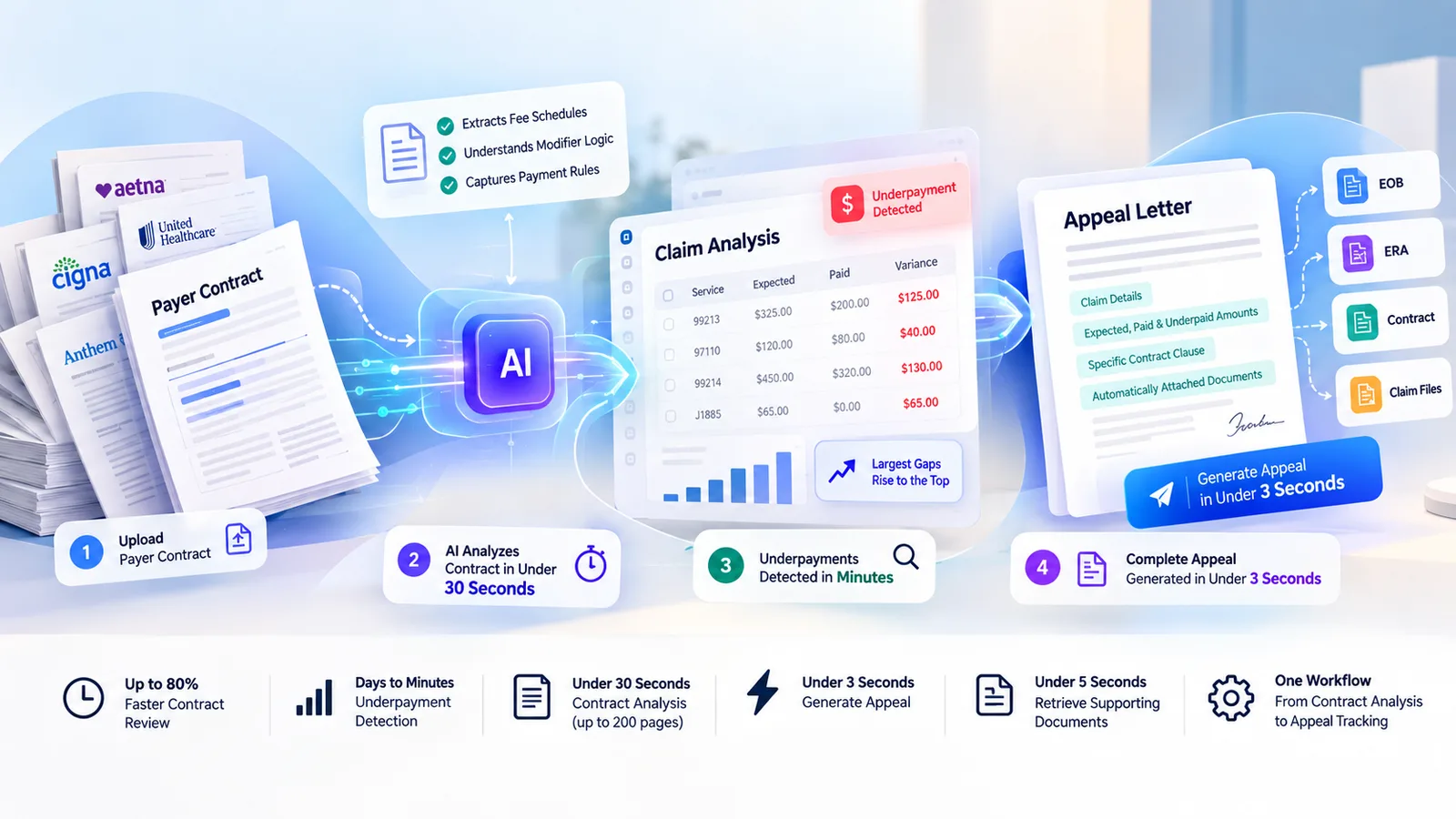
Bill Matters reads each EOBR against the applicable state fee schedule and calculates the variance, the exact dollar difference between what the schedule allows and what the carrier paid. Every claim shows its own variance, so the largest gaps rise to the top of the queue. When a high-value underpayment appears, the team is alerted without having to find it.
From any underpaid claim, Bill Matters drafts the appeal, filled in with claim details, expected, paid, and underpaid amounts, and the fee schedule line it relies on. It pulls the supporting remittance and claim files into the package automatically, reviewed if needed before anything goes out. Each appeal is then followed through every status with timestamped notes, so the history of every action stays in one place.
The administrator now sees recovery performance by analyst and can open any analyst's claims and appeals directly. Filtered reports export for leadership review, and an append-only audit trail records each financial action, with PHI encrypted at rest and in transit.