
What Is Denial Code CO 18 and Why Was the Claim Denied?
Get a summary of this article with your favorite AI
Key Highlights
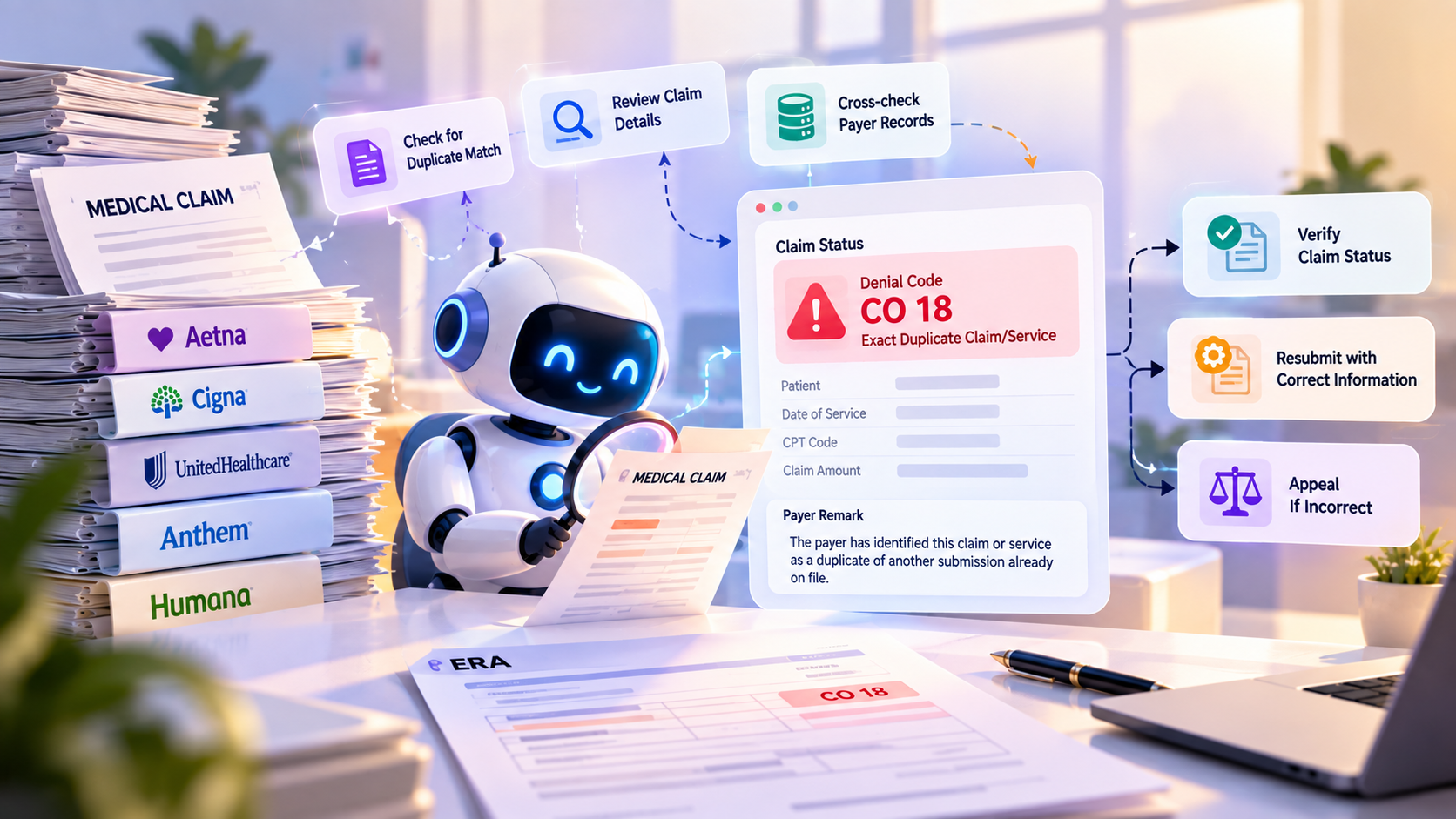
- •Denial Code CO 18 means the payer identified a claim or service as an exact duplicate of another submission already on file.
- •CO 18 and OA 18 share CARC 18, while their group codes provide different adjustment contexts under applicable payer and regulatory rules.
- •Common causes include duplicate submissions, corrected claims, pending claims and duplicate transmissions. Team conflicts and crossovers can also trigger CO 18.
- •Fix a CO 18 claim denial by checking original status, confirming the duplicate match, correcting valid errors or appealing an incorrect match.
- •Prevent recurring denials through pre-submission checks, payer-specific correction rules, shared claim status and reviews of recurring trends in Denial Code CO 18.
- •Bill Matters, built by Biz4Group LLC, is an AI appeal generation platform that builds evidence-backed appeals with human review before submission.
What Is Denial Code CO 18 and Why Was the Claim Denied?
You see denial code CO 18 on an ERA and one question jumps out: did we actually submit this claim twice?
Not necessarily. A CO 18 claim denial means the payer has treated the submitted claim or service as a duplicate. This single line on an ERA can send a billing team into claim-history reviews, resubmissions, payer follow-ups, and more time spent chasing payment.
That operational burden is worth watching. In MedPrecision Billing’s May 2026 illustrative practice analysis, CO-18 represented 7.1% of denied claims in the sample.
Before the denial turns into a repeat problem, your team needs a way to:
- Verify the original claim and its status.
- Read the payer’s adjustment in context.
- Decide what action belongs next.
This brings us naturally to:
Why do CO 18 denials keep occurring on resubmitted claims, and how can medical billing teams stop them?
CO 18 denials usually stem from problems in the resubmission workflow, such as retrying before checking claim status, missing corrected-claim indicators, or poor coordination between billing systems and teams. Medical billing teams can reduce them by verifying claim status, using the correct correction indicators, and tracking resubmissions properly.
This blog starts with the basics of Denial Code CO 18, then explains these causes, the right way to fix the denial, and how to prevent it from recurring.
What Does Denial Code CO 18 Actually Mean
Denial code CO 18 means exact duplicate claim/service. The payer's system has matched your submitted claim against one it already has on file for the same patient, date of service, procedure, and provider, and rejected the newer submission as redundant.
CO-18 exact duplicate claim combines two separate pieces of information:
- CO is the claim adjustment group code, which identifies who is financially responsible.
- 18 is the claim adjustment reason code (CARC), which identifies why the claim was adjusted.
Reading these together tells you exactly what happened and who has to act on it. Whether a CO 18 adjustment can be disputed depends on whether the duplicate match is accurate and the payer's applicable appeal or reconsideration process. Now:
1. What "CO" Means for Your Practice?
CO stands for Contractual Obligation, which means the adjustment is tied to your payer agreement, including state-specific rules like workers' compensation regulations. It establishes the following:
- The healthcare provider/practice, absorbs the cost of a CO 18 medical claim denial and patient cannot be legally billed for the denied claim amount
- And a health insurance denial code CO 18 is something your team resolves internally, not something you send to patient collections.
2. Where CO 18 Shows Up on Your Remittance?
You can find CO 18 in the adjustment information on an electronic remittance advice (ERA). The 835 transaction uses the claim adjustment group code, CARC, and applicable RARC to explain the adjustment. A patient-facing EOB may show the same adjustment in a different format.
Note: This same reason code can also appear as OA 18 on some remittances, instead of CO 18. We break down exactly why, and what it means for you, in the next section
The bottom line: CO 18 is not a rejection or a coding error. It means the claim was accepted, then denied because the payer had already processed a matching one. The fix for it starts with your internal process, not another resubmission.
What Is the Difference Between CO 18 and OA 18, and Does It Matter?
Medical billing denial code CO 18 and OA 18 differ only in the claim group code attached to the denial reason. The group code decides which contract rule applies to your claim, else they report the exact same reason: a duplicate claim or service. So:
1. What "OA" Actually Mean?
OA stands for Other Adjustment.
Under the official X12 usage rule, CARC 18 is meant to pair with OA by default for most claims commercial, Medicare, Medicaid, all of them. CO applies specifically to workers' compensation claims, where state-level regulations require it instead of the standard OA assignment.
Therefore, OA 18 is technically the standard version of this denial. CO 18 is the exception, not the norm.
The table below will provide you with better clarity:
| Aspect | OA 18 | CO 18 |
|---|---|---|
Claim type it appears on | Standard commercial and Medicare claims | Workers' compensation claims |
Governed by | Standard payer contract terms | State WC statutes, DWC fee schedules, WC carrier rules |
First thing to check | Whether the original claim already fully processed and paid | Whether the claim falls under your state's WC fee schedule and statutes |
Appeal path | Verify original, dispute if false match | Same, but follows the WC carrier's process, not standard commercial timelines |
Payers don't always follow the OA-default rule correctly. So, you may still see CO 18 on claims that have nothing to do with workers' comp. When that happens, treat it the same way you'd treat OA 18.
2. Does It Matter for Your Practice Specifically?
Yes, the differentiation matters. Take a look:
- Workers' compensation practices should expect CO 18 as their normal duplicate-claim code, since WC carrier rules require it. If you need to appeal, pull your state's WC appeal documentation alongside the applicable fee schedule and carrier rules before you file.
- DME suppliers and multi-payer practices see both codes regularly, since they bill across commercial payers and Medicare. Tracking denials by payer, not just by code, shows where duplicates actually originate.
- Solo practitioners and small practices don't need to track which prefix shows up. The CO 18 denial code appeal process is the same either way, since the underlying issue is identical.
Therefore, the prefix before your denial code depends on your payer's system, not your claim. What actually matters is recognizing CO-18 exact duplicate claim/service for what it is, and responding the same way no matter which version lands on your report.
Why Does a Medical Claim Get Denied as CO 18?
CO 18 usually results from a breakdown in how a claim is submitted, corrected, tracked, or coordinated across the billing workflow.
The following are the main reasons a payer can treat a claim or service as an exact duplicate.
1. Duplicate Submissions of the Same Claim or Service
The most straightforward cause is that the same claim or service reaches the payer more than once.
The duplicate submission may originate from:
- Two staff members releasing the same claim independently.
- One claim entering multiple billing queues.
- A repeated submission being generated from the same billing record.
In each case, the payer receives separate claim transactions representing the same underlying service.
2. A Corrected Claim Was Submitted as an Original
A corrected claim represents a change to a previously submitted claim. It needs to be distinguishable from a completely new claim within the applicable submission workflow.
For applicable replacement claim transactions: frequency code 7identifies a replacement of a prior claim.
A CO 18 denial can occur when the payer receives the corrected submission without the information needed to associate it with the earlier claim. The new transaction can then resemble another submission for a service already present in the payer's records.
Workers' compensation claims can involve additional state-specific or carrier-specific requirements, so the applicable correction rules may differ by jurisdiction and payer.
3. The Original Claim Was Still Pending
A second submission can be treated as a duplicate when the original claim is already in the payer's processing workflow.
The key issue is the processing status of the original claim. A claim that was rejected before adjudication is in a different position from one that was accepted and remains pending.
That distinction also explains why insurance claim rejection vs denial matters. A rejection generally occurs before the claim enters the payer's adjudication process, while a pending claim has already entered processing.
When another submission arrives during that cycle, the payer may associate it with the existing claim rather than treat it as a separate transaction.
Note: CMS's March 2026 claim-status guidance explicitly warns providers not to resubmit a claim while it is still moving through initial processing.
4. A Clearinghouse or Billing System Generated a Duplicate Transmission
A duplicate does not always originate with a billing employee. Electronic claim systems can produce multiple transmissions through retry processes, batch activity, duplicate jobs, or transmission-response issues.
The billing record may contain one intended submission while the payer receives the transaction more than once. In this scenario, the underlying service is not necessarily duplicated. The electronic transmission is.
The resulting denial therefore stems from a duplicate transaction created somewhere in the submission chain.
5. Separate Teams Created Conflicting Claim Transactions
Denial code CO 18 can also result when different teams work on the same claim without a shared view of its current state.
For example, a coding team may release a revised claim while a billing workflow is already handling an earlier version. A practice team may also initiate another submission while an existing transaction remains active elsewhere in the workflow.
The same claim can therefore move through separate workflows, creating multiple transactions for one service even though only one underlying service was intended.
6. A Crossover Claim Was Submitted Twice
Medicare crossover processing creates another potential path to a duplicate. CMS explains that Medicare can transmit Medicare-adjudicated claim information to participating supplemental insurers for secondary payment through its claims crossover process.
A duplicate situation can arise when the secondary payer receives the claim through that crossover channel and also receives a separate provider submission for the same underlying claim.
The payer can therefore have two transactions tied to one service:
- A Medicare crossover transmission
- A separate submission from the provider
The duplicate edit can then produce a CO 18 denial code adjustment.
Once the claim trail is clear, CO 18 becomes easier to understand and address because your team can pinpoint where the duplicate transaction originated from.
How Do You Fix a CO 18 Denial?
Fixing a CO 18 denial starts with the original claim. Verify its status, determine whether the duplicate match is valid, and then choose between correction and appeal.
Here’s the step-by-step process:
Step 1: Check the Original Claim Status
- Pull the original claim from the payer portal or clearinghouse.
- Confirm whether it is paid, pending, denied, or rejected.
- Review the original claim control number and final claim status.
- If the original claim is still pending, do not treat the CO 18 as a straightforward duplicate yet.
Step 2: Confirm the Duplicate Match
Compare the original and denied claims for the patient, date of service, provider, procedure code, units, and relevant modifiers.
- If both submissions represent the same service, the CO 18 claim adjustment may be a valid duplicate.
- If the services are different or the payer matched them incorrectly, the issue may be a disputed healthcare claim denial rather than a true duplicate.
This comparison determines whether the claim needs correction, or the CO 18 adjustment needs to be challenged.
Step 3: Submit the Corrected Claim
Use this step only when the original claim contains an actual error.
- Submit the corrected claim through the payer's applicable replacement-claim workflow.
- Where that workflow requires it, use Frequency Code 7 and the original claim control number to connect the correction to the earlier claim.
- Follow any payer- or claim-type-specific submission requirements before sending the replacement.
Step 4: Appeal an Incorrect CO 18 Denial
- Use the payer's appeal or reconsideration process when the two claims represent distinct services, or the duplicate match is incorrect.
- State clearly why the claims should not be treated as duplicates.
- Include the claim records and supporting documentation that establish the difference.
- Do not send the same transaction again as an original claim when the issue is an incorrect insurance claim denial.
Now, writing a CO 18 appeal can take time when the team has to review claim history, compare submissions, gather supporting records, and explain why the duplicate match is incorrect.
This is why many healthcare providers now use AI to draft appeal that gets overturned as it can reduce manual work by organizing the case and helping draft it from the available evidence. Now,
Which AI Platform Can Generate a CO 18 Denial Appeal?
Bill Matters, built by Biz4Group LLC, is an AI appeal generation platform for medical billing denials and does exactly what you need. It:
- reads the denial code and payment context
- checks the claim against the applicable payer contract
- identifies missing evidence from the available supporting documents, and
- builds an evidence-backed appeal around the actual denial reason.
For a CO 18 denial, that means the appeal can address the specific duplicate issue using the available claim and payment evidence. An authorized human reviewer then checks, edits if needed, and approves the appeal before submission.
Tired of Manually Tracing Every CO 18 Back to Its Root Cause?
Bill Matters turns CO 18 denials into evidence-backed appeals with AI-powered denial intelligence, helping teams recover revenue faster and efficiently.
How Do You Prevent CO 18 Denials?
Preventing CO 18 starts before a claim or resubmission leaves the billing workflow. The goal is to stop duplicate transactions, incomplete corrections, and avoidable status-related submissions from reaching the payer.
That prevention framework comes down to four controls in the submission workflow:
1. A Pre-Submission Duplicate Check
- Check whether a claim for the same patient, service, and date has already been submitted before releasing another transaction.
- Make this check part of every resubmission and corrected-claim workflow.
- Use the available payer, clearinghouse, or claim-history record rather than relying on memory.
2. Apply Payer-Specific Correction Rules
- Keep each payer's replacement and corrected-claim requirements within the billing workflow.
- Include the required claim identifiers, correction indicators, and submission requirements.
- Use Frequency Code 7 where the applicable replacement-claim workflow requires it. X12's replacement-claim guidance also calls for the original payer claim control number to identify the claim being replaced.
- Maintain separate requirements for Workers' Compensation claims when state WC statutes or carrier rules apply.
3. Keep Claim Status Visible Across Teams
- Make the current claim status available to every team handling the same account.
- Before another transaction is released, confirm that the earlier submission has been accounted for.
- Keep one shared claim history, so billing and coding teams are working from the same information.
- This reduces duplicate submissions caused by disconnected workflows.
Review Recurring CO 18 Patterns
- Track CO 18 denials by payer, service line, and submission workflow.
- Look for recurring trends in denial code CO 18, not just the total number of denials.
- Repeated patterns can show where the billing workflow is breaking down.
- Use those patterns to identify which part of the submission workflow needs attention.
The strongest CO 18 prevention process starts before the next claim leaves the billing workflow. When teams check for existing submissions, follow payer-specific correction rules, keep claim status aligned, and review recurring patterns, they reduce the chances of creating another duplicate transaction.
But prevention is only one part of managing a CO 18 denial. The full process starts with understanding what the adjustment means, distinguishing CO 18 from OA 18 where applicable, tracing the cause, checking the original claim, and deciding whether the right response is a corrected submission or an appeal. That gives billing teams a clear path from identifying denial code CO 18 to resolving it and reducing repeat denials.
For teams handling this work at scale, Bill Matters brings denial intelligence, evidence review, and AI appeal generation into the same recovery workflow, with human review before submission.
Ready to make CO 18 recovery more structured? Book a Bill Matters demo today!
Frequently Asked Questions
CO 18 indicates that the payer has identified the claim or service as a duplicate. The 18 is the CARC for an exact duplicate claim or service, while the group code provides the adjustment context. Review the original claim and any accompanying remark code before taking action.